California Clamming Regulations
There's nothing quite like the thrill of digging for your own dinner, feeling the sand beneath your fingers, and unearthing a fresh, briny clam. But let's be real, the sheer volume and complexity of California's clamming regulations can make you feel like you need a law degree just to enjoy a day at the beach. This guide is here to cut through the confusion, lay out the rules in plain English, and help you navigate California's clamming regulations so you can focus on the fun part: finding those delicious bivalves.
The Foundation of Responsible Clamming in California
Clamming, while seemingly simple, is a treasured pastime along California's vast coastline, from the sandy beaches of Pismo to the mudflats of San Francisco Bay. But with great bounty comes great responsibility, and understanding the "why" behind the regulations makes adhering to them a whole lot easier.
Why Clamming Regulations Exist
You might wonder why there are so many rules for something as basic as digging for clams. Trust me, it's not to make your life harder! These regulations are thoughtfully put in place by the California Department of Fish and Wildlife (CDFW) and the California Department of Public Health (CDPH) for a few critical reasons, all revolving around the health of our marine ecosystems and the safety of consumers.
Firstly, conservation is paramount. Many clam species, like the iconic Pismo clam, were once heavily overharvested, leading to significant population declines. Regulations on bag limits, size restrictions, and seasons ensure that enough clams can reproduce and grow, maintaining healthy populations for future generations of clammers. It's about sustainable harvesting, so our kids and grandkids can experience the same joy of a successful clam dig. Imagine if everyone just took as many as they wanted; our clam beds would be bare in no time, and that's a sad thought for any outdoor enthusiast.
Secondly, public health and safety are a huge concern. Shellfish, by their very nature, are filter feeders. This means they can accumulate toxins produced by harmful algal blooms, commonly known as "red tides." Consuming shellfish contaminated with these biotoxins can lead to severe illness, including paralytic shellfish poisoning (PSP) or amnesic shellfish poisoning (ASP), which can be fatal. The CDPH actively monitors coastal waters and issues advisories or closures to protect the public from these invisible dangers. So, when an area is closed, it's not a suggestion; it's a critical health warning.
The Essential California Fishing License for Clamming
This is where some folks get tripped up, thinking that since they're not "fishing" with a rod and reel, they don't need a license. Well, I'm here to tell you, that's a common misconception that can land you a hefty fine! In California, any take of marine invertebrates, including clams, requires a valid sport fishing license for anyone 16 years of age or older. Yes, even if you're just using your hands.
Think of it this way: you're harvesting a natural resource, and the state needs a way to manage that resource and fund conservation efforts. Your fishing license fees go directly towards supporting the CDFW's work in monitoring fish and shellfish populations, enforcing regulations, and maintaining our precious marine environments. It's a small price to pay for the privilege of enjoying our coastlines and the bounty they offer.
You have a few options when it comes to licenses. Most recreational clammers opt for an annual resident or non-resident sport fishing license, which covers you for a full calendar year. If you're just visiting or want to try clamming for a day or two, you can also purchase a one-day or two-day license. It's crucial to have your physical license (or a valid digital copy if accepted) with you while clamming, as wardens do patrol popular clamming spots. If you need a refresher on getting yours, check out our comprehensive guide on the California Fishing License Guide or learn How to Get a California Fishing License. For details on what it might cost you, we've broken that down in California Fishing License Cost.
Navigating Specific California Clamming Regulations
Once you've got your license sorted, the real fun (and the real detail work) begins: understanding the specific rules for the clams you're after. California boasts a variety of clam species, each with its own set of guidelines.
Species-Specific Bag and Size Limits
This is arguably the most critical and often overlooked aspect of clamming regulations. It's not a free-for-all; each clam species you might encounter has specific rules governing how many you can take (bag limit) and how big they must be (size limit) to be legal. Ignoring these can lead to fines and, more importantly, can harm clam populations.
Take Pismo clams, for example, a highly prized species known for its size and flavor. They have very specific size limits, measured across the longest part of the shell, and a strict bag limit. If you're out digging for these beauties, you must have a measuring device with you. A small ruler or a specialized clam gauge (easily found on Amazon or at local tackle shops) is essential. If a clam is undersized, it must be reburied immediately, hinge-down, in the same hole you found it. Don't just toss it aside; that significantly reduces its chances of survival. Other popular clams like Washington clams, gaper clams, littleneck clams, and butter clams all have their own specific limits too. Knowing how to correctly identify your catch is just as important as knowing the rules themselves. You can dive deeper into these specifics with our guide on California Fishing Bag and Size Limits.
Here’s a quick overview of some common clamming regulations in California, but always verify with current CDFW regulations:
| Species | Minimum Size Limit (Shell Length) | Daily Bag Limit | Notes |
|---|---|---|---|
| Pismo Clams | 4.5 inches (114 mm) | 10 clams | Must be reburied immediately if undersized, hinge-down. |
| Washington Clams | None specified | 10 clams | Found in bays and estuaries. |
| Gaper Clams | None specified | 10 clams, of which only 5 may be taken away from the digging site intact. | Siphons can be removed and measured. |
| Littleneck Clams | None specified | 50 clams | Includes Manila clams. Common in bays and estuaries. |
| Butter Clams | None specified | 50 clams | Larger than littlenecks, often found deeper. |
| Razor Clams (Pacific) | 4.5 inches (114 mm) | 20 clams | Primarily found on northern California beaches. |
Note: This table provides general guidance. Always consult the most current CDFW regulations booklet and CDPH advisories before heading out.
Open and Closed Seasons and Areas
Just like with fish, clams have their times and places. Clamming seasons and specific area closures are dynamic and crucial for both conservation and public safety. You can't just dig anywhere, anytime.
For conservation purposes, some clam species might have seasonal closures to protect them during spawning or growth periods. For example, some areas might be closed to clamming completely or only open for certain months of the year. It's imperative to check the current California Fishing Regulations Explained booklet, available digitally on the CDFW website or in print at most tackle shops and on Amazon, before planning your trip. These closures ensure that clam populations aren't depleted and can continue to thrive.
Beyond conservation, public health closures are a constant reality, especially in California. As mentioned earlier, "red tides" are a serious concern. These harmful algal blooms can produce biotoxins that accumulate in shellfish, even if the water looks perfectly clear. The California Department of Public Health (CDPH) maintains a shellfish biotoxin information line and updates its website regularly with current advisories. Before every single clamming trip, you absolutely must check for warnings or closures due to paralytic shellfish poisoning (PSP) or amnesic shellfish poisoning (ASP). Clamming in an area under a biotoxin advisory is incredibly dangerous and simply not worth the risk.
Additionally, certain areas are designated as Marine Protected Areas (MPAs) or state parks with specific rules. Many MPAs are "no-take" zones where even clamming is strictly prohibited. Understanding where these boundaries lie is critical. While some piers in California allow you to fish without a license for finfish, the rules for clamming from a pier might be different or simply not permitted. If you're considering harvesting any marine life, always double-check the local regulations for that specific location. Our article on California Marine Protected Areas Explained offers a good overview of these critical zones. Also, our guide on California Saltwater Fishing Regulations often includes updates relevant to mollusk harvesting.
Permitted Gear and Methods for Clamming
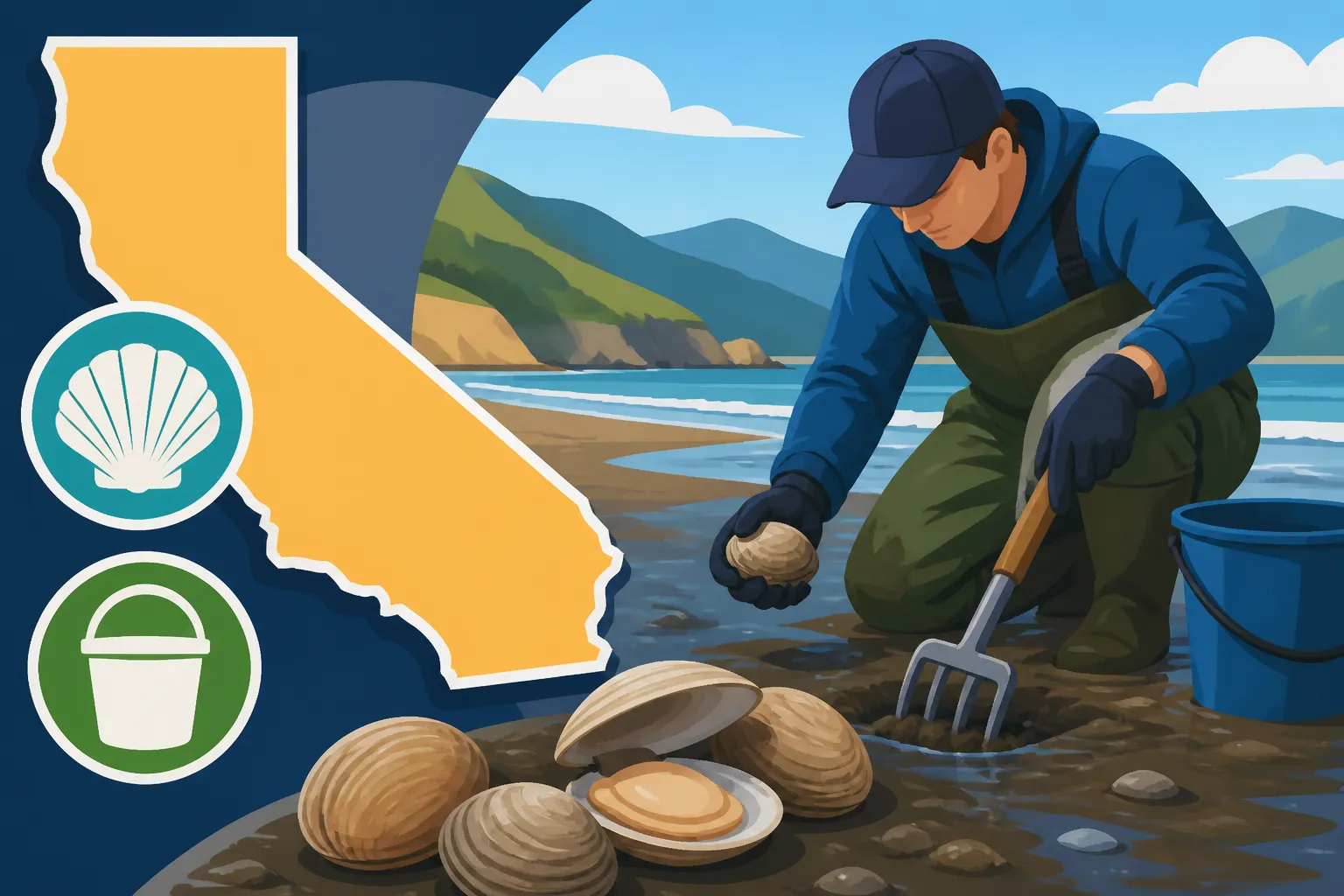
The beauty of clamming is its simplicity, but even here, there are rules about what you can use and how you can use it. Generally, you're permitted to use clam forks, shovels, or your bare hands to dig for clams. The key is that the method must be active and not overly disruptive to the environment.
What's typically not allowed are devices that mechanically pump or dredge for clams, as these can be highly destructive to the clam beds and the surrounding marine habitat. The idea is to keep it low-impact and sustainable. When you're out there, remember to respect the environment. If you're using a shovel, try to dig carefully and minimize disturbance to eelgrass beds or other sensitive areas. You'll want to make sure you have a sturdy clam shovel, a bucket to hold your catch, and a measuring device. Good quality clam shovels and buckets can be found at sporting goods stores or even on Amazon, ready for your next adventure.
Also, be mindful of how many holes you're digging. While there's no specific limit on the number of holes, excessive digging can tear up the beach and disrupt other marine life. The goal is to be efficient and respectful of the natural environment, leaving it as undisturbed as possible for the next person and, more importantly, for the clams themselves.
Staying Compliant and Enjoying Your Clamming Experience
The difference between a fantastic day of clamming and a frustrating encounter with a game warden often comes down to preparation and attentiveness. Knowing where to find the most accurate and up-to-date information is your best defense against inadvertently breaking the rules.
Checking Official Sources for Current Regulations
I can't stress this enough: regulations change! What was legal last year might not be legal today. Relying on old advice or what your buddy did a decade ago is a recipe for disaster. Your go-to source for the most accurate and current clamming regulations is always the official California Department of Fish and Wildlife (CDFW) website and their annual Sport Fishing Regulations Booklet.
You can download the booklet as a PDF, which is super convenient to have on your phone, or pick up a physical copy at any CDFW office or authorized license agent. Reading this booklet can be a bit daunting, I know, it's dense with legal jargon. But trust me, taking the time to review the sections on shellfish is crucial. If you need a little help deciphering it, our article on How to Read the California Fishing Regulations Booklet can be a useful tool.
Beyond the CDFW, the California Department of Public Health (CDPH) is your essential resource for biotoxin advisories. Bookmark their Shellfish Biotoxin Information Line and their website. Always, always check for closures or warnings related to red tide before you even leave your house. This step is non-negotiable for your safety. Local bait and tackle shops, park rangers, and even fishing charter operators are also often excellent sources of local, up-to-date information. They're on the water daily and know what's happening.
Common Mistakes to Avoid
Even with the best intentions, it's easy to make a mistake when clamming. But being aware of the most common pitfalls can help you avoid them.
One of the biggest blunders is not checking for red tide warnings. As mentioned, the consequences can be severe. Another frequent issue is misidentifying clams, leading to unintentionally violating size or bag limits. Some clams look remarkably similar, especially to the untrained eye. If you're unsure, it's always best to err on the side of caution or release the clam. Having a good field guide (like one you can get on Amazon) specifically for California shellfish can be a lifesaver here.
Exceeding bag limits, even by one clam, or taking undersized clams, is a definite no-no. Wildlife officers are diligent, and they do check catches. Clamming in closed areas, whether due to conservation or public health, is another serious offense. Always know your location and check for signage. And of course, the most basic mistake of all: not having a valid fishing license. This isn't just a minor infraction; it can result in significant fines and penalties. Our article on California Fishing License Fines and Penalties lays out exactly what you could be facing. Trust me, it's not worth the risk for a few clams.
Best Practices for a Successful and Sustainable Harvest
Responsible clamming isn't just about avoiding fines; it's about being a good steward of our natural resources. A successful clamming trip goes beyond just the number of clams in your bucket; it's also about ensuring the health of the clam bed and the enjoyment of others.
When you're digging, be gentle. If you unearth an undersized clam, or one you don't intend to keep, rebury it carefully, hinge-down, in the exact same spot you found it. This dramatically increases its chances of survival and growth. Avoid leaving large, open pits on the beach; fill in your holes as you go. This not only makes the beach safer for others but also protects the habitat.
Consider the tide. The best clamming often happens at very low tides, especially minus tides, when more of the clam beds are exposed. Plan your trip around these tides for the best access and success. And remember, always bring a cooler with ice to keep your harvested clams fresh and safe until you can clean and prepare them. Proper handling after the catch is just as important as the catch itself.
Lastly, be mindful of your surroundings. Share the beach respectfully with other clammers, beachcombers, and wildlife. We're all out there to enjoy California's incredible coast. If you're looking for some general ideas on where to go, check out our guide to the Best Saltwater Fishing Spots in California, which often points out great clamming beaches too! By following these best practices, you're not just ensuring your own enjoyable outing, but you're contributing to the sustainability of this cherished tradition for everyone.
Disclaimer
The information provided in this guide is for general informational purposes only and is not intended as legal advice. California fishing and clamming regulations are complex and subject to change frequently. Always consult the official California Department of Fish and Wildlife (CDFW) regulations booklet and the California Department of Public Health (CDPH) advisories for the most current and accurate information before engaging in any clamming activity.