Best Baits and Lures for King Salmon in California
There's nothing quite like the thrill of a King Salmon bite, but let's be honest, getting these magnificent fish to commit can sometimes feel like solving a cryptic puzzle. Many anglers spend countless hours on California's bountiful waters, scratching their heads wondering why the kings aren't biting their offerings. These powerful fish are notoriously selective, and if you've ever felt that particular frustration, you're not alone. This guide is dedicated to unraveling that mystery, offering you an exhaustive look at the best baits and lures specifically designed to entice King Salmon across California's diverse fishing grounds, from the deep blue ocean to the rushing freshwater rivers.
Understanding King Salmon Behavior and Habitat in California
Before we even talk about hooks and lines, it’s crucial to understand the fish itself. King Salmon, also known as Chinook Salmon, are truly magnificent creatures that undertake epic journeys. Their behavior, feeding patterns, and where you'll find them are heavily influenced by their life cycle and the ever-changing California environment. Knowing this foundational information will dramatically improve your chances of choosing the right bait or lure at the right time.
Where King Salmon Live and Migrate in California
King Salmon have a fascinating life cycle that spans both marine and freshwater environments. They begin their lives in California's freshwater rivers and streams, such as the Sacramento River, Feather River, and Klamath River. After spending a year or two in these natal waters, they migrate out to the vast Pacific Ocean to grow and mature. During their ocean phase, they can be found along the entire California coast, often in nutrient-rich upwelling zones, feeding on baitfish like anchovies and sardines. Prime ocean fishing grounds include areas off Bodega Bay, Half Moon Bay, and Monterey Bay.
As they reach maturity, typically after three to five years, a primal urge calls them back to their birth rivers to spawn. This is when the famous "salmon runs" occur, attracting anglers from all over. The exact timing and locations can vary year to year, influenced by water flows, temperature, and ocean conditions. Understanding these migratory patterns is key because the baits and lures that work in the ocean are often very different from what's effective in a river system. For a deeper dive into their seasonal movements, you might find our guide on California Salmon Season Dates Explained particularly helpful.
When King Salmon Are Most Active
King Salmon are opportunists, but their activity levels are dictated by several factors, including light, tide, water temperature, and their physiological state. In the ocean, they tend to be most active during low-light conditions – dawn and dusk – or when there's a strong tidal current pushing baitfish. Overcast days can also extend their feeding windows. They are cold-water fish, preferring temperatures generally between 50-60°F (10-15°C). If the water gets too warm, they'll often move to deeper, cooler areas.
When they enter freshwater rivers for their spawning migration, their feeding behavior shifts dramatically. While they might strike out of aggression or memory, they are no longer actively feeding in the same way they did in the ocean. Instead, they conserve energy for the arduous journey upstream and the spawning process. This means that presentations in rivers often need to provoke a reaction strike rather than mimicking a meal. The best times to target them in rivers are often during periods of stable water flow, after a fresh rain that might draw new fish into the system, or early mornings and late afternoons when light is subdued.
Top Baits for King Salmon in California
When it comes to tempting a King Salmon, sometimes the natural, irresistible scent and appearance of real bait just can't be beaten. While artificial lures have their place, many seasoned anglers swear by the effectiveness of fresh, properly presented bait, especially in the ocean and certain river scenarios. The key is freshness and a presentation that mimics natural prey.
Cut Bait and Herring Rigs
Herring is arguably the king of King Salmon baits, especially in the ocean. Its oily flesh, iridescent scales, and natural profile are incredibly enticing. However, it's not enough to simply hook a herring; the presentation is everything. Most anglers use a specialized "herring rig" or "rotator rig" designed to make the herring spin or roll seductively in the water, mimicking a wounded baitfish.
There are various ways to prepare herring for these rigs. Many prefer to "brine" their herring overnight in a mixture of rock salt, sometimes with borax or scent additives, to firm up the flesh and enhance its natural oils and reflectivity. The type of cut also matters – a "plug cut" or "diagonal cut" is common, where the head and part of the body are removed at an angle, allowing the bait to rotate when trolled. Rigging involves threading multiple hooks through the bait to ensure proper rotation and a solid hook-up when a salmon strikes. Brands like Silver Horde offer pre-tied herring rigs, or you can purchase components on Amazon to tie your own, customizing for hook size and leader length. This meticulous attention to detail can make all the difference, transforming a lifeless bait into an irresistible presentation for hungry King Salmon.
Anchovies and Sardines
While herring often takes center stage, smaller baitfish like anchovies and sardines are incredibly effective, particularly when King Salmon are keyed in on smaller prey. These are often fished alive, if possible, or as dead bait rigged to spin. In Southern California, especially when targeting offshore species, live anchovies and sardines are the go-to. They can be slow-trolled, drift-fished, or cast out with a light lead. The natural frantic swimming action of a live baitfish is hard for a salmon to resist.
When using dead anchovies or sardines, the rigging is similar to herring, often employing a "pinhead" or "tray" rig that allows the bait to spin. Again, freshness is paramount. Frozen bait should be thawed carefully and kept on ice to maintain its integrity. Some anglers also experiment with brining these smaller baits to make them more durable and enhance their scent trail. These baits are excellent choices when the local fish count indicates that King Salmon are feeding on schools of these smaller forage fish, a common scenario along the Central and Northern California coasts. For more details on bait selection for specific species, consult our comprehensive guide on California Fish Species: Complete Guide.
Roe and Cured Eggs
When King Salmon make their way into freshwater rivers, their primary objective shifts from feeding to spawning. This is where roe (fish eggs) becomes an incredibly effective bait. While they aren't actively eating in the traditional sense, they will strike at roe out of instinct, aggression, or a territorial response to protect their own future offspring. Fresh, naturally colored salmon or steelhead roe is highly prized.
The roe is typically "cured" to make it tougher, preserve its scent, and enhance its color. Anglers have countless secret recipes for curing roe, often involving borax, rock salt, and various dyes or scent enhancers. Brands like Pautzke Bait Company offer popular curing agents. The cured roe is then presented in small clusters, often tied into "roe bags" using specialized netting material, or fished as individual eggs (known as "single eggs"). These are typically drift-fished under a float or with minimal weight, allowing them to tumble naturally along the river bottom, mimicking dislodged eggs. Proper presentation is vital, ensuring the roe drifts freely and naturally into prime salmon holding lies. Mastering this technique often separates successful river anglers from those who go home empty-handed.
Effective Lures for King Salmon in California
Sometimes, the flash, vibration, and erratic movement of an artificial lure are exactly what's needed to trigger a King Salmon's predatory instincts, especially when they're actively feeding or when you need to cover a lot of water. Lures offer versatility and can be incredibly effective in both ocean and freshwater environments.
Spoons and Plugs
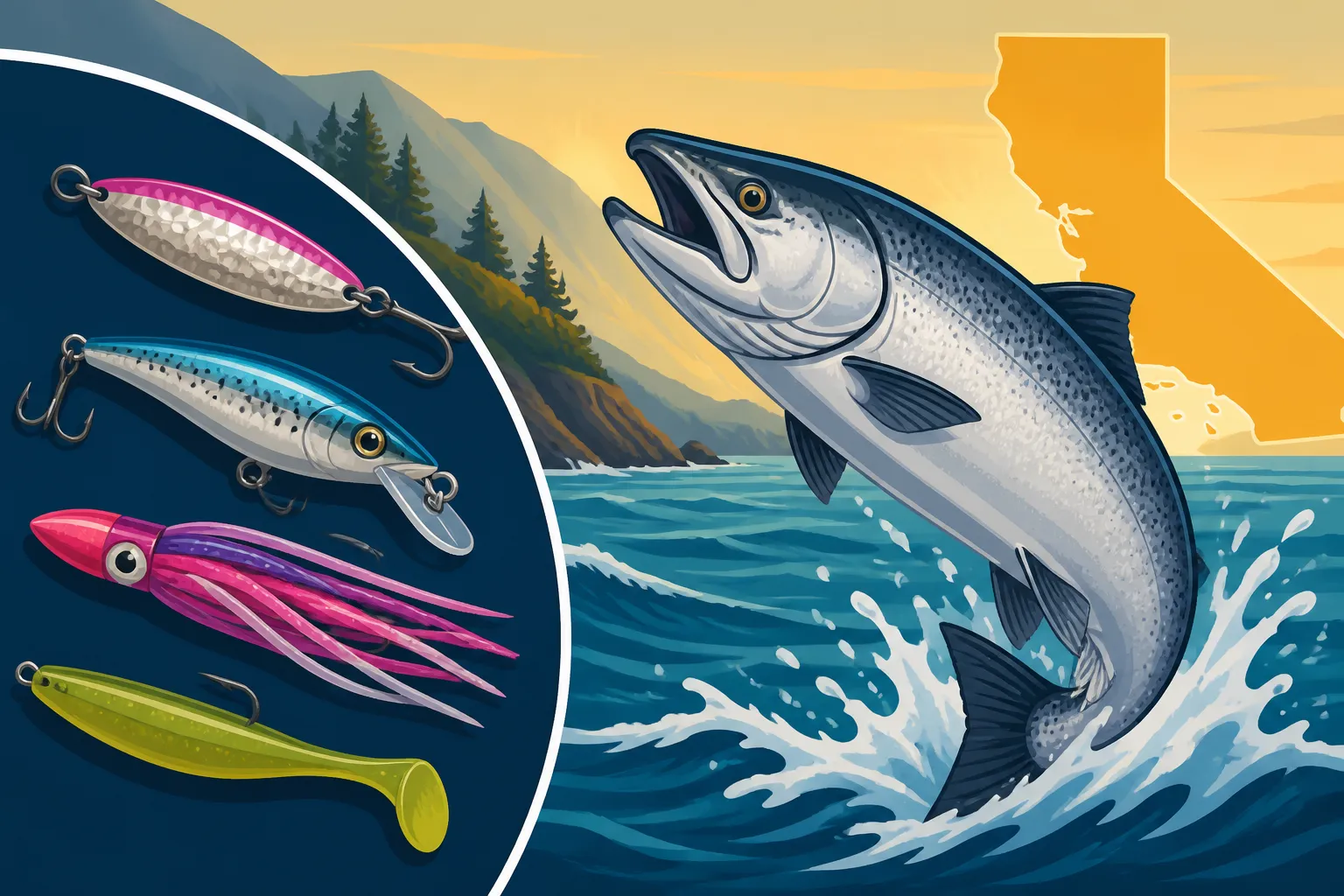
Spoons are a perennial favorite for King Salmon, both in the ocean and in larger rivers. Their wobbling, reflective action perfectly mimics a fleeing or injured baitfish. In the ocean, larger, heavier spoons are trolled at various depths, often behind a flasher or dodger to add extra attraction and erratic movement. Popular ocean spoons include the Silver Horde Coho Killer, Luhr Jensen Kingfisher, and Gibbs Delta Croc. Colors can vary widely, but metallic finishes (silver, gold, copper) are staples, along with patterns that mimic anchovies or herring. These are often trolled at depths that correspond to the thermocline or where baitfish schools are marking on your sonar.
Plugs, particularly diving plugs like the Luhr Jensen Kwikfish or FlatFish, are also highly effective. These lures have a distinctive wobbling, diving action that can drive salmon wild. They are often "tuned" (adjusted) to ensure they run true in the water and achieve the desired action. In rivers, Kwikfish plugs are particularly popular, often back-trolled or pulled behind a boat in deep pools, with or without added scent. The aggressive, thumping action of these plugs can trigger an unprovoked strike from even a non-feeding salmon. When fishing rivers, consider the water clarity and flow – brighter, more reflective plugs for murky water, and more natural, subdued colors for clear, low-light conditions.
Hoochies and Squids
In saltwater, particularly when fishing from a boat, hoochies and artificial squid are indispensable. These soft plastic lures, designed to imitate squid or small baitfish, are almost always fished behind a flasher or dodger. The flasher, a large, reflective plate, creates vibration and flash that attracts salmon from a distance, while the hoochie trailing behind it provides the actual target. The combined action of the flasher's erratic movement and the hoochie's subtle undulations is incredibly effective.
Hoochies come in a dizzying array of colors and sizes. Popular choices for King Salmon include various shades of green, blue, pink, and purple, often with glow-in-the-dark accents for deeper water or low light. Many anglers "tip" their hoochies with a small piece of bait, like a chunk of herring or anchovy, to add a natural scent element – a technique that can be particularly deadly. You can find a vast selection of these on Amazon, allowing you to experiment with different combinations until you find what the fish are keying in on. The depth at which you deploy these is critical, often requiring downriggers or heavy lead weights to get them into the strike zone.
Spinners and Trolling Flies
Spinners are fantastic all-around lures for King Salmon, especially in rivers and nearshore ocean environments. Their rotating blade creates flash and vibration that fish simply can't ignore. In freshwater, inline spinners like Blue Fox Vibrax or Mepps Aglia are popular choices, particularly for casting into river runs and pools. They are retrieved at a speed that allows the blade to spin freely, mimicking a struggling baitfish. Weight can be added to help them get down in faster currents.
For ocean trolling, large spinners are often paired with a flasher or dodger, similar to hoochies. However, a specialized "trolling fly" or "salmon fly" can also be used effectively behind a flasher. These are typically synthetic flies, often with Mylar or reflective materials, designed to imitate small baitfish or krill. They don't have their own action but get their enticing movement from the flasher. Popular trolling flies include the Yamashita Gold Star and other similar patterns. Colors again range widely, but chartreuse, green, blue, and white are common and productive. The key to both spinners and trolling flies is to maintain a consistent speed that gives the lure its intended action and keeps it in the strike zone.
Mastering Presentation and Technique for King Salmon
Having the right bait or lure is only half the battle; how you present it to a King Salmon is equally, if not more, important. These fish are masters of their environment and can be incredibly sensitive to unnatural movements, smells, or sounds. Adapting your technique to the specific environment and conditions will significantly increase your success rate.
Trolling Strategies for Open Water
Trolling is perhaps the most common and effective method for targeting King Salmon in the vast expanse of the ocean. It involves pulling your baits or lures behind a boat, covering large areas of water and allowing you to present your offering at specific depths and speeds. The most critical elements of successful trolling are speed, depth, and pattern.
Your trolling speed should be adjusted to give your chosen bait or lure its most natural and enticing action. For herring and anchovies rigged to spin, this might be a slower speed, while spoons and plugs might require a bit more pace to achieve their characteristic wobble. Depth control is achieved using downriggers, diving planes (like the Dipsy Diver or Pink Lady), or heavy lead weights (cannonballs). Using a fishfinder to mark bait schools and individual salmon is crucial for knowing where to set your depth. Many anglers troll in S-curves or figure-eights, especially around bait schools, as the change in speed and direction of the turn can often trigger a bite from following fish. Keeping a close eye on your boat speed and current is essential. Fishing reports often hint at effective trolling speeds and depths for specific areas, which can be found in resources like the Best Fishing Spots in Northern California or the San Francisco Bay Fishing Spots guides.
Casting and Drifting in Rivers
When King Salmon enter freshwater rivers, the game changes entirely. Here, stealth and precision are paramount. Casting and drifting techniques dominate, aiming to present baits or lures naturally to fish holding in pools, runs, and riffles. Unlike the ocean, river salmon are focused on spawning, not feeding, so presentations often need to provoke a reaction strike.
For baits like cured roe, drift fishing under a float (bobber) or with a minimal amount of weight is highly effective. The goal is to allow the roe to tumble along the bottom at the same speed as the current, just like naturally dislodged eggs. Anglers often use sensitive rods and light lines to detect the subtle takes. For lures such as plugs or spinners, casting upstream and retrieving downstream or "swinging" them across current is common. Plugs like Kwikfish can also be "back-trolled" by guiding them downstream into holding water from a boat, allowing the current to impart their action. Understanding river currents, identifying prime holding water (deeper pools, current breaks behind rocks or logs), and making precise casts are fundamental skills for river salmon fishing. Our guide on How to Fish for Salmon on the Sacramento River offers more specific river techniques.
Matching the Hatch and Water Conditions
One of the most valuable lessons an angler can learn is to "match the hatch" – or, in the case of salmon, match the predominant forage. This means observing what the fish are naturally feeding on and selecting baits or lures that imitate that prey in terms of size, shape, and color. If you're seeing schools of anchovies in the area, anchovy-colored lures or actual anchovies are a smart choice. If the ocean water has a green tint, opt for green-hued lures.
Water conditions also play a massive role. In clear water, subtle, natural colors and presentations are often best, as fish have excellent visibility and are more likely to spook. In murky or stained water, brighter, more vibrant colors (like chartreuse or "glow" patterns) and lures that create strong vibrations are more effective at getting noticed. After a heavy rain, rivers might be high and turbid, calling for larger, more visible baits or lures that can push through the murky water. Conversely, low, clear river conditions demand smaller, more natural offerings and extreme stealth. Always pay attention to water temperature, clarity, and current to fine-tune your approach.
Choosing the Right Gear for King Salmon Fishing
Having the right rod, reel, line, and terminal tackle can make a huge difference when battling a powerful King Salmon. These aren't dainty fish, and your gear needs to be up to the task.
Rods and Reels for Salmon
For ocean trolling, a sturdy, medium-heavy to heavy conventional rod, typically 8 to 10 feet long, paired with a reliable level-wind conventional reel is standard. Reels like the Shimano Tekota or Daiwa Saltist are popular choices, known for their strong drags and line capacity. For river fishing, a slightly lighter but still powerful baitcasting or spinning rod (7 to 9 feet) can be effective, offering more versatility for casting and drifting techniques. Reels in the 3000-5000 size range for spinning, or comparable baitcasters, work well. The key is a rod with enough backbone to handle a powerful fish and a reel with a smooth, strong drag system.
Line and Terminal Tackle
Braided mainline is often preferred for its strength-to-diameter ratio and lack of stretch, providing excellent sensitivity. A common setup is 30-50 lb braid for ocean fishing, sometimes with a top shot of monofilament. For leaders, fluorocarbon is highly recommended due to its low visibility in water, typically in the 20-40 lb range, depending on the fishing pressure and water clarity.
Terminal tackle includes swivels, snap swivels, and lead weights. High-quality ball bearing swivels are essential, especially when trolling lures that spin, to prevent line twist. Various weights, from cannonball sinkers for downriggers to pencil leads or slinky weights for river drifting, will be needed. Hooks should be sharp and strong – often single barbless hooks are required in certain freshwater areas, so always check the latest California Freshwater Fishing Regulations. Always carry a variety of sizes and strengths to match your baits and lures.
Essential Accessories
Beyond the basics, a few accessories can make your King Salmon trip more successful. A good fishfinder/chartplotter combo is invaluable for locating fish and bait schools in the ocean. A landing net with a wide hoop and sturdy handle is crucial for landing these powerful fish. Pliers, line cutters, and a measuring tape (for size limits) are must-haves. Don't forget a cooler with plenty of ice to properly preserve your catch. And for ocean trips, safety gear like a VHF radio, life vests, and flares are non-negotiable.
Bait and Lure Comparison for King Salmon
To help you make sense of the many options, here's a quick comparison of popular King Salmon baits and lures:
| Bait/Lure Type | Best Use Case | Pros | Cons | Typical Colors/Patterns |
|---|---|---|---|---|
| Herring/Cut Bait | Ocean trolling, sometimes rivers | Natural scent & appearance, highly effective when trolled correctly. | Requires careful rigging & storage, can be messy. | Natural bait colors, iridescent |
| Anchovies/Sardines | Ocean (live or dead), especially when kings are focused on small bait | Highly natural, very effective when fished fresh. | Delicate, can wash out quickly (dead bait), live bait harder to keep. | Natural bait colors |
| Roe/Cured Eggs | Freshwater rivers (drift fishing) | Irresistible to migrating salmon, triggers aggressive strikes. | Requires curing, fragile, can attract non-target species. | Natural orange, pink, red (cured) |
| Spoons | Ocean trolling, large rivers | Excellent flash & wobble, durable, wide range of sizes/colors. | Less scent than natural bait, can get expensive. | Silver, gold, chrome, green, blue |
| Plugs (Kwikfish) | Ocean trolling, river back-trolling | Aggressive thumping action, good for attracting reaction strikes, durable. | Requires tuning, specific trolling/current speed for optimal action. | Chartreuse, metallic, natural patterns |
| Hoochies/Squids | Ocean trolling (with flashers) | Highly visible, vibrant colors, mimics natural prey, durable, cost-effective. | Requires flasher for action, less natural scent unless tipped with bait. | Green, blue, pink, purple, glow |
| Spinners | Rivers (casting), nearshore ocean | Creates flash & vibration, versatile for various conditions, easy to cast. | Can get snagged easily in rivers, less effective in very deep water without added weight. | Silver, gold, copper, chartreuse, orange |
Remember, the "best" bait or lure can change daily, even hourly. The most successful anglers are those who are willing to experiment and adapt their approach based on what the fish are telling them.
Final Thoughts and Getting Out There
Catching a King Salmon in California is an experience that few anglers ever forget. The sheer power, the dogged fight, and the beauty of these fish make every moment on the water worthwhile. While there are no guarantees in fishing, arming yourself with knowledge about their behavior, selecting the right baits and lures, and mastering effective presentation techniques will dramatically tip the odds in your favor.
Don't be afraid to try new things, talk to local bait shops or fishing guides – they are a wealth of information specific to current conditions. For example, a local shop near the California Delta Fishing Guide area will have hyper-local tips that are invaluable. Pay attention to fishing reports, consider the time of year and specific regulations (check out the California Salmon Regulations and Limits), and most importantly, enjoy the process. Every day on the water is a learning experience, and with a bit of persistence, you'll soon be reeling in those magnificent King Salmon.
Disclaimer
Fishing involves inherent risks, and conditions can change rapidly. Always prioritize safety, wear appropriate personal flotation devices, and be aware of your surroundings. Regulations, seasons, and limits are subject to change by the California Department of Fish and Wildlife. It is your responsibility to check the most current official regulations before heading out on the water. This guide is for informational purposes only and does not constitute professional fishing advice or a substitute for official regulations.