How to Identify California Rockfish Species
If you've ever spent a good portion of your fishing trip scratching your head, staring at a fish, and wondering "what in the world is this thing?" — especially when it comes to rockfish — then you are absolutely not alone. California's waters are teeming with a bewildering array of rockfish species, many of which look incredibly similar to the untrained eye. This guide is here to help you cut through the confusion and confidently identify the various rockfish species you might encounter, ensuring you stay within regulations and deepen your understanding of these fascinating bottom-dwellers.
The Challenge of Rockfish Identification
Let's be honest, trying to identify rockfish can feel like a game of "spot the difference" where all the differences are tiny, and the clock is ticking because you need to get that fish back in the water! It's a common frustration among even seasoned anglers, and there are very good reasons why these fish are so tricky to tell apart.
Why Rockfish Are So Tricky
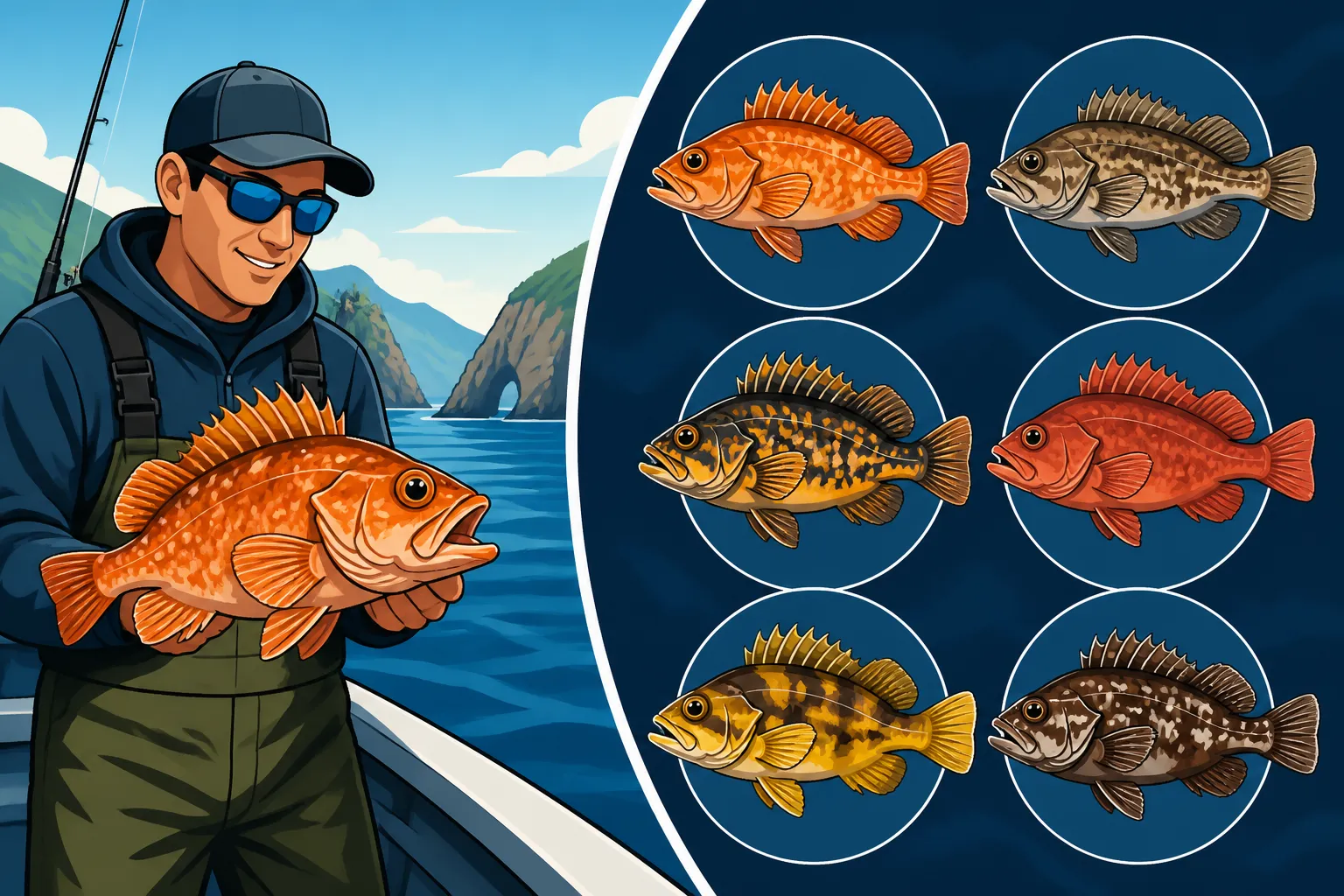
California boasts over 70 different species of rockfish (genus Sebastes), a truly impressive number. This sheer diversity is part of what makes our fisheries so rich, but it's also the root of our identification woes. Many species share similar body shapes, fin structures, and even coloration. Imagine trying to pick out a specific breed of dog when you're looking at 70 different kinds of brown dogs, all roughly the same size – that's often what it feels like with rockfish!
Their coloration, which seems like an obvious identifier, can also be a trickster. A rockfish's color can change dramatically based on its habitat depth, its diet, or even the stress it experiences during capture. A Vermilion Rockfish caught from 30 feet might look a little different from one caught at 200 feet, and both might change hues once they hit the deck. Plus, some species, especially juveniles, can look very different from their adult counterparts, adding yet another layer of complexity to the puzzle.
The Importance of Accurate Identification
Beyond just satisfying your curiosity, knowing your rockfish is absolutely critical for responsible and legal angling. The California Department of Fish and Wildlife (CDFW) has very specific regulations that often differ by species. This isn't just about general rockfish limits; it's about individual species within the rockfish family. For example, certain species might have different size limits, bag limits, or even be completely prohibited from retention due to conservation concerns.
Mistakes can lead to fines, confiscation of your catch, or even loss of your fishing privileges. More importantly, misidentification can unintentionally harm sensitive fish populations. By taking the time to learn how to properly identify your catch, you become a better steward of our marine resources. It’s a commitment to both the sport and the ecosystem. You can find detailed rules by reviewing the California Fishing Bag and Size Limits and California Rockfish Regulations and Limits to ensure you're always compliant.
Essential Features for Rockfish Identification
While the sheer number of rockfish species can be daunting, there are specific anatomical features that are consistent across individuals of the same species, making them reliable identification markers. Learning to spot these "key indicators" is like having a secret decoder ring for rockfish.
Fin Rays, Spines, and Lateral Lines
This is where the real science of fish identification comes into play, and it’s surprisingly straightforward once you know what to look for. The number of spines and soft rays in a fish’s dorsal (top), anal (bottom rear), and pectoral (side) fins are often unique to each species.
For rockfish, the dorsal fin is particularly important. You'll typically find a spiny section followed by a soft-rayed section. Counting the rigid, pointed spines and the softer, segmented rays can provide a definitive clue. Similarly, the anal fin usually has a few spines before its soft rays. The lateral line—that distinctive line of pores running along the side of the fish—also offers valuable clues. Its curvature, completeness, and even the number of scales along it can vary. For instance, some rockfish have a gently curving lateral line, while others might have one that drops sharply. Getting a good look at these features, often best done with a quick, careful check before release, is paramount.
Mouth Size, Jaw Position, and Eye Characteristics
Another set of crucial indicators lies in the head region. Pay close attention to the size of the mouth in relation to the rest of the head. Does the upper jaw extend past the eye? Is the lower jaw protruding significantly (prognathous), or is it recessed (subterminal)? Some species, like the Bocaccio, are famous for their incredibly large mouths, which immediately helps narrow down the possibilities.
The presence or absence of a "symphyseal knob" on the chin (a small, bony protrusion on the tip of the lower jaw) is also a strong identifier for several species. Additionally, the size of the eyes, their position on the head, and any distinctive bony ridges or spines above them can be telling. Some rockfish, particularly those from deeper waters, tend to have exceptionally large eyes to gather what little light is available, while shallower species might have smaller, more proportionate eyes.
Coloration and Markings
While we mentioned that coloration can be variable, many rockfish species do possess characteristic patterns or markings that, when combined with other features, become very reliable. Think of these as the "tattoos" or "birthmarks" of the fish world.
Look for distinct bands, stripes, blotches, or spots. Are they vertical or horizontal? Do they fade or are they sharply defined? For example, some rockfish might have a distinct dark blotch on their gill plate (operculum), while others might have subtle mottling that helps them blend into rocky reefs. The presence of a "starburst" pattern around the eye or specific fin coloration (like yellow fins on a Yellowtail Rockfish) can also be key. Always remember to use coloration as one piece of the identification puzzle, confirming it with structural features. It’s like double-checking your work – never rely on color alone!
Common California Rockfish Species – Your Go-To Guide
California's rockfish community is vast, but a handful of species are regularly encountered by anglers, making them essential to know. Mastering these common ones will give you a solid foundation for identifying others.
Vermilion Rockfish (Red Snapper)
Ah, the Vermilion! Often mistakenly called "red snapper" (which is actually a Gulf Coast species), the Vermilion Rockfish is one of the most sought-after rockfish in California due to its vibrant color and delicious white meat. These beauties typically sport a bright red to orange-red body, often with some subtle mottling or blotching.
Key identification features include a large mouth that extends past the eye, and perhaps most tellingly, a usually distinct white blotch or two on the lateral line area. When freshly caught, the blotches are quite pronounced. The dorsal fin usually has 13 spines, followed by 13-15 soft rays. They can grow quite large, often reaching over 20 inches, making them a prize catch. If you’re targeting these, make sure you know the California Rockfish Depth Restrictions as they are often found in deeper waters.
Copper Rockfish
The Copper Rockfish is another popular species known for its beautiful and variable coloration. These fish typically have a mottled copper, olive-brown, or reddish-brown body, often with irregular white or yellowish blotches on their back and sides. A dark, often copper-colored blotch on the operculum (gill cover) is a very common and helpful identifying mark.
Their fins are usually a yellowish-orange. The mouth is moderately sized, and the dorsal fin typically has 13 spines and 11-14 soft rays. Coppers are often found in rocky reef habitats, kelp beds, and near structure in shallower to moderate depths, making them a common catch for both shore and boat anglers. They are spirited fighters and another excellent eating fish.
Black Rockfish
If you're fishing in Northern or Central California, you're almost guaranteed to encounter the Black Rockfish. As its name suggests, this species is generally dark in color, ranging from a uniform dark grey to black, sometimes with lighter mottling on its sides. Don't be fooled by slightly lighter specimens, though; their defining characteristics lie elsewhere.
Black Rockfish have a relatively large mouth with a lower jaw that protrudes slightly, and often a prominent symphyseal knob. Their most distinctive feature is a dorsal fin with a deep notch between the spiny and soft-rayed sections. They typically have 13 dorsal spines and 13-15 soft rays. The caudal (tail) fin is usually uniformly dark, sometimes with a faint lighter streak. They are often found in shallower waters, especially around kelp and rocky outcroppings.
Yellowtail Rockfish
The Yellowtail Rockfish is a beautiful and somewhat streamlined species, often confused with other olive-colored rockfish. Its body is typically an olive-brown to dark green on the back, fading to lighter shades on the sides and belly. The defining characteristic, as implied by its name, is a distinctly yellow caudal (tail) fin, though other fins may also have a yellowish tint.
They have a relatively small mouth that does not extend past the eye, and a prominent lower jaw. The lateral line is usually straight and clear. They typically have 13 dorsal spines and 13-15 soft rays. Yellowtails are often found schooling in mid-water over rocky reefs, making them a favorite for vertical jigging. Catching a good-sized yellowtail is always a treat, and they are excellent table fare.
Other Notable California Rockfish to Recognize
While the common species are a great start, California's diverse waters mean you'll likely encounter other rockfish that are equally important to identify correctly. These species, though perhaps less frequently caught or more regionally specific, are crucial to know for both regulatory compliance and a deeper appreciation of our marine ecosystem.
Bocaccio
The Bocaccio (pronounced "boh-kah-chee-oh"), sometimes referred to as "salmon grouper" or even "trout" due to its reddish-brown color, is a distinct species. It has a more elongated, slender body compared to many other rockfish, which tend to be chunkier. Its coloration ranges from olive-brown to bright red, often with some light mottling, especially when young.
The most striking feature of the Bocaccio is its incredibly large mouth, which extends well beyond the eye. Seriously, it's hard to miss once you've seen one! Their lower jaw also protrudes significantly, giving them a perpetually surprised look. They typically have 12-13 dorsal spines and 13-15 soft rays. Bocaccio are primarily a deeper-water species, often caught by anglers targeting rockfish on deeper reefs. They're a schooling fish and can grow quite large, making them a popular target when available. Just remember to check the current California Groundfish Regulations as their seasons and limits can vary.
Canary Rockfish
The Canary Rockfish is easily one of the most striking and beautiful species in the rockfish family. Its vibrant coloration is usually an unmistakable bright orange to yellow-orange, often with three distinct, diffuse orange stripes radiating across its face from the eye. These "canary stripes" are a key identifier.
They generally have a lighter patch or stripe along their lateral line. The dorsal fin typically has 13 spines and 13-15 soft rays. The mouth is moderately sized, and the lower jaw often has a small symphyseal knob. Unfortunately, Canary Rockfish are a species of concern, having been overfished in the past. While populations are recovering, regulations for Canary Rockfish are often very strict, sometimes even requiring immediate release. This makes accurate identification especially critical. Always consult the latest CDFW regulations before heading out.
Kelp Rockfish
As their name suggests, Kelp Rockfish are master camouflagers, perfectly adapted to blend into their namesake kelp forest and rocky reef habitats in shallower waters. Their coloration is highly variable, ranging from mottled browns and greens to reddish hues, often mimicking the algae and rocks around them. This makes them a bit harder to spot visually, but their habitat preference is a big clue.
They are generally smaller than many other rockfish species. Look for a relatively small mouth and eyes, and a robust body. They typically have 13 dorsal spines and 13-14 soft rays. Unlike some of the deeper-water rockfish, you'll find Kelp Rockfish hugging the structure, often in less than 60 feet of water. They're not usually targeted for their size, but they're a common catch when fishing the inshore kelp lines and rocky shorelines, especially for anglers using lighter tackle or diving for lobsters.
Practical Tools and Strategies for Field Identification
Even with all this knowledge, identifying a fish quickly on a rocking boat or a slippery pier can still be a challenge. That's why having the right tools and knowing a few tricks of the trade can make all the difference.
Essential Gear for On-the-Water ID
First and foremost, a good, waterproof field guide is your best friend. Something like "Pacific Coast Fishes" by Eschmeyer, Herald, and Hamann, or a more specialized rockfish guide, can be invaluable. Many of these guides include clear illustrations or photos and highlight key identification features. You can often find excellent field guides and laminated fish identification cards on Amazon that are designed to withstand the rigors of a fishing trip. Having a ruler or tape measure handy is also crucial for verifying size limits – another critical aspect of compliance.
Beyond physical guides, consider a good quality smartphone or action camera. Taking a quick, clear photo of the fish from different angles, especially of its head and fins, can allow you to review it later or even get help from an expert. Just be sure to do this quickly and minimize the fish's time out of the water, especially if you intend to release it. A small, waterproof notepad and pencil can also be useful for jotting down observations if you prefer a low-tech approach.
Best Practices for Quick Identification
When you land a rockfish and need to identify it, speed and care are key. Get into the habit of quickly observing the fish's overall shape, color patterns, and the critical features we discussed earlier (fin counts, mouth size, etc.). If you're unsure, try to gently lay the fish on a wet, clean surface (like a measuring board) to get a better look and snap a clear photo. For species with very strict regulations or those you intend to release, the less time they spend out of the water, the better their chances of survival.
If you are absolutely certain of identification, measure it, and if it's legal size and within your bag limit, you can retain it. If there's any doubt, especially with protected species or those with complex regulations, the safest bet is a quick and careful release. Always remember the concept of barotrauma when bringing fish up from deep water; be prepared with a descending device if you plan to release deep-caught rockfish. You can dive deeper into the regulatory aspects by checking out topics like California Fishing Regulations Explained or even How to Read the California Fishing Regulations Booklet.
Digital Resources and Community Help
In today's connected world, you're never truly alone in your identification quest. Several excellent smartphone apps are available that can help with fish identification, often using AI recognition from photos or providing interactive guides. Many state agencies, including the CDFW, offer online resources, species galleries, and even downloadable regulation summaries that can be accessed on your phone.
Beyond official channels, online fishing forums and social media groups are fantastic communities where you can post a photo of your catch and get rapid input from experienced anglers. Just be sure to provide clear photos and any relevant details (like where and how deep you caught it). This crowdsourced knowledge can be incredibly helpful for learning and refining your identification skills, especially when you're stumped by a particularly obscure or unusual specimen.
Understanding Regulations and Conservation
Knowing how to identify rockfish is only one piece of the puzzle. Understanding and adhering to the specific regulations for each species, as well as broader conservation efforts, is paramount to ensuring healthy fish populations for generations to come.
Navigating Size and Bag Limits
The CDFW publishes comprehensive sport fishing regulations annually, and these often include specific size and bag limits for various rockfish species. These limits are not arbitrary; they are carefully determined by fisheries scientists to manage populations sustainably. For instance, a Vermilion Rockfish might have a different minimum size and daily bag limit than a Copper Rockfish.
It's critical to review the current regulations before every fishing trip, as they can change based on scientific assessments and environmental factors. Some years might see more restrictive limits or even closures for certain species if populations are deemed vulnerable. For example, some management areas might have specific rules, like those detailed in the California Rockfish Rules in the Southern Management Area, or general regulations for groundfish. Always measure your fish accurately, and if it's undersized, release it gently and immediately. These rules protect the future of rockfish fishing.
Marine Protected Areas (MPAs)
California has established a network of Marine Protected Areas (MPAs) along its coast, which are essentially underwater parks designed to conserve marine life and habitats. Within these MPAs, fishing activities are often restricted or completely prohibited, even for common species like rockfish.
Understanding where MPAs are located and what activities are allowed or prohibited within them is absolutely crucial. Fishing in a "no-take" zone, even accidentally, can lead to serious penalties. Before you head to a new fishing spot, always consult current MPA maps and regulations. The CDFW website provides interactive maps and detailed descriptions of all MPAs. You can learn more about these critical zones in our guide to California Marine Protected Areas Explained. Knowing your boundaries helps protect these vital conservation areas.
The Importance of Responsible Angling
Beyond strict compliance with regulations, responsible angling encompasses a broader ethic of stewardship. This means practicing catch-and-release techniques properly for fish you don't intend to keep, minimizing barotrauma in deep-caught fish (using descending devices or venting tools), and avoiding unnecessary waste of your catch.
It also means reporting any suspected poaching or environmental violations to the authorities. Being a responsible angler contributes directly to the long-term health of California's marine ecosystems and ensures that future generations can enjoy the incredible experience of fishing for rockfish. Whether you're learning How to Catch Rockfish in California or just admiring them, treating these fish with respect is the ultimate goal.
| Species | Primary Coloration | Key ID Feature 1 | Key ID Feature 2 | Typical Habitat Depth |
|---|---|---|---|---|
| Vermilion | Bright red to orange-red | Large mouth, past eye | White blotches on lateral line | Moderate to Deep |
| Copper | Mottled copper/olive-brown | Dark blotch on operculum | Irregular white blotches | Shallow to Moderate |
| Black | Dark grey to black | Deep notch in dorsal fin | Protruding lower jaw | Shallow to Moderate |
| Yellowtail | Olive-brown/dark green | Distinct yellow caudal fin | Straight lateral line | Moderate |
| Bocaccio | Olive-brown to red | Very large mouth, past eye | Slender, elongated body | Deep |
| Canary | Bright orange to yellow | 3 bright facial stripes | Lighter lateral line stripe | Moderate to Deep |
| Kelp | Mottled brown/green | Small mouth and eyes | Camouflaged, irregular blotches | Shallow (kelp beds) |
Disclaimer
The information provided in this guide is for educational and informational purposes only and is not a substitute for official regulations. Fishing rules and regulations in California are subject to change by the California Department of Fish and Wildlife (CDFW). Always consult the most current CDFW sport fishing regulations booklet or website before engaging in any fishing activities. Compliance with all local, state, and federal laws is the responsibility of the angler.