California Salmon Bag Limit Explained
It can be incredibly frustrating trying to keep up with California's ever-changing fishing regulations, especially when it comes to prized species like salmon. One minute you think you've got it figured out, and the next, a season is shortened, or a limit shifts. It feels like you need a law degree just to go fishing sometimes! This comprehensive guide is here to untangle the complexities of California's salmon bag limits, helping you understand the rules, why they change, and how to stay compliant so you can enjoy your time on the water without worry.
Understanding the Dynamic Nature of Salmon Regulations
Fishing for salmon in California isn't just about dropping a line; it's about navigating a intricate web of rules designed to protect these incredible fish and ensure their sustainability. Unlike some other species, salmon regulations are notoriously dynamic, changing year by year, and sometimes even within a season. This isn't because the California Department of Fish and Wildlife (CDFW) wants to make your life harder, but rather because salmon populations are highly sensitive to environmental factors, ocean conditions, and spawning success.
These regulations are a collaborative effort, often involving state and federal agencies like the CDFW and NOAA Fisheries, all working to manage salmon stocks that migrate vast distances, sometimes across multiple states and international waters. Factors like drought, ocean temperatures, and habitat quality in freshwater spawning grounds directly impact how many salmon return each year. When returns are low, regulations tighten; when they're healthy, we might see more generous seasons. It's a constant balancing act to ensure that there are enough fish to reproduce and sustain future generations, while also allowing for recreational and commercial fishing opportunities. You might also find it useful to dive into the general principles laid out in our main article on California Fishing Regulations Explained.
Why Salmon Limits Fluctuate Annually
The salmon population in California is largely comprised of Chinook (King) salmon, which are anadromous, meaning they spend most of their lives in the ocean but return to freshwater rivers to spawn. This lifecycle makes them vulnerable to a wide array of environmental challenges, leading to significant year-to-year variations in their numbers. For example, severe droughts can reduce river flows, making it difficult for juvenile salmon to reach the ocean or for adults to return to their spawning grounds. El Niño and La Niña cycles can drastically alter ocean temperatures and food availability, impacting salmon growth and survival at sea.
Beyond natural phenomena, human activities also play a role. Dam operations can impede migration, and changes in water diversions can affect river habitats. Each spring, fisheries managers conduct extensive assessments, analyzing everything from spawning escapement data (how many fish made it back to spawn) to ocean survival rates of specific year classes. These complex models and forecasts directly inform the fishing season dates, daily bag limits, and size restrictions for the upcoming year. It's a science-driven process aimed at conservation, and understanding this helps put those frustrating regulation changes into perspective. It's truly a testament to the dedication to maintaining healthy fish stocks for everyone.
Key Regulatory Bodies and Their Roles
Navigating the world of salmon fishing means understanding who's setting the rules. In California, the primary state agency is the California Department of Fish and Wildlife (CDFW). They are responsible for managing and protecting fish and wildlife resources within the state's borders, including salmon in freshwater systems and within state ocean waters. The CDFW publishes the annual sport fishing regulations booklet, which is the angler's bible for current rules.
However, salmon don't stay neatly within state lines. Their oceanic migrations mean that federal agencies also play a huge role. The Pacific Fishery Management Council (PFMC), in conjunction with NOAA Fisheries, develops and recommends regulations for salmon in federal ocean waters off California, Oregon, and Washington. These federal decisions often dictate the overall ocean salmon season, including opening and closing dates, as well as the daily bag and size limits. The CDFW then aligns its state regulations, particularly for ocean salmon fishing, with these federal guidelines. This collaborative approach ensures that salmon are managed consistently across their range, preventing overfishing in one area from undermining conservation efforts in another. When you're trying to figure out the exact dates and limits, it's these two entities you're usually consulting.
Specific Salmon Bag Limits in California
When we talk about salmon bag limits, we're primarily focused on Chinook (King) salmon, as Coho salmon are typically prohibited for retention in California waters due to their endangered status. The regulations for Chinook salmon can vary significantly depending on whether you're fishing in the ocean or in freshwater rivers, and also by specific geographic zones. These limits often include not just the number of fish you can keep, but also minimum size requirements and sometimes specific gear restrictions. It's crucial to consult the most current CDFW regulations booklet or their website before every trip, as these rules are subject to change, even mid-season, based on biological assessments.
Ocean Salmon Bag Limits by Management Area
Ocean salmon fishing off California is divided into different management areas, each with its own specific regulations regarding season dates, bag limits, and size restrictions. These areas are established to manage localized salmon stocks and respond to regional ocean conditions and stock assessments. For instance, the regulations in the Fort Bragg area might differ from those in the San Francisco or Monterey Bay areas.
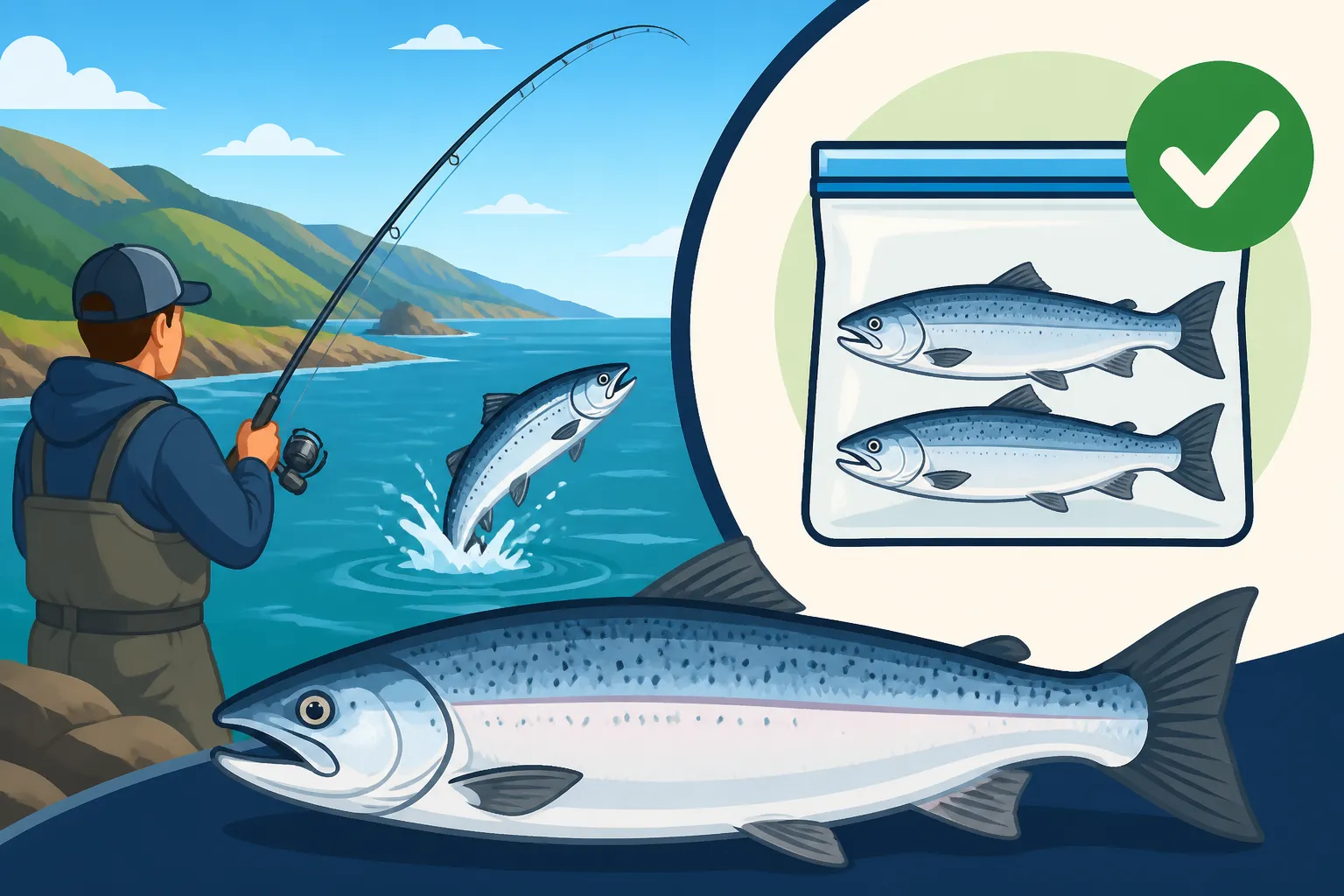
Typically, the general ocean bag limit for Chinook salmon is two fish per day, but this is a maximum and can be reduced to one fish, or even closed entirely, in specific areas or during certain periods. There's also usually a minimum size limit, often around 20 or 24 inches total length, to protect juvenile fish. Anglers must remember that once you catch your limit, you cannot continue fishing for salmon. If you're out on a charter, the captain and crew will be well-versed in these rules, but it’s always good practice for you to be aware as well. You'll definitely want to check the California Ocean Salmon Regulations for the most current details.
Here's a generalized table illustrating potential ocean salmon bag and size limits by management area. Please remember, these are illustrative and subject to annual changes by the CDFW and PFMC. Always check current regulations.
| Management Area (General) | Season (Illustrative) | Daily Bag Limit | Minimum Size Limit |
|---|---|---|---|
| North of Point Arena | Mid-May to Early Sept | 2 Chinook Salmon | 20 inches total length |
| Point Arena to Pigeon Point (San Francisco) | Mid-April to Late Oct | 2 Chinook Salmon | 24 inches total length |
| Pigeon Point to U.S./Mexico Border (Monterey/Southern CA) | Mid-April to Late Oct | 2 Chinook Salmon | 24 inches total length |
Note: Coho Salmon are generally prohibited for retention statewide in California. Always verify current dates and limits with the official CDFW regulations before fishing.
Freshwater Salmon Bag Limits by River System
When salmon enter freshwater rivers to spawn, the regulations can become even more specific and nuanced. Each major river system, like the Sacramento River, Feather River, or Klamath River, often has its own set of rules, influenced by the health of the specific salmon run returning to that river. These rules are particularly critical because they directly impact the spawning population.
Freshwater salmon seasons are often shorter and more restrictive than ocean seasons, sometimes with a daily bag limit of one or two Chinook salmon. Size limits may also apply, and there can be specific restrictions on tackle, such as requiring barbless hooks or specific lure types, to minimize harm to fish intended for release. Certain sections of rivers might be entirely closed to salmon fishing to protect spawning grounds. For example, specific stretches of the Sacramento River above the Red Bluff Diversion Dam might have very different rules than sections further downstream. This level of detail underscores the importance of consulting the California Fishing Regulation Booklet Explained directly. It’s not uncommon to see "California Salmon Season Dates Explained" as a separate resource due to these complexities.
It's also essential to remember that you'll need a valid California Fishing License Guide, and for salmon, you'll almost certainly need a California Salmon Report Card in addition to your license. This card is vital for tracking catch and effort, which directly feeds into future stock assessments and regulation setting. Failing to properly fill out and return your report card can lead to penalties, so don't overlook this critical step.
Navigating the Nuances of Salmon Bag Limits
Beyond the basic numbers, there are several nuances to salmon bag limits that anglers often overlook, leading to potential violations. Understanding these finer points is just as important as knowing the daily count. It's not just about what you catch, but also how you handle it, and what other permissions you might need.
Daily vs. Possession Limits
One common area of confusion for new anglers, and even some seasoned ones, is the difference between a daily bag limit and a possession limit. The daily bag limit refers to the maximum number of fish of a specific species (in this case, salmon) you can keep in a single day. Once you've reached that number, you must stop fishing for that species for the rest of the day.
The possession limit, on the other hand, refers to the maximum number of fish you can have in your possession at any given time, whether it's on your person, in your cooler, in your vehicle, or stored at your home. For salmon in California, the possession limit is often the same as the daily bag limit. This means if the daily limit is two salmon, you can only possess two salmon at any time, even if you’ve fished for multiple days. This prevents anglers from accumulating large quantities of fish over several outings. For example, if you catch two salmon on Monday, you can't go out Tuesday and catch two more, then have all four in your freezer. You must consume or process the previous day's catch before you can legally keep more. Always check if the possession limit differs, though for salmon, they are often aligned.
Minimum Size Requirements for Salmon
Just as important as the number of fish you can keep is their size. California's salmon regulations almost always include a minimum size limit, which is a crucial conservation measure. This ensures that most salmon have had at least one opportunity to spawn before being harvested. For Chinook salmon, ocean size limits typically range from 20 to 24 inches total length, measured from the tip of the snout to the tip of the longest lobe of the tail. Freshwater size limits can sometimes be smaller, but again, this varies by river and season.
It's absolutely critical to measure your fish immediately upon catching it. If it doesn't meet the minimum size, it must be released immediately and with as little harm as possible. Carrying a reliable measuring tape or a fish ruler is non-negotiable. Many tackle shops, and even online retailers like Amazon, offer sturdy, waterproof measuring devices that are perfect for this purpose. Releasing undersized fish quickly and carefully ensures they have the best chance of survival. Failure to adhere to minimum size limits can result in significant fines and penalties, so double-check those numbers before keeping anything! You can find specific details on California Salmon Size Limit Explained.
How Report Cards Tie into Bag Limits
For salmon, a California Salmon Report Card isn't just an optional extra; it's a mandatory requirement that works hand-in-hand with your bag limit. This physical card, which you purchase in addition to your California Fishing License Cost, serves a vital scientific purpose. Every time you catch and keep a salmon, you are legally required to mark the date, location, and species on your report card immediately. Even if you release a salmon, you often need to record the effort, depending on the specific report card rules.
The data collected from these report cards provides the CDFW with invaluable information about angler catch rates, fishing effort, and the health of salmon populations. This information is directly used to assess the effectiveness of current regulations and to make informed decisions about future seasons and bag limits. Think of it as your personal contribution to salmon conservation. At the end of the year, even if you didn't catch any salmon, you're required to return your report card to the CDFW (or report online) by a specific deadline. Failing to obtain a report card, fill it out correctly, or return it can lead to hefty fines, regardless of whether you adhered to the bag limit. It's a small administrative task that has a huge impact on sustainable fishing.
Practical Tips for Staying Compliant
Nobody wants to accidentally break a fishing regulation. It's not just about the potential fines; it's about respecting the resource and contributing to sustainable fishing practices. Staying compliant with California's salmon bag limits, and all other regulations, comes down to diligence and preparation. You have to be proactive because the rules aren't always static.
Always Check Current Regulations Before You Go
This cannot be stressed enough: always check the current California fishing regulations immediately before your trip. Do not rely on last year's knowledge, what your buddy told you, or even an old online article. Salmon regulations, in particular, are subject to change due to fluctuating stock assessments and environmental conditions. The CDFW publishes an annual Freshwater Sport Fishing Regulations booklet and an Ocean Sport Fishing Regulations booklet, both of which are available online as PDFs on their official website. You can also pick up physical copies at most tackle shops and sporting goods stores.
A good habit is to bookmark the CDFW salmon regulation pages on your phone or print out the relevant sections for your specific fishing area. This way, you have the most up-to-date information right at your fingertips. Imagine planning a trip to the Sacramento River for salmon, only to find out upon arrival that the season has been delayed or the bag limit reduced due to low returns. Checking beforehand saves disappointment and ensures you're fishing legally. You can always refer to the California Fishing Regulation Booklet Explained for tips on how to navigate it.
Essential Gear for Compliance
Being prepared with the right gear isn't just about catching fish; it's also about staying compliant with regulations. Here are a few essentials for salmon fishing:
- Measuring Device: A sturdy, waterproof measuring tape or fish ruler is absolutely critical for ensuring your catch meets the minimum size limit. Don't eyeball it! Many options are available from brands like Rapala or Berkley, easily found at local tackle shops or online at Amazon.
- Method of Recording: For your salmon report card, you'll need a pen or pencil that works reliably even when wet. A small, waterproof notebook or a laminated card can also be useful for jotting down notes before transferring them to your official report card.
- Cooler and Ice: Beyond keeping your catch fresh, having an adequate cooler and ice helps ensure you can properly store your fish if you reach your bag limit, especially if you're out for a full day. This also helps prevent spoilage until you can process your fish at home.
- Pliers/Forceps: If you're using barbless hooks (often required for freshwater salmon fishing) or practicing catch-and-release for undersized fish, having pliers or forceps for quick and clean hook removal minimizes stress and injury to the fish.
Having these items readily accessible means you can quickly and accurately comply with regulations, ensuring a smooth and enjoyable fishing experience.
Responsible Angling Practices
Beyond simply following the rules, responsible angling practices are about embodying the spirit of conservation. This means understanding the fragility of salmon populations and doing your part to protect them.
- Careful Catch and Release: For any fish you intend to release, whether it's undersized or you've reached your limit, minimize handling time. Use wet hands to avoid removing their protective slime coat, and release them gently back into the water, ensuring they swim off strong. If a salmon is deeply hooked, it's often best to cut the line as close to the hook as possible rather than trying to remove it, especially if the hook is stainless steel and will eventually corrode.
- Proper Fish Identification: While salmon fishing in California usually targets Chinook, it's essential to be able to distinguish them from other species, especially the protected Coho salmon. Familiarize yourself with the identifying characteristics of salmon species in your area.
- Respecting Closures and MPAs: Be aware of any specific river sections or ocean areas that are closed to fishing or designated as Marine Protected Areas (MPAs). Fishing in these areas can result in severe penalties. Our guide on California Marine Protected Areas Explained can help clarify where these are located.
- Reporting Violations: If you witness someone violating fishing regulations, such as keeping oversized or undersized fish, or exceeding bag limits, it's important to report it to the CDFW. Their "CalTIP" line (1-888-334-CALTIP) is available 24/7. This helps protect the resource for everyone.
By practicing responsible angling, you're not just avoiding fines; you're actively contributing to the health and longevity of California's salmon fishery, ensuring that future generations can enjoy the same incredible opportunities we have. After all, the best way to enjoy Best Season for Salmon in California is by doing so responsibly.
Final Thoughts on California Salmon Bag Limits
Navigating the world of California salmon bag limits might seem like a maze, but with a bit of dedication to staying informed and adopting responsible practices, it's entirely manageable. The key takeaway here is diligence: these regulations are not static. They reflect the ever-changing health of our precious salmon populations, driven by environmental factors and the ongoing efforts of fisheries management. Your role as an angler goes beyond just catching fish; it extends to being a steward of the resource, respecting the rules that are put in place to ensure that these magnificent creatures continue to thrive for generations to come. So, get your California Fishing License Guide, grab your report card, double-check those regulations, and get out there to enjoy the incredible experience of salmon fishing in California!
Disclaimer
The information provided in this guide is for general informational purposes only and is not a substitute for the official California Department of Fish and Wildlife (CDFW) fishing regulations. Regulations can change frequently, often without prior notice. Always consult the current official CDFW Freshwater Sport Fishing Regulations and Ocean Sport Fishing Regulations booklets, or the CDFW website, before engaging in any fishing activity to ensure compliance with all laws and regulations.