Lake Trout in California: Where and How to Catch
There's a unique thrill, and let's be honest, sometimes a fair bit of frustration, that comes with targeting Lake Trout in California. These aren't your typical stocked rainbows eager to bite near the shore; these are often deep-dwelling, elusive creatures that demand patience, specific gear, and a solid understanding of their habits. This comprehensive guide is here to unravel the mysteries of "laker" fishing in the Golden State, from where they hide to the best techniques to coax them onto your line.
Understanding California's Lake Trout Landscape
Lake Trout, or Salvelinus namaycush, are truly magnificent fish, a powerful species of char that can grow to impressive sizes. While they're not native to California, they've been introduced to several large, cold, and deep bodies of water where they've established thriving populations. Chasing them means venturing into some of the state's most stunning, yet challenging, aquatic environments.
Where Lake Trout Thrive in California
When you think about Lake Trout in California, one name immediately springs to mind: Lake Tahoe. This iconic, crystal-clear alpine lake, straddling the California-Nevada border, is synonymous with trophy-sized lake trout, locally known as "Mackinaw." The sheer depth and cold, oxygen-rich waters of Tahoe provide the perfect habitat for these apex predators. Anglers often spend years trying to crack the code of Lake Tahoe's Mackinaw, and landing a 20-pounder or more is a truly brag-worthy achievement. If you're planning a trip to this gem, our detailed guide on Lake Tahoe Fishing Guide can give you even more insights.
Beyond Tahoe, other significant lakes also hold respectable populations. Donner Lake, just a short drive from Lake Tahoe, is another fantastic fishery known for its deep waters and healthy Lake Trout. While perhaps not reaching the sheer size of Tahoe's giants, Donner Lake offers consistent action for those who know its nuances. Another spot worth exploring, particularly for its challenging yet rewarding fishing, is Stampede Reservoir in the Truckee area. These lakes typically have depths exceeding 100 feet, often much more, which is where these cold-loving fish prefer to spend their time, especially during warmer months. They'll hug structure like underwater ledges, drop-offs, and submerged timber, waiting to ambush unsuspecting prey.
Identifying Lake Trout: Key Characteristics
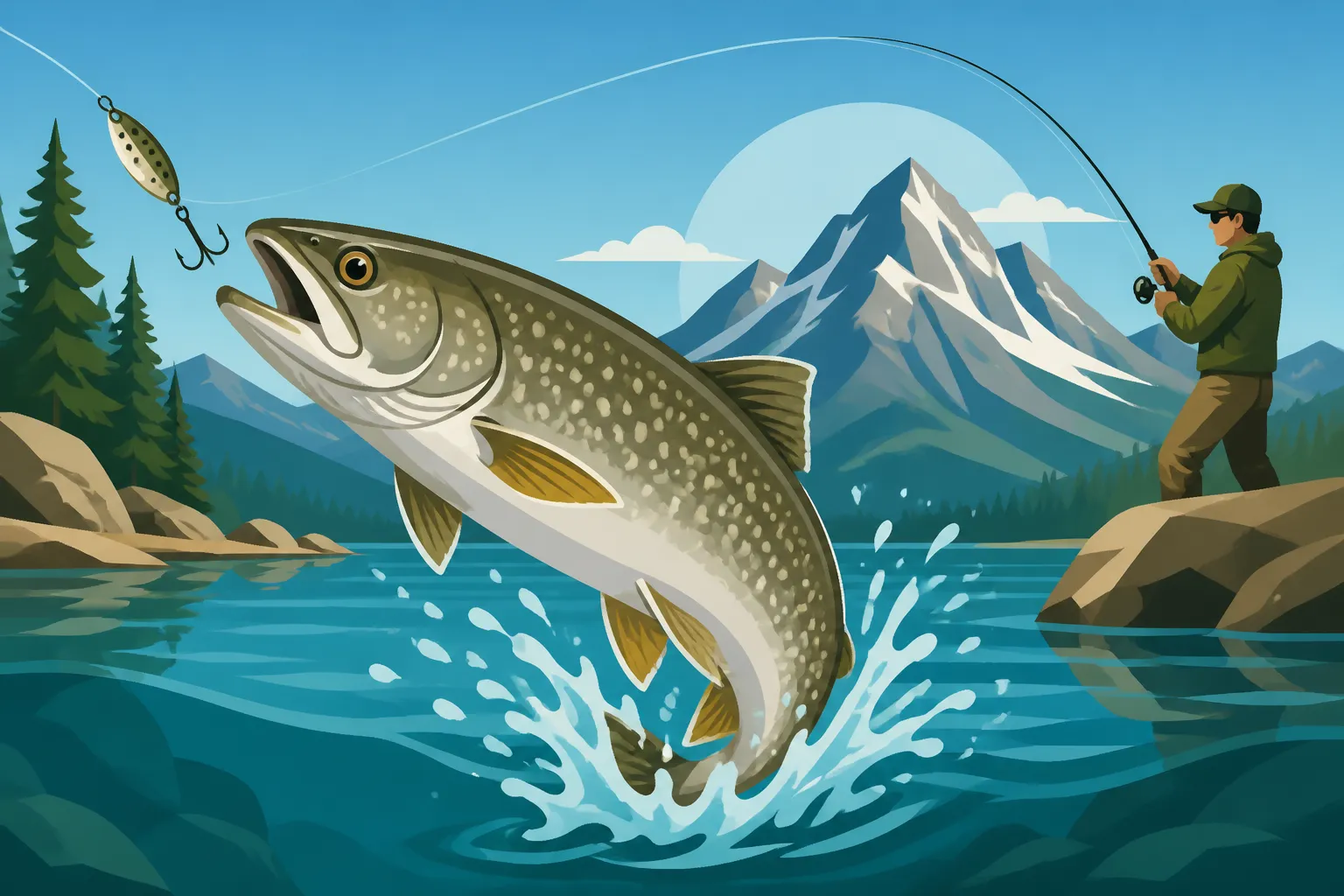
Knowing your target is half the battle, and Lake Trout have some distinct features that set them apart from other trout species you might encounter in California. First off, they're generally much larger and bulkier than Rainbows or Browns. Their bodies are elongated, often with a torpedo-like shape, indicating their predatory nature. Their coloration can vary quite a bit depending on the specific lake and diet, but they typically have a dark green, gray, or brown back, fading to lighter sides and a white belly.
What truly distinguishes them are the numerous light, often worm-like or irregularly shaped spots covering their body, including their dorsal fin and caudal (tail) fin. Unlike the more uniform spots of a rainbow trout, these are irregular and often quite pale. Their mouth is large, extending beyond the eye, another sign of their piscivorous (fish-eating) diet. The tail fin is deeply forked, a characteristic shared with other char species but particularly pronounced in Lake Trout, which helps them powerfully propel through deep water. You won't find the same iridescent stripe as a rainbow or the distinct red spots of a brown trout on a true Mackinaw.
Essential Gear and Tackle for California Lake Trout
Fishing for Lake Trout isn't like casting for panfish off a dock. These fish live in a different world, often hundreds of feet below the surface, and require specialized equipment to reach them and, more importantly, to land them. Don't skimp on your gear here; a cheap setup might cost you the fish of a lifetime.
Rods, Reels, and Line Choices
For Lake Trout, especially in deep-water trolling or jigging scenarios, you'll need robust gear. A medium-heavy to heavy action rod, typically 7 to 9 feet long, is ideal. Look for rods with a sensitive tip to detect subtle bites but plenty of backbone to handle a powerful fish pulling against deep-water resistance. Brands like Shimano or Daiwa offer excellent trolling rods designed for this kind of work, readily available through retailers like Amazon.
When it comes to reels, a sturdy baitcasting reel with a high line capacity is paramount for trolling, as you might be letting out hundreds of feet of line. For jigging, a powerful spinning reel or a smaller, high-gear ratio baitcaster can also work, but always prioritize line capacity and a smooth, reliable drag system. A good quality reel ensures that when that monster hits, you have the stopping power and durability to fight it.
Line choice is critical. For trolling, many experienced anglers use braided line as their main line because of its strength and lack of stretch, which helps with bite detection at extreme depths. A 30-50 lb test braided line is common. However, because braid is highly visible, you'll want to add a fluorocarbon leader of 10-25 lb test at the business end. Fluorocarbon is nearly invisible underwater and incredibly abrasion-resistant, a big plus when fishing around rocky bottom structure. Some anglers also use lead core line for trolling, which helps sink lures to specific depths without the need for downriggers, though it requires a bit more finesse to manage.
Lures and Baits That Get Results
Lake Trout are opportunistic predators, and a variety of lures and baits can entice them. The key is presenting them at the correct depth and imitating their natural prey, which often includes Kokanee salmon, various baitfish, and even smaller trout.
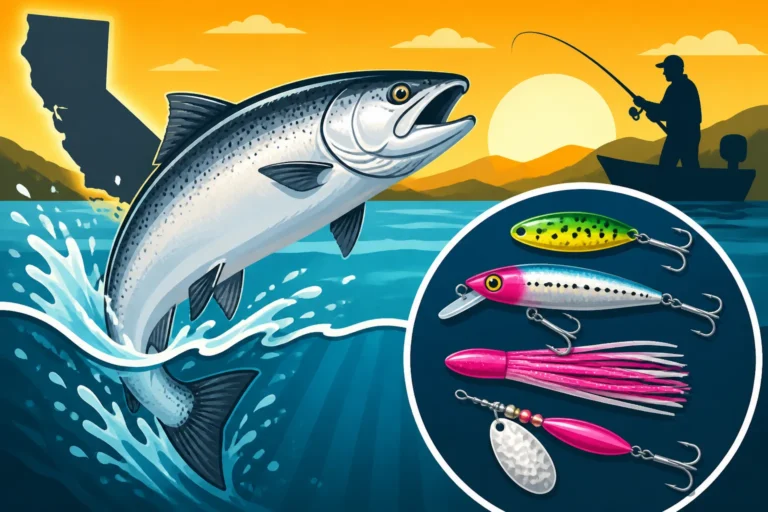
Large spoons are perennial favorites for trolling. Classic options like the "Krocodile" spoon, various Luhr Jensen models, or the bigger "Daredevle" spoons in chrome, blue/silver, or clown patterns are very effective. These lures have a wobbling action that mimics an injured baitfish. Stickbaits, such as Rapala "Deep Divers" or J-13 Rapalas, in natural colors like silver/black or perch, also produce well, especially when trolled at faster speeds. These dive deep and have a tight wiggle that appeals to hungry Lakers. You can find a huge selection of these specific lures on Amazon, making it easy to stock up before your trip. For more targeted advice on what to throw, check out our guide on Best Baits and Lures for Lake Trout in California.
When jigging, heavy jigs are necessary to get down to the depths quickly. Metal jigs ranging from 1 to 4 ounces, sometimes even heavier, are common. Jigging spoons like the "Crippled Herring" or blade baits can be highly effective. Tip these jigs with a piece of anchovy, mackerel, or even a small plastic grub for added scent and appeal. Live bait, when allowed, is often irresistible. Large minnows, shiners, or even small Kokanee salmon (check local regulations carefully before using game fish as bait) can be deadly when slow-trolled or still-fished on a drop-shot rig near the bottom.
Specialized Equipment for Deep Water
Reaching Lake Trout in their deep-water domain requires more than just a rod and reel. Specialized equipment is almost a necessity for consistent success.
- Downriggers: These devices are perhaps the most crucial tool for deep-water trolling. A downrigger uses a heavy cannonball weight to carry your lure down to a precise, predetermined depth, usually attached to a release clip that snaps free when a fish strikes. This allows you to present your lure exactly where the fish are holding, without adding weight directly to your fishing line that would dampen the fight.
- Lead Core Line: As mentioned, lead core line is an alternative to downriggers. It's a specialized line with a lead core and a braided outer sheath. Each color segment (typically 10 yards) adds a certain amount of depth. By letting out a specific number of colors, you can achieve a desired depth, though it's less precise than a downrigger.
- Fish Finders/Sonars: A high-quality fish finder is indispensable. It not only shows you the depth and bottom contour but also marks fish, bait balls, and underwater structure. Look for units with advanced CHIRP sonar and side-imaging capabilities to get the most comprehensive view of the underwater world. Brands like Humminbird or Lowrance are popular choices and can be found at specialized outdoor retailers or online.
- GPS and Mapping: Modern fish finders often integrate GPS with detailed lake maps. This allows you to mark productive spots, troll precise contours, and return to hot zones. Understanding the underwater topography from a detailed map can be a game-changer for finding those elusive Lakers.
- Planer Boards: While less common for the deepest Lake Trout, inline planer boards can be useful in certain situations, especially when trolling shallower or for covering a wider spread of lures behind the boat.
Mastering Lake Trout Fishing Techniques
Lake Trout fishing is a game of depth and precision. The techniques revolve around getting your presentation down to where these cold-loving fish reside and then making it irresistible.
Trolling for Deep-Water Giants
Trolling is arguably the most popular and effective method for targeting Lake Trout in California's deep lakes. It allows you to cover vast amounts of water and present lures at consistent depths. The art of successful trolling involves several key factors:
Firstly, depth control is paramount. Lake Trout often congregate along specific thermoclines or near underwater structure. Use your fish finder to locate schools of baitfish or marks of larger fish, and then set your downriggers to put your lures right in that zone. It's not uncommon to fish depths between 60 and 200 feet, sometimes even deeper. Adjust your downrigger weights and setback distances to fine-tune your presentation.
Secondly, speed and pattern matter. A typical trolling speed for Lake Trout is relatively slow, usually between 1.5 to 2.5 miles per hour. However, it's always wise to experiment. Sometimes a slight increase or decrease in speed can trigger a strike. Trolling in S-turns or along contours rather than in straight lines can also be more effective. When your boat turns, your lures on the inside and outside of the turn speed up or slow down, and their depth changes slightly, creating an erratic action that often provokes a chase. This variation can be key to triggering a bite.
Finally, lure selection and presentation go hand-in-hand. Match the hatch, meaning use lures that resemble the baitfish available in that particular lake. Larger spoons, stickbaits, or even dodgers and flashers trailed by a small fly or squid imitation are all popular choices. Ensure your lures are running true and clean, as a spinning or fouled lure will rarely get a strike. It takes patience and meticulous attention to detail, but the reward of a screaming reel is absolutely worth it. This deep dive into California Trout Fishing Techniques has even more insights.
Vertical Jigging in the Depths
While trolling covers horizontal territory, vertical jigging is about pinpoint accuracy, often over marked fish or distinct underwater structure. This method is incredibly effective when fish are concentrated in specific areas, such as over a rock pile, a sunken island, or along a sharp drop-off.
The technique involves dropping a heavy jig directly down to the fish's depth. Once it reaches the desired depth, you work the jig by lifting your rod tip sharply a foot or two, then letting it flutter back down on a semi-slack line. The idea is to imitate an injured or dying baitfish. Pay close attention on the fall, as many strikes occur as the lure descends. Sometimes a steady retrieve with a subtle jigging motion is all it takes, while other days, aggressive snaps and long pauses are necessary.
Using your fish finder to position your boat directly over the fish or structure is vital. When you see a "mark" on your screen, drop your jig right to that depth. Feel for any tap, twitch, or unusual resistance, as Lake Trout bites can sometimes be very subtle, especially in deep, cold water. Sometimes, just holding the jig perfectly still at the right depth for an extended period, known as dead-sticking, can tempt a wary laker.
Optimal Seasons and Conditions for Lake Trout
Lake Trout are creatures of comfort when it comes to temperature. Their preferred water temperature ranges from about 40 to 55 degrees Fahrenheit. This dictates their behavior and where you'll find them throughout the year.
Year-Round Opportunities and Seasonal Shifts
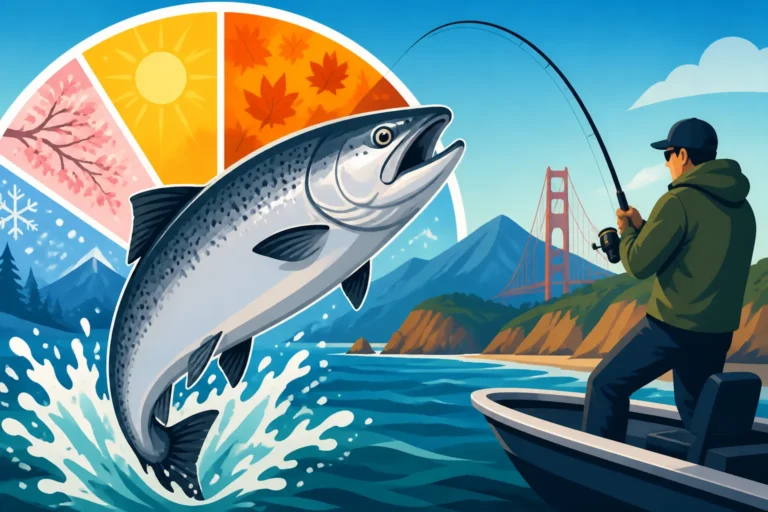
One of the great things about Lake Trout is that you can pursue them year-round in California's deep waters, though your tactics will change significantly with the seasons.
- Spring (March-May): As surface waters begin to warm, Lake Trout may move into slightly shallower depths, sometimes as "shallow" as 30-60 feet, particularly if there are large baitfish schools present. This can be a fantastic time for aggressive trolling with spoons and stickbaits. The fish are often hungry after winter and actively feeding.
- Summer (June-August): This is when Lake Trout go deep. Really deep. They'll retreat to the colder, oxygen-rich waters typically found at 80-200 feet or more. Downriggers become essential, and precise depth control is paramount. Early mornings and late evenings might see them rise slightly in the water column, but generally, expect to fish the abyss. Our article on Best Season to Catch Lake Trout in California offers a deeper dive into these seasonal patterns.
- Fall (September-November): The fall turnover, when surface waters cool and mix with deeper layers, can sometimes bring Lake Trout up shallower again, especially as they prepare for spawning. This can be another excellent trolling period, and jigging can also be very effective. Spawning typically occurs in late fall over rocky shoals and reefs.
- Winter (December-February): Ice fishing is a popular method for Lake Trout in frozen lakes like Donner Lake or some high Sierra lakes (where ice conditions allow and are safe). When open water fishing, they remain deep, similar to summer patterns, but may be slightly less active. Vertical jigging through the ice or slow trolling with downriggers in open water areas are the go-to techniques.
Best Time of Day and Weather Considerations
While Lake Trout are often deep, there are still optimal times within a day and certain weather conditions that can improve your chances.
- Time of Day: Early mornings, from dawn until about 10 or 11 AM, and late afternoons, from around 4 PM until dusk, are generally considered prime times. During these periods, light penetration into the deep water is lower, and baitfish are often more active, leading to more predatory behavior from the Lakers. However, given their deep-water habits, they can bite throughout the day, especially if you're consistently presenting your lure at the right depth.
- Weather: Overcast days or periods of light rain can sometimes trigger more active feeding, as the reduced light levels make the fish feel more secure and less visible to aerial predators. Stable weather patterns are usually better than rapidly changing conditions. Strong winds can make boat control and deep-water presentations challenging, so calmer days are often preferred. Pay attention to barometric pressure; a falling barometer can sometimes signal an impending bite, though this is debated among anglers.
Navigating California's Lake Trout Regulations
Even the most seasoned angler can get tripped up by regulations, and fishing in California, especially for specific species like Lake Trout, requires careful attention to the rules set by the California Department of Fish and Wildlife (CDFW). Ignorance is no excuse, and fines can be steep.
Licenses, Limits, and Special Rules
First and foremost, you absolutely need a valid California fishing license to fish for Lake Trout in any public water. This applies to both residents and non-residents, and there are different options available, from annual licenses to short-term options like a California Two-Day Fishing License. Make sure your license is current and always carried with you. You can purchase one online through the CDFW website or from licensed vendors. For a complete overview, consult our California Fishing License Guide.
Specific regulations for Lake Trout (Mackinaw) often involve bag limits and size limits. These can vary not only by species but also by the specific body of water. For example, Lake Tahoe might have different rules than Donner Lake or other reservoirs. It's crucial to check the most current CDFW Sport Fishing Regulations booklet, which is updated annually. You can usually find a copy online or at any tackle shop. For instance, in Lake Tahoe, the general statewide trout limits typically apply, but always double-check. The California Trout Limits and Regulations article is a great starting point, but always verify with the official CDFW regulations for your specific fishing location.
Beyond general limits, there might be special regulations for certain waters regarding gear restrictions (e.g., barbless hooks, specific bait limitations) or seasonal closures, although Lake Trout fisheries are often open year-round due to their non-native status. Always read the specific regulations for the lake you plan to fish to avoid any unpleasant surprises.
Catch and Release vs. Keeping Your Catch
Lake Trout are excellent table fare, with firm, orange-pink flesh, especially those from cold, clear waters like Tahoe. If you plan to keep your catch, ensure you adhere strictly to the bag and size limits. It's a good idea to have a cooler with ice readily available in your boat to properly care for any fish you intend to eat, preserving their quality.
However, many anglers, especially those targeting larger, older fish, practice catch and release. Trophy Lake Trout can be decades old, and releasing them ensures they can continue to contribute to the fishery. If you're practicing catch and release, especially for deep-caught fish, certain precautions are necessary:
- Minimize Handling: Touch the fish as little as possible. Wet your hands before handling to protect its slime coat.
- Rapid Release: Get the fish back in the water quickly. Excessive time out of water reduces its survival chances.
- De-hooking Tools: Use long-nosed pliers or a de-hooker to quickly remove hooks. If the fish is deeply hooked, it's often better to cut the line as close to the hook as possible rather than tearing sensitive tissue.
- Fizzing (for pressure changes): Fish brought up from extreme depths can suffer from barotrauma (swim bladder expansion). If a fish cannot swim back down on its own, some experienced anglers use a technique called "fizzing" to release gas from the swim bladder. This is a delicate procedure that, if done incorrectly, can harm the fish, so only attempt it if you are properly trained. Otherwise, it's generally best to release the fish quickly and hope for the best, or consider keeping it if regulations allow.
Responsible angling means understanding both the legal requirements and the ethical considerations for the health of the fishery. By staying informed through resources like the California Freshwater Fishing Regulations and practicing careful handling, we can all contribute to sustainable Lake Trout fishing for years to come.
Top California Lake Trout Destinations & Tactics
To bring it all together, let's look at some key details for the premier Lake Trout locations in California.
| Lake | Primary Location | Key Depths (approx.) | Common Techniques | Recommended Lures/Baits | Best Season | Key Regulations (always verify) |
|---|---|---|---|---|---|---|
| Lake Tahoe | Eastern Sierra | 80-300+ feet | Deep Trolling, Jigging | Large Spoons, Stickbaits, Anchovy | Year-round | Check CDFW for specific limits |
| Donner Lake | Truckee Area | 60-200 feet | Trolling, Jigging | Spoons, Fickle Fish, Minnows | Spring, Fall, Winter (ice) | Check CDFW for specific limits |
| Stampede Res. | Truckee Area | 50-150 feet | Trolling, Jigging | Spoons, Tubes, Live Bait | Spring, Fall | Check CDFW for specific limits |
Note: Always consult the current California Department of Fish and Wildlife (CDFW) regulations booklet for the most up-to-date and specific rules for each body of water before heading out.
Disclaimer
Fishing regulations, conditions, and fish behavior can change rapidly. The information provided in this guide is for general informational purposes only and should not be considered legal advice. Always consult the most current official California Department of Fish and Wildlife (CDFW) regulations booklet and local advisories before engaging in any fishing activities. Adhere to all licensing requirements, bag limits, and size restrictions. Practice safe boating and fishing techniques, and prioritize your personal safety and the well-being of the fish.