How to Troll for Kokanee in California
There's nothing quite like the thrill of a kokanee salmon tugging on your line, especially when you've put in the effort to seek out these elusive, silver-sided beauties in California's clear, deep waters. Many anglers find themselves scratching their heads, wondering why these landlocked sockeye can be so finicky, especially when trying to pinpoint their preferred depth and lure. This guide is dedicated to demystifying the art of trolling for kokanee in California, breaking down the gear, techniques, and local insights you need to turn those frustrating outings into triumphant catches.
The Allure of Kokanee: Why These Silver Streaks Captivate Anglers
Kokanee salmon fishing isn't just about catching fish; it's about the serene beauty of California's mountain lakes, the strategic dance of boat control, and the rewarding fight of a fish known for its spirited acrobatics. These fish might be small, but their cunning and delicious pink flesh make them a prized target.
What Makes Kokanee So Special and Tricky to Catch
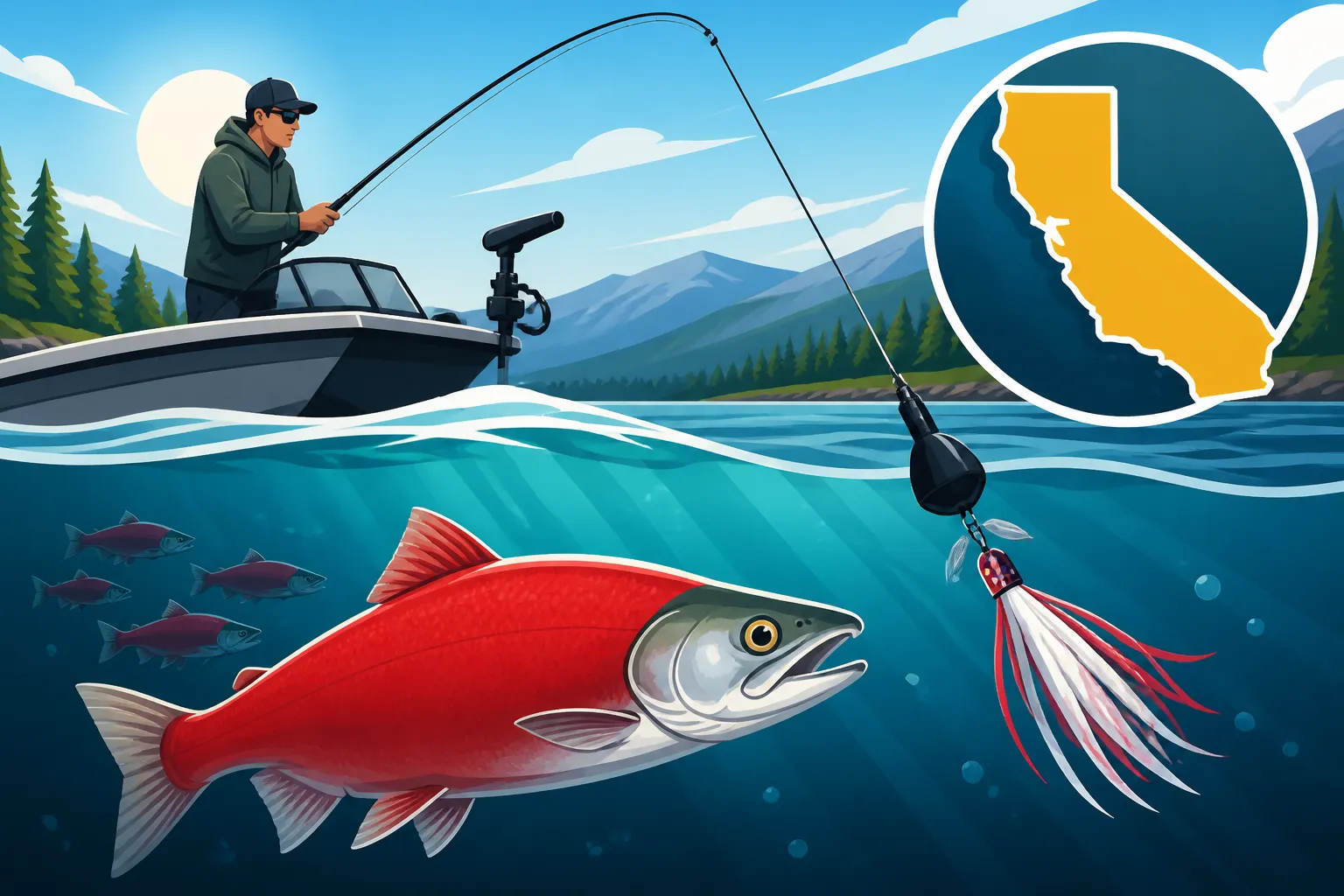
Kokanee salmon, essentially landlocked sockeye salmon, are a unique freshwater species in California. Unlike their anadromous ocean-dwelling cousins, they spend their entire lives in freshwater lakes and reservoirs. This distinction plays a huge role in understanding their behavior. They primarily feed on zooplankton, tiny microscopic organisms that drift in the water column. This diet means they aren't attracted to typical fish baits like worms or minnows, but rather to lures that mimic these small food sources or simply irritate them into striking. Their mouths are also incredibly delicate, which means a gentle touch is needed both when they bite and when you're reeling them in.
Their lifecycle is quite fascinating too. Most kokanee in California live for about four years, growing steadily before they undertake a spectacular spawning run, usually in the fall. During this period, their silver bodies turn a vibrant red, and the males develop a distinct hooked jaw (kype). Knowing this helps you understand why they might be at certain depths or behaving a particular way throughout the year. They're not always aggressively feeding, and sometimes you're triggering a reaction strike more than a hunger strike, which adds to the challenge.
Where to Find California's Best Kokanee Action
California is blessed with a fantastic array of lakes and reservoirs that hold healthy populations of kokanee. These fish thrive in cold, deep, and clear waters, often where other trout species also reside. Some of the most renowned spots include Lake Pardee in the Sierra Nevada foothills, a true gem famous for its trophy kokanee. Then there's Stampede Reservoir near Truckee, another popular locale known for consistent action. Further south, you'll find excellent opportunities at New Melones Lake, where kokanee have found a great home in the deep canyons. Lake Berryessa offers a more accessible option for many Northern California anglers, while the vast expanse of Lake Tahoe boasts some of the largest, albeit deepest, kokanee in the state. Other notable mentions include Trinity Lake, Union Valley Reservoir, and Don Pedro Reservoir.
The key to finding kokanee in these lakes often lies in understanding their seasonal movements. In colder months, they might be closer to the surface or in shallower coves as the entire water column is cool. However, as summer progresses and the surface waters warm, they'll retreat to the thermocline – that invisible boundary layer where warm surface water meets colder deep water. This layer is usually rich in the zooplankton they feed on and provides the ideal temperature. Knowing the lake's topography and where deep channels or submerged structures are located can also point you in the right direction, as these areas often hold baitfish and, consequently, kokanee. For a broader overview of the state's prime fishing spots, you might want to check out our guide on the Best Lakes to Fish in California.
Gearing Up for Kokanee Trolling Success
Trolling for kokanee is a specialized discipline, and having the right gear isn't just a suggestion—it's practically a requirement. These fish are notorious for their light bites and delicate mouths, meaning your tackle needs to be finely tuned to detect them and then fight them effectively without losing them.
The Right Rod, Reel, and Line for the Delicate Dance
When it comes to kokanee, sensitivity is the name of the game. You're looking for a rod that can telegraph even the slightest tick or change in pressure from a shy kokanee. A light to ultra-light action rod, typically between 6 feet 6 inches and 7 feet 6 inches in length, with a very sensitive tip, is ideal. Fiberglass or a composite blend often works well because it offers a bit more forgiveness than pure graphite, which can be too stiff and lead to pulled hooks. A moderate action is preferred, allowing the rod to bend further down the blank, absorbing the head shakes and sudden surges of a hooked kokanee. Brands like Lamiglas and Berkley make rods specifically designed for kokanee and trout trolling.
For reels, a small, smooth spinning reel or a low-profile baitcasting reel with a reliable drag system is perfect. The key here is consistency and a smooth payout. A line counter reel is a huge bonus, especially when you're trying to replicate a successful depth or experiment with different presentations. Speaking of lines, your main line can be either monofilament, fluorocarbon, or braided line. Many seasoned kokanee anglers opt for braided line (like 10-15 lb test) for its incredible sensitivity and zero stretch, allowing them to feel those subtle bites. However, braid is highly visible, so you must use a fluorocarbon leader. A 4-8 lb test fluorocarbon leader is typically used, as it's nearly invisible underwater and has excellent abrasion resistance. For those who prefer a simpler setup, a good quality 6-8 lb monofilament main line works, but you'll sacrifice some sensitivity. You can find a wide range of these specialized rods, reels, and lines on platforms like Amazon, often at competitive prices.
The Depth-Defying Duo: Downriggers and Lead Core
Getting your lure to the exact depth where kokanee are feeding is paramount, and this is where depth control methods become invaluable. The most effective tool for precise depth control is a downrigger. A downrigger allows you to precisely position your lure at a specific depth using a heavy cannonball weight. Your fishing line is clipped to the downrigger release, and when a fish bites, the line pops free, allowing you to fight the fish directly without the weight. This precision is crucial when kokanee are holding in a tight band in the water column, perhaps right on the thermocline. Electric downriggers are incredibly convenient, especially for solo anglers or those who want to quickly adjust depths. Manual downriggers are also perfectly effective and a more budget-friendly option.
An alternative or supplementary method is lead core line. This specialized fishing line has a lead core encased in a braided nylon sheath, causing it to sink. Each "color" of lead core (usually 10 yards per color) sinks to a predictable depth at a given trolling speed. For example, at 1.5 mph, 1 color might get you down 5-7 feet, 5 colors around 25-35 feet, and so on. The main advantage of lead core is its simplicity—no extra gear mounted to your boat. The downside is that it's not as precise as a downrigger for fine-tuning depth, and you're fighting the weight of the line along with the fish. Other methods like diving planes (e.g., Dipsy Divers) or snap weights can also be used, but downriggers offer the ultimate in control and efficiency for kokanee. A reel with a good line counter is essential for consistently deploying lead core or weighted lines to known depths.
| Depth Control Method | Pros | Cons | Ideal Use |
|---|---|---|---|
| Downriggers | Precise depth control; line pops free for direct fight; can stack multiple lines; easy depth adjustments. | Requires boat mounting and power (for electric); initial cost; can be bulky; needs careful setup to avoid tangles. | When kokanee are holding at very specific depths or when precise targeting is critical. |
| Lead Core Line | Simple, no extra boat equipment; stealthy presentation (no cannonball); good for wider depth ranges. | Less precise depth control (depth depends on speed/amount of line); fights the weight of the line; slower to retrieve; more difficult to change depths quickly. | When fish are scattered across a broader depth range or for shallower trolling without bulky equipment. |
| Diving Planes | Relatively simple, no boat mounting needed; can get lures down quickly without heavy weights. | Less precise depth control than downriggers; can be bulky to handle; fighting resistance from the diver itself. | For moderate depths and when a downrigger isn't feasible or desired. |
| Snap Weights | Very versatile, can be added or removed easily; allows quick depth changes on existing lines. | Not as precise as downriggers; additional weight on the line can dampen strike detection. | For minor depth adjustments or adding weight to shallow-running lures. |
Lures, Dodgers, and the Scent Factor
Kokanee are attracted by flash, vibration, and scent. This trifecta is key to designing an effective trolling setup.
Lures: You'll want an assortment of small, bright lures. Popular choices include mini-hoochies (small squid skirts), wedding rings, and mini-plugs (like Luhr Jensen Kwikfish size K4/K5). Brands like Shasta Tackle Company's "Kokanee Killers" and Vance's Tackle "Tuff-E-Nuff" lures are staples in many kokanee anglers' tackle boxes. Color can vary daily, so having pink, orange, chartreuse, and natural silver/blue combinations is a good idea. Experimentation is crucial!
Dodgers and Flashers: These aren't just for looks; they serve a vital purpose. Dodgers and flashers create vibration and a flash of light that attracts kokanee from a distance. They also impart an erratic, enticing action to your trailing lure. Dodgers (like those from Sep's Pro Fishing and Vance's Tackle) have a wide, side-to-side wobble, while flashers (e.g., sling blade flashers) rotate. The size of your dodger should match the size of your lure—a general rule of thumb is to use a smaller dodger for smaller lures. Again, having a variety of colors (silver, gold, pink, chartreuse) is essential for matching the conditions.
Scent: This is arguably the most critical component. Kokanee rely heavily on their sense of smell. Since their natural diet is zooplankton, scents that mimic this or simply appeal to their olfactory senses are incredibly effective. Pro-Cure, Pautzke's Krill Juice, and Mike's Glo Scent are top choices. These come in various flavors like garlic, anises, krill, and corn. Liberally apply scent to your lure and any bait you're using. Reapply frequently, especially after catching a fish or if you haven't had a bite in a while. You can find all these specialized kokanee lures, dodgers, and scents from various brands on Amazon, allowing you to build up a diverse tackle box ready for any conditions.
Mastering the Art of Kokanee Trolling
Once you have your gear ready, it's time to put it to use. Trolling for kokanee isn't just about dragging a lure behind a boat; it's a nuanced dance of speed, depth, and presentation.
Speed, Depth, and Stealth: The Trolling Triangle
Finding the right trolling speed for kokanee is often a delicate balance. Generally, slower is better. Most kokanee are caught trolling between 0.8 and 1.5 miles per hour. However, don't be afraid to experiment. Sometimes a slightly faster or slower speed can trigger a bite on a particularly finicky day. The right speed will make your dodger and lure "work" correctly, giving them their intended action.
Depth control, as we've discussed, is paramount. Kokanee often suspend in schools at specific depths, particularly along the thermocline. A good fish finder is your best friend here. Watch for arches or clouds of baitfish (which kokanee feed on) and adjust your downrigger or lead core accordingly. It's not uncommon to find them anywhere from 15 feet down to 80 feet or even deeper, depending on the lake and time of year. For instance, in mid-summer at Lake Tahoe, they might be incredibly deep, while in spring at Lake Berryessa, they could be shallower. To cover more water and test different depths, employ S-turns or zigzag patterns with your boat. This varies the speed and depth of your lures on the inside and outside of the turn, often triggering strikes from hesitant fish. Maintaining stealth is also important; loud boat motors can spook these sensitive fish, so consider using an electric trolling motor if available.
Rigging Your Lures for Irresistible Appeal
Proper rigging is crucial for kokanee. For hoochies and wedding rings, a common setup involves a dodger followed by a short leader (typically 8 to 18 inches) to the lure. The leader length is key: too short, and the lure won't have enough action from the dodger; too long, and it might get tangled. Experimentation here is highly recommended. The leader should be 4-8 lb fluorocarbon, tied directly to the lure.
When it comes to bait, shoepeg corn is the undisputed champion for kokanee. Its buoyant nature helps keep the lure suspended, and its subtle flavor and texture are irresistible. Many anglers dye their corn various colors (chartreuse, pink, red) using commercial dyes or even Kool-Aid. You can also use maggots, small pieces of shrimp, or a combination. The "pop" of the corn on the hook is often what seals the deal—it provides visual appeal and helps disperse scent. Use one or two kernels of corn on a small, sharp hook (size 4 or 6 octopus hooks are common). Thread the corn so it sits naturally and doesn't impede the lure's action. Remember, a fresh application of scent to your corn and lure every 15-20 minutes can make a significant difference.
Reading the Water and Adjusting Your Strategy
Your sonar (fish finder) is an invaluable tool. It’s not just for seeing fish; it helps you understand the entire underwater environment. Look for the thermocline, bait balls (which often appear as large, dense clouds), and any underwater structure like submerged trees or rock piles where kokanee might be holding. If you see fish at a certain depth, make sure your lures are running right at or slightly above that level.
Water conditions also play a big role. On bright, sunny days, kokanee might prefer deeper water and subtler colors, while on overcast days, they might rise higher in the water column and be more attracted to brighter, more aggressive colors. Wind and current can affect your trolling speed and depth, so be prepared to make constant adjustments to keep your lures in the strike zone. If one color or depth isn't working after a reasonable amount of time (say, 30 minutes), don't be afraid to change it up. Often, a subtle change in lure color, dodger size, or scent can turn a slow day into a productive one. Understanding the different California Fishing Seasons: Month-by-Month Guide can also help predict fish behavior throughout the year.
Troubleshooting and Common Kokanee Conundrums
Even the most experienced kokanee anglers have days when these fish seem to vanish or refuse to bite. It's part of the challenge, but understanding how to troubleshoot can save a trip from being a bust.
The Faint Nibble: Detecting Those Elusive Bites
One of the most frustrating aspects of kokanee fishing is their incredibly light bite. Unlike a hard-hitting bass or a thrashing trout, a kokanee often just "nips" at the lure. This can manifest as a slight twitch of your rod tip, a momentary cessation of the dodger's vibration, or even just a subtle slackening of your line. This is where the sensitivity of your rod and line (especially braided line with a fluorocarbon leader) truly shines.
It requires constant vigilance and concentration. Keep your eyes glued to your rod tip. If you see any unusual movement, or if the rhythm of your dodger's pull feels different, assume it's a bite. Don't set the hook like you're trying to yank a tree stump out of the ground. Instead, sweep the rod smoothly and firmly upwards, applying steady pressure. Because their mouths are so delicate, a gentle yet firm hookset is usually all it takes. Once hooked, maintain constant pressure but avoid horsing the fish in, as this often leads to pulled hooks or torn mouths.
When the Bite Goes Cold: Adapting to Finicky Fish
There are days when you've done everything right—you're at the right lake, at the right time of year (perhaps during the Best Times to Fish in California), and you've followed all the advice—but the kokanee just aren't biting. This is when adaptability becomes your greatest asset.
First, re-evaluate your depth. Even a change of 5-10 feet can make all the difference. Sometimes they're above the main school, sometimes below.
Second, change your speed. Try slowing down to a crawl (0.5 mph) or speeding up slightly (1.8 mph). This can alter the action of your dodger and lure just enough to trigger a strike.
Third, cycle through your lure colors and styles. If pink isn't working, try orange or green. If hoochies are failing, switch to a wedding ring or a small plug. Don't be afraid to try combinations you haven't used before.
Fourth, refresh your scent. Even if you just put it on, a fresh burst of garlic or krill juice can sometimes wake up a dormant bite. If you're fishing with multiple rods (where permitted), use different setups on each rod until you find what's working. This trial-and-error process is fundamental to kokanee fishing. Persistence often pays off, and sometimes waiting out a slow period, or even moving to a different section of the lake, is the best strategy.
Staying Legal and Responsible
California has a rich and diverse fishery, and protecting it is everyone's responsibility. Before you even launch your boat, always ensure you have a valid California fishing license. You'll also want to thoroughly review the current regulations for the specific body of water you're fishing. Kokanee bag limits and size limits can vary by lake and season, so what's legal at Lake Pardee might be different at New Melones Lake. These regulations are in place to ensure sustainable fish populations for future generations of anglers. You can find comprehensive details in our California Fishing Regulations Explained and more specific information in the California Freshwater Fishing Regulations. It's always a good idea to consult the annual California Freshwater Sport Fishing Regulations booklet, or even better, check the California Department of Fish and Wildlife (CDFW) website for the most up-to-date information. Understanding how to interpret this resource is covered in our How to Read the California Fishing Regulations Booklet guide.
Responsible angling also means practicing proper fish handling. Kokanee are delicate fish. If you plan to release them, do so quickly and carefully, minimizing their time out of the water. If you're keeping them, dispatch them humanely and get them on ice as soon as possible to preserve their quality.
Disclaimer
Please be aware that fishing regulations in California can change frequently. Always consult the latest official regulations from the California Department of Fish and Wildlife (CDFW) before heading out on any fishing trip. This guide is for informational purposes only and does not supersede state or local fishing laws.