California Rockfish Species Identified
Oh, the humble rockfish! If you’ve spent any time at all fishing the diverse waters of California, you know the feeling. You reel up a beautiful fish, often vibrant in color, and immediately think, "Okay, what kind of rockfish is this?" It’s a moment of truth that can quickly turn into a head-scratcher because, let's be honest, many of them look incredibly similar, especially to the untrained eye. Getting it wrong isn't just a matter of curiosity; it can mean the difference between a legal catch and a violation. This guide is here to untangle the often-confusing world of California rockfish identification, helping you confidently know what you've landed.
The Rockfish Conundrum: Why Identification is So Tricky
There's a reason why even seasoned anglers sometimes pause when a new rockfish hits the deck. California's waters are home to an astounding variety of these bottom-dwelling beauties, and their subtle differences can be incredibly hard to spot at a glance. You’re not alone if you’ve felt the frustration of pulling up what looks like yet another "red fish" or "brown fish" and wondering if it’s legal to keep.
The Sheer Diversity and Similarities
The genus Sebastes, which encompasses rockfish, is one of the most speciose groups of marine fish in the world, with over 100 species found in the North Pacific alone. California boasts a significant portion of this diversity. Imagine a family reunion with 60 cousins who all share very similar facial features but have slightly different quirks. That's essentially what you're dealing with when identifying rockfish.
For instance, you might catch a Vermilion Rockfish and then, a few drops later, a Bocaccio. Both are reddish, both have large mouths, and both are highly sought after. But their bag limits, and sometimes even their seasons or depth restrictions, can be very different. The pressure to correctly identify your catch is real, especially when facing strict California Fishing Regulations Explained that vary by species, size, and even location. It's not just about bragging rights; it's about adherence to the rules that protect these valuable fisheries for everyone.
The Importance of Knowing Your Catch
Beyond satisfying your angler's curiosity, accurate rockfish identification is paramount for several critical reasons. First and foremost, regulations. The California Department of Fish and Wildlife (CDFW) sets specific rules for different rockfish species. This includes things like California Rockfish Bag Limit Explained (how many you can keep), California Rockfish Size Limit Explained (how big they need to be), and even specific seasons or depth restrictions, like the California Rockfish Depth Restrictions that apply to certain areas. Misidentification can easily lead to an accidental violation, which no one wants.
Secondly, conservation efforts rely on accurate data. Anglers who accurately identify and report their catches (even if not formally required for every species) contribute to a better understanding of fish populations and health. This helps biologists manage the fishery sustainably. Finally, it just makes you a better, more informed angler. Knowing what you're catching helps you understand their habits, preferred baits, and even how best to handle them for release or consumption. It deepens your connection to the sport and the marine environment.
Key Features for Rockfish Identification
Alright, let's get down to the nitty-gritty. While rockfish can be tricky, they do have distinct characteristics if you know where to look. Think of yourself as a detective, searching for clues on the fish's body. These aren't always glaringly obvious, but they are there!
Color Patterns and Markings
This is often the first thing people notice, and while it's a good starting point, it can also be misleading. Many rockfish share similar base colors – reds, browns, blacks, and even greens. However, the patterns, markings, and intensity of these colors can be key differentiators.
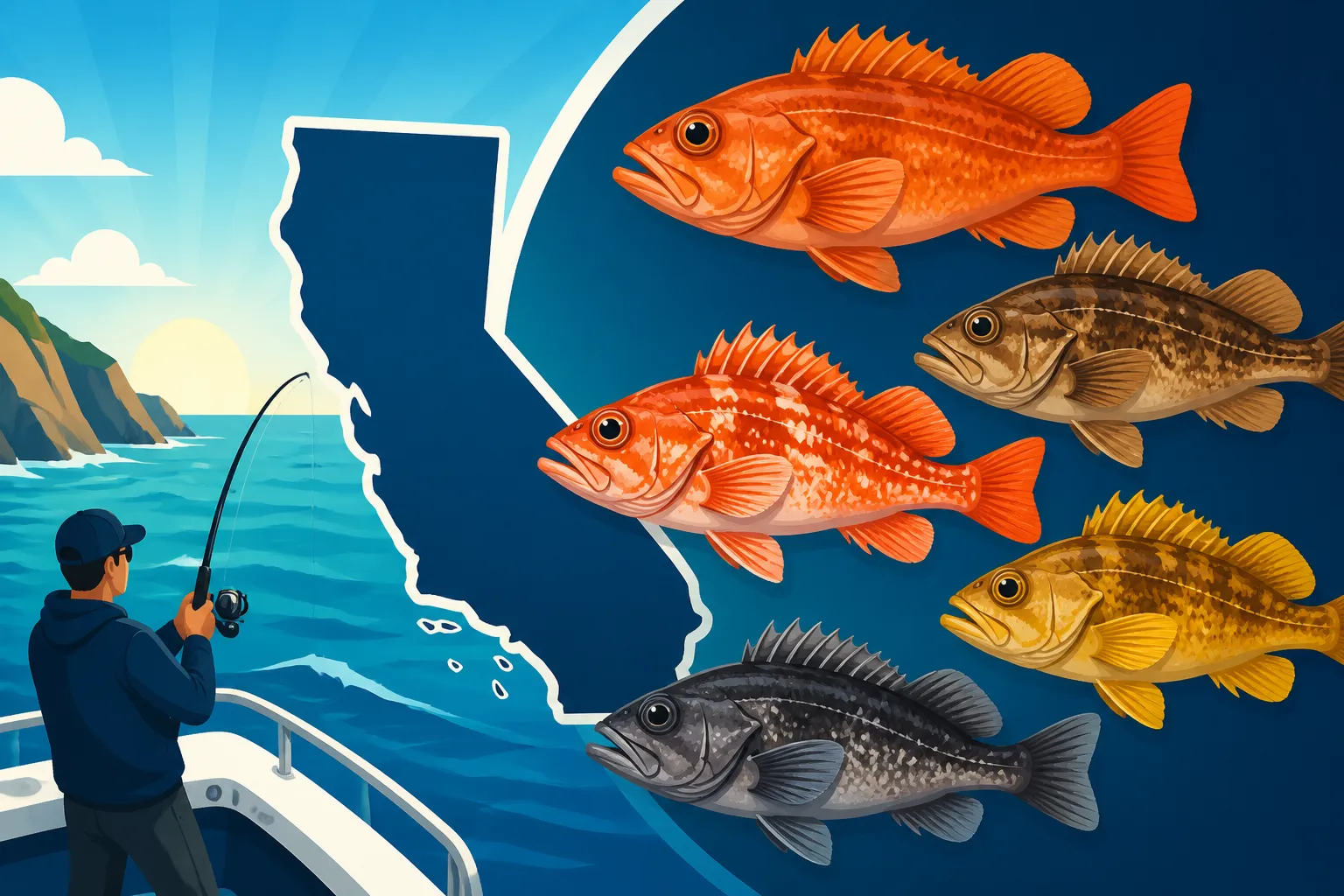
Take the Canary Rockfish, for example. It's usually a bright orange to yellow-orange with three distinct orange stripes across its head, and often has a pale, almost white lateral line. Contrast that with a Vermilion Rockfish, which is a vivid, uniform orange-red, usually without those distinct head stripes. Then there's the Copper Rockfish, which lives up to its name with a mottled coppery-brown body, often with lighter patches and a distinctive light blotch on its side below the dorsal fin. Some species, like the Black Rockfish, are almost uniformly dark, while others, like the Grass Rockfish, have disruptive green and brown patterns to blend in with kelp. Pay close attention to stripes (how many, where they run), blotches (shape, location), and the general uniformity or mottling of the color. A good waterproof field guide you can get from a place like Amazon can be invaluable here, as it provides clear illustrations or photos for comparison right on the boat.
Fin Spines and Ray Counts
This is where things get a bit more technical, but it's often the most reliable way to tell certain species apart, especially when color can vary due to depth, stress, or individual variation. Rockfish have spiny dorsal fins, and counting those spines (and sometimes the soft rays behind them) can be a definitive identifier.
For instance, the Bocaccio (meaning "big mouth" in Italian, a clue in itself!) typically has 13 dorsal fin spines and 13-15 soft rays. Compare that to a Chilipepper Rockfish, which has a similar reddish-pink hue but generally has 13 dorsal spines and 12-14 soft rays. These subtle differences matter. You'll need to be careful when counting, as those spines are sharp! Also, look at the anal fin spines and the pectoral fin rays. Are they branched or unbranched? How many are there? This level of detail is usually found in a comprehensive California Fishing License Guide or the specific regulations booklet, often providing species-specific spine and ray counts that act as irrefutable evidence.
Jaw and Eye Characteristics
The head of a rockfish offers a treasure trove of identification clues. The size and shape of the jaw, the presence of various spines on the head, and even the size and position of the eyes can be crucial.
Consider the Copper Rockfish again; it has a relatively small mouth. Now, look at a Lingcod, which, while not a true rockfish, is often caught in the same habitats and shares some physical traits. A Lingcod has an enormous mouth, packed with needle-sharp teeth. Back to rockfish: does the lower jaw protrude beyond the upper jaw? This is a key feature for species like the Blue Rockfish, which also often has a characteristic blue-gray coloration and a relatively small mouth. Other rockfish, like the Canary, have an upper jaw that extends slightly beyond the lower. Furthermore, check for spines on the head – on the preopercle (the bone in front of the gill cover), opercle (gill cover), and even above the eyes. Some rockfish, like the Thornyhead, are absolutely covered in prominent spines, giving them a very distinctive, almost prehistoric look. The size of the eyes relative to the head can also be telling, especially for deep-water species which often have disproportionately large eyes to gather what little light penetrates the depths.
Common California Rockfish Species and Their Hallmarks
California's rockfish scene is diverse, but a handful of species are regularly encountered by anglers. Getting familiar with these will give you a huge leg up in identification. Let's group them by their general appearance, keeping in mind that colors can vary.
The "Red" Rockfish Group
This is probably the most confusing group because so many rockfish are some shade of red, orange, or pink. But pay attention to the subtleties!
-
Vermilion Rockfish (Sebastes miniatus): Often called "red snapper" by anglers (though it's not a true snapper!), this fish is a vibrant orange-red to vermilion, typically with irregular dark blotches on its back and sides. A key identifier is a patch of rough scales on the lower jaw. They have a relatively large mouth. You'll find them in rocky reefs, often from shallow depths down to several hundred feet.
- Habitat & Behavior: These are bottom dwellers, preferring hard, rocky structures. They're often caught near the bottom with baits or jigs. They're a favorite target for many boat anglers due to their size and delicious flesh.
- Look-alikes: Bocaccio and Canary Rockfish. Vermilions tend to be a deeper, more uniform red than the Bocaccio, and lack the distinctive head stripes of the Canary. Their lower jaw scales are a strong clue.
-
Bocaccio (Sebastes paucispinis): Meaning "big mouth," the Bocaccio is typically reddish-brown on the back, fading to pinkish-red on the belly. They have a noticeably elongated, torpedo-like body and, true to their name, a very large mouth that extends past the eye. Their scales are relatively smooth compared to some other rockfish.
- Habitat & Behavior: Bocaccio are often found in mid-water over rocky reefs or pinnacles, but can also be near the bottom. They are active predators, often chasing baitfish. They can grow quite large, making them a prize catch.
- Look-alikes: Vermilion Rockfish and Chilipepper Rockfish. Bocaccio are generally more slender than Vermilions and lack the Vermilion's characteristic scales on the lower jaw. From the Chilipepper, they can be distinguished by their larger mouth and more uniform reddish coloration, compared to the Chilipepper's more pinkish hue and often mottled appearance.
-
Chilipepper Rockfish (Sebastes goodei): These fish are a beautiful blend of pinkish-red to orange on their back, fading to white or silvery on their belly. They often have a long, slender body, similar to the Bocaccio, but their mouth is smaller, usually ending around the middle of the eye. They also tend to have a slightly pointed snout.
- Habitat & Behavior: Chilipeppers are often found schooling over soft bottoms near rocky areas, especially in deeper waters. They feed on krill and small fish, making them susceptible to sabiki rigs and deep jigs.
- Look-alikes: Bocaccio. The primary difference is the mouth size. If the mouth extends well past the eye, it’s likely a Bocaccio. If it stops around the middle of the eye, it's probably a Chilipepper.
The "Dark" Rockfish Group
These species usually sport shades of black, blue, gray, or olive, often blending in with darker reef structures or deeper water.
-
Black Rockfish (Sebastes melanops): A very common and popular catch, especially in Northern California. These rockfish are typically dark gray to black on their back, fading to lighter gray on their belly, often with a mottled appearance. They have distinct dark spots on their dorsal fins, and their lower jaw usually extends slightly beyond the upper jaw.
- Habitat & Behavior: Found in shallow to moderate depths, often near kelp beds, jetties, and rocky shorelines. They are opportunistic feeders, taking a variety of baits and lures. These are excellent fighting fish and are frequently caught by shore and kayak anglers.
- Look-alikes: Blue Rockfish and Dusky Rockfish. Black rockfish are generally larger and darker than Blue Rockfish, and lack the distinctive blue tint. The spotting on their dorsal fins is a good clue.
-
Blue Rockfish (Sebastes mystinus): As their name suggests, these are typically a deep, uniform blue or bluish-gray, sometimes with vague darker mottling. They have a relatively small mouth, and their lower jaw often slightly protrudes. Their body is somewhat deeper than many other rockfish.
- Habitat & Behavior: Blue rockfish are often found schooling in mid-water over rocky reefs and kelp forests, particularly in shallower to moderate depths. They primarily feed on plankton and small invertebrates.
- Look-alikes: Black Rockfish and Deacon Rockfish. Blue Rockfish are typically smaller and have a more prominent blue coloration than Black Rockfish. In central and northern California, they are often confused with the recently recognized Deacon Rockfish, which is very similar but tends to have a more vivid blue.
-
Olive Rockfish (Sebastes serranoides): These fish are usually olive-green to greenish-brown on their back, with lighter flanks and a white belly. They have a streamlined, bass-like body shape and a relatively small mouth. They often have indistinct bars or blotches on their sides.
- Habitat & Behavior: Olives are found in kelp beds and rocky reefs, often higher in the water column than some other rockfish, ambushing prey. They are aggressive feeders, hitting plastics, jigs, and live bait.
- Look-alikes: Kelp Rockfish and Grass Rockfish. Olive Rockfish are more streamlined and less mottled than Kelp or Grass Rockfish, with a more uniform green-olive hue. Their body shape is a key differentiator.
The "Mottled" or "Speckled" Rockfish Group
This group includes fish with camouflaged patterns, often browns, greens, and grays, designed to blend into rocky or kelpy environments.
-
Copper Rockfish (Sebastes caurinus): A striking and beautiful fish, the Copper Rockfish has a base color that ranges from coppery-brown to olive-brown, with lighter, often whitish, blotches and bands. A very reliable identifying feature is a distinct light-colored patch or stripe below the soft-rayed portion of the dorsal fin, often extending onto the lateral line.
- Habitat & Behavior: Coppers are true bottom-huggers, living in rocky reefs, kelp beds, and even around artificial structures. They are ambush predators and will readily strike jigs, plastics, and live bait.
- Look-alikes: Quillback Rockfish and Gopher Rockfish. The light patch on the side is often the best way to distinguish a Copper from these similar-looking species. Quillbacks have a very high dorsal fin and deep body, while Gophers have distinct yellow spots.
-
Kelp Rockfish (Sebastes atrovirens): Living up to their name, these rockfish are masters of camouflage in kelp forests. Their coloration is typically a mottled mix of dark brown, olive, and greenish patches, perfectly mimicking kelp fronds. They have a deeper body than an Olive Rockfish and often have a distinctive dark band running through the eye.
- Habitat & Behavior: Exclusively found in kelp beds and rocky structures within the kelp zone. They are less prone to being caught on the bottom than many other rockfish, often ambushing prey within the kelp canopy.
- Look-alikes: Grass Rockfish and Olive Rockfish. Kelp rockfish are typically more mottled and chunky than the streamlined Olive Rockfish. They also lack the prominent dark head band often seen on Grass Rockfish.
-
Gopher Rockfish (Sebastes carnatus): These rockfish are often brown to reddish-brown, heavily mottled with lighter, irregular white to yellow blotches. What truly sets them apart are the distinctive bright yellow, or yellowish-white, spots that are usually visible on their back and head.
- Habitat & Behavior: Gophers are typically found in shallow to moderate depths over rocky bottoms, often in association with kelp and other structures. They are smaller than many other rockfish but a beautiful catch.
- Look-alikes: Brown Rockfish and Copper Rockfish. The distinct yellow or whitish spots are the key. Brown Rockfish have a more uniform brown, sometimes with darker spots, but lack the bright yellow found on Gophers.
Here's a quick comparison table for some common California rockfish species:
| Species | Primary Coloration | Key Distinguishing Feature(s) | Typical Habitat Depth |
|---|---|---|---|
| Vermilion Rockfish | Vivid orange-red | Rough scales on lower jaw; irregular dark blotches | Shallow to deep reefs |
| Bocaccio | Reddish-brown to pink-red | Large mouth extending past eye; elongated body | Mid-water over reefs/pinnacles |
| Chilipepper Rockfish | Pinkish-red to orange | Smaller mouth (to middle of eye); often slender | Deeper waters, soft bottoms |
| Black Rockfish | Dark gray to black | Dark spots on dorsal fin; lower jaw slightly protrudes | Kelp beds, rocky shores |
| Blue Rockfish | Deep blue to bluish-gray | Small mouth; uniform blue color; often schooling | Mid-water, kelp/reefs |
| Olive Rockfish | Olive-green to brownish | Streamlined, bass-like body; indistinct bars | Kelp beds, rocky reefs |
| Copper Rockfish | Coppery-brown to olive | Distinct light patch below soft dorsal fin | Rocky reefs, kelp beds |
| Kelp Rockfish | Mottled brown/olive/green | Deep body; dark band through eye; kelp camouflage | Exclusively kelp beds |
| Gopher Rockfish | Brown to reddish-brown | Distinct bright yellow or whitish spots on back/head | Shallow to moderate rocky bottoms |
Beyond the Visual: Other Clues for ID
While looking at the fish itself is your primary method, smart anglers use every piece of information available. Sometimes, where and how you caught a fish can give you crucial hints about its identity, even before you get a good look.
Habitat and Depth Preferences
Rockfish species often have preferred stomping grounds. Understanding these preferences can narrow down your possibilities considerably. For example, if you're fishing deep water, say 400 feet, over a sandy bottom, and you pull up a red fish, it's highly unlikely to be a Kelp Rockfish, which is almost exclusively found in shallower kelp forests. Instead, you might be looking at a Bocaccio or a Chilipepper.
Similarly, if you're casting lures from the shore into a kelp-laden rocky area, and you catch a dark, robust rockfish, your mind should immediately jump to species like the Black Rockfish or perhaps an Olive Rockfish. These species are known to frequent shallower, inshore structures, unlike some of the deeper-dwelling "reds." The California Rockfish Conservation Areas also specify zones where certain fishing practices are restricted, and often these areas correlate with specific habitats for vulnerable species. Knowing the typical depths you're targeting can greatly assist your on-the-spot identification.
Size and Shape as Indicators
While not foolproof, the general size and body shape can provide valuable clues, especially once you've gained some experience. Some rockfish, like the Bocaccio, are known for their elongated, somewhat slender build, which is why they are often called "salmon rockfish." Others, like the Vermilion, tend to be a bit chunkier with a more robust build for their length.
The overall maximum size of a species is also a general indicator. If you catch a rockfish that's only 8 inches long, it's unlikely to be a full-grown Bocaccio, which can reach over 3 feet. Conversely, if you land a 25-inch fish, you can rule out many of the smaller rockfish species like the Gopher or Grass Rockfish, which rarely exceed 15 inches. This is where experience and knowing the average adult size of various California Fish Species Complete Guide really comes into play. Keep in mind that young fish can look different from adults, and variations exist, but these general characteristics are still helpful.
Tools and Resources for Accurate Identification
It's okay to admit you need help sometimes! No one expects you to be a walking encyclopedia of rockfish. Thankfully, there are some fantastic resources available to help you make those crucial identifications on the water or once you're back at the dock.
Field Guides and Apps
The absolute best thing you can have with you on the boat or shore is a good, waterproof field guide. These guides often feature detailed illustrations or high-quality photographs of various rockfish species, highlighting their key identification features with arrows and descriptions. Look for guides specifically focused on Pacific Coast or California marine fish. Many anglers swear by guides published by organizations like the Monterey Bay Aquarium or similar regional experts. You can often find excellent, compact, and durable versions on Amazon that fit easily into your tackle box.
Beyond physical books, there are some great fishing apps available for smartphones that can help with fish identification. Some even use AI or image recognition, though their accuracy can vary. Others are essentially digital versions of field guides, allowing you to quickly browse through species descriptions and images. A quick search for "California fish identification app" in your app store might reveal some helpful options. Just make sure whatever you choose is reliable and covers the species you're likely to encounter.
Consulting with Experts
Never underestimate the power of simply asking! If you're on a party boat, the deckhands and captain are usually a wealth of knowledge. They handle hundreds of fish a day and can often identify a rockfish at a glance. Don't be shy about asking them for help. They're often happy to share their expertise.
If you're fishing from your own boat or the shore, take clear photos of your catch from multiple angles, especially showing the fins, head, and any distinctive markings. Once you're back on solid ground, you can refer to your field guide, check online resources like the CDFW website, or even share your photos with local tackle shop owners or experienced anglers in online forums. You can also find a lot of information on specific regions, like the California Rockfish Rules in the Central Management Area, which might feature photos or descriptions of common species in that zone. The angling community is generally very supportive, and most people are eager to help you learn and become a more knowledgeable angler.
Disclaimer
Fishing regulations, seasons, and species identification guidelines can change frequently. Always consult the latest official California Department of Fish and Wildlife (CDFW) regulations booklet or website before heading out to fish. This guide is for informational purposes only and should not be used as the sole authority for legal compliance.