California Yellowtail: Kelp Bed Tactics
There's nothing quite like the thrill of a California yellowtail ripping line off your reel, but when they're hunkered down in those dense kelp forests, it can feel like you're fighting the underwater jungle as much as the fish. It’s a common frustration, losing a good fish to a kelp-cutter or getting hopelessly snagged before you even get a bite. This guide is all about giving you the battle plan, the gear know-how, and the proven tactics to successfully target and land these powerful game fish right out of their favorite kelp bed hideouts.
Understanding Yellowtail Behavior in Kelp
Successfully targeting yellowtail in kelp beds starts with understanding why they're there and what makes them tick in that environment. It's not just a random hangout spot; it's their preferred hunting ground and sanctuary.
Why Yellowtail Love Kelp Beds
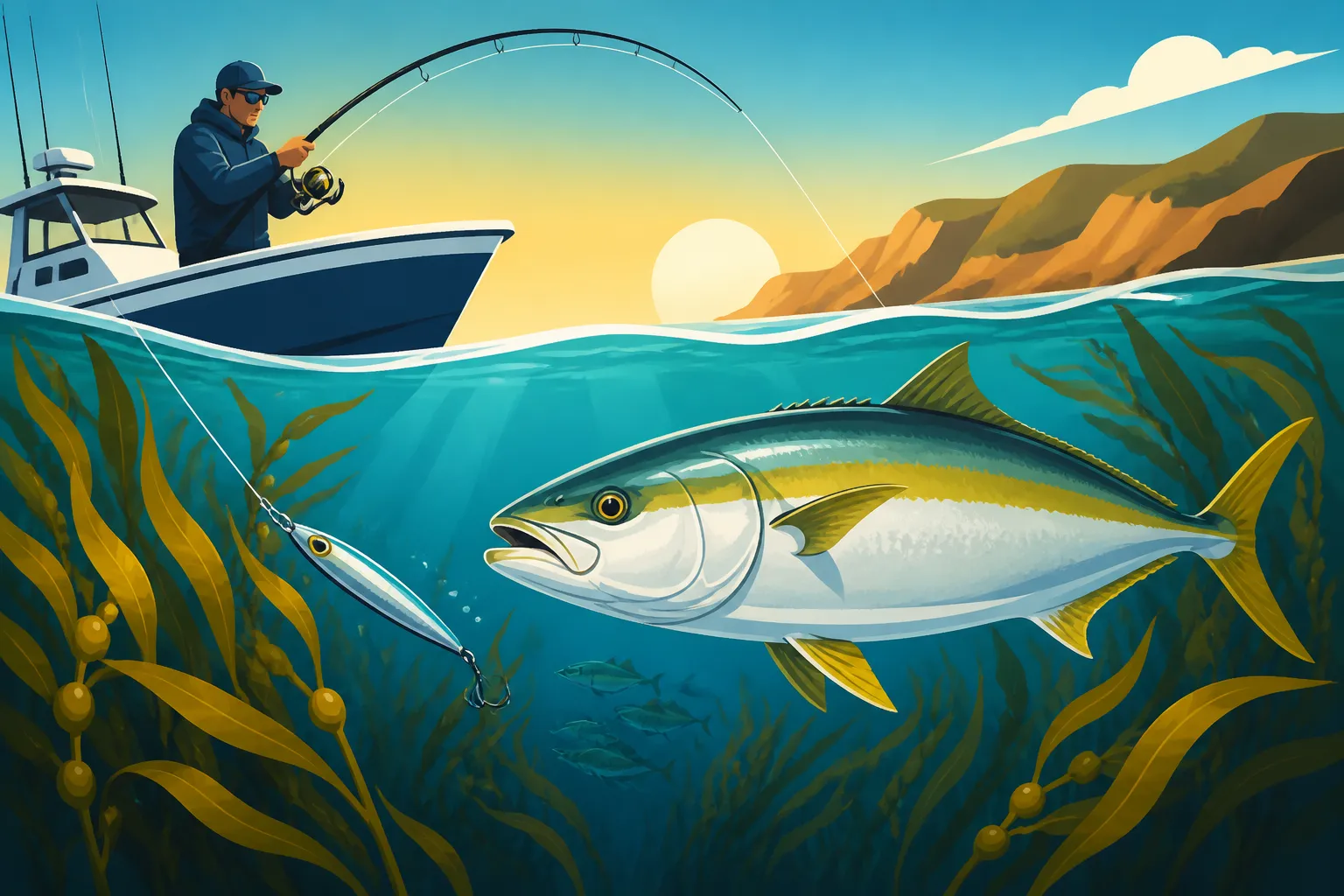
Kelp beds are vibrant, dynamic underwater ecosystems that provide everything a yellowtail needs to thrive. Think of them as bustling underwater cities with endless food sources and protective cover. Forage fish like anchovies, sardines, and mackerel absolutely swarm these areas, drawn to the smaller organisms and shelter the kelp offers. These baitfish are prime targets for yellowtail, making kelp beds the ultimate buffet. Beyond food, the thick stalks of kelp offer unparalleled ambush points for predatory fish like yellowtail. They can dart out from behind a curtain of kelp, surprise their prey, and retreat just as quickly.
Furthermore, kelp beds provide essential protection from larger predators, like sharks and seals, and even from fishing pressure. The dense canopy and intricate underwater structure make it difficult for anything bigger to navigate effectively, giving the yellowtail a significant advantage. It's not uncommon to find several schools of yellowtail congregating in a single, large kelp patty or an extensive kelp forest, especially during warmer months. They'll often push bait up against the kelp edges, creating explosive feeding frenzies that are as thrilling to witness as they are to fish.
Seasonal and Tidal Influences on Kelp Fishing
While yellowtail love kelp year-round, their presence and activity within these underwater forests are heavily influenced by the seasons and tides. Generally, yellowtail are more prevalent in Southern California's kelp beds during the warmer months, typically from late spring through fall. The rising ocean temperatures bring in warmer water currents, which often carry abundant baitfish closer to shore and into the kelp line. During these periods, yellowtail can be incredibly aggressive, chasing down offerings with gusto.
However, even in winter, don't count them out entirely, especially in specific areas where water temperatures remain milder. They might just be holding a bit deeper or closer to structure, requiring a different approach. Tides also play a crucial role. A strong incoming or outgoing tide can create current lines and upwellings around the kelp, concentrating baitfish and making them easier targets for yellowtail. This increased water movement often stimulates a feeding bite. Conversely, slack tide can sometimes slow the bite down, making the fish more lethargic, though this isn't always the case. Understanding the local currents and how they interact with specific kelp beds on a given day is key to predicting where and when the yellowtail might be most active. You can often find great insight into these patterns by checking a detailed California Fishing Seasons: Month-by-Month Guide.
Essential Gear and Tackle for Kelp Bed Yellowtail
Fishing kelp for yellowtail isn't just about showing up with a rod; it's about coming prepared for a fight, a true tug-of-war where the kelp is as much of a factor as the fish itself. Your gear needs to be up to the task of pulling a strong, angry fish out of its underwater fortress.
Rod, Reel, and Line Selection
This isn't the time for finesse ultralight setups. When fishing for California yellowtail in kelp, you need backbone.
For rods, look for something with a fast action and a heavy power rating. A 7- to 8-foot rod rated for 20-50 lb line is a good starting point. This gives you enough leverage to steer a charging yellowtail away from kelp stalks but still has enough tip sensitivity to feel subtle bites. Brands like Shimano, Daiwa, and Penn offer excellent saltwater jigging or heavy-action spinning rods that fit the bill.
When it comes to reels, you have options. Many anglers prefer conventional reels, particularly star-drag models in the 25-40 size (e.g., a Penn Fathom 40N or a Shimano Trinidad 20A), as they offer superior cranking power and drag pressure to stop a hard-running fish. However, powerful spinning reels, like a Shimano Saragosa 8000-10000 or a Daiwa Saltist 6000-8000, are also very effective, especially for casting lighter lures or live bait. The key is a strong, smooth drag system that won't give up under pressure.
Line choice is critical. Most serious kelp anglers spool up with braided line as their main line, typically 50-80 lb test. Braid has no stretch, which means you get direct contact with the fish, better feel for bites, and maximum pulling power. However, yellowtail are notoriously line-shy, and braid is visible underwater. This is why a high-quality fluorocarbon leader is essential. Connect your braid to a 4- to 8-foot section of 40-60 lb fluorocarbon leader using a strong knot like an FG knot or an Albright knot. The lower visibility and abrasion resistance of fluorocarbon are invaluable in the kelp.
Must-Have Lures and Baits
When yellowtail are in the kelp, they're usually there to feed, and having the right presentation can make all the difference.
For live bait, fresh is always best. Sardines, anchovies, mackerel, and squid are the gold standard. Depending on where you're fishing, these can sometimes be purchased at bait receivers or caught with sabiki rigs near bait balls. If you're on a charter, they usually provide the bait. Ensure your live bait is lively and frisky; a sluggish bait won't fool a wary yellowtail. For rigging live bait, a sharp, strong hook is non-negotiable. Circle hooks (2/0 to 6/0, depending on bait size) are popular for their ability to set in the corner of the fish's mouth, reducing gut hooks and allowing for easier release if needed. J-hooks are also used, but require a more immediate and aggressive hook set.
When live bait isn't available or the fish are keyed in on a specific artificial presentation, you'll want a selection of lures. Surface iron, also known as "candy bars" (like those from Salas, Tady, or Ahi USA), are classic choices, especially when yellowtail are busting on the surface or in the upper water column. These are cast far and retrieved quickly, mimicking a fleeing baitfish. Yo-yo jigs, heavier metal jigs like a Salas 7X or a Tady 4/0, are perfect for when yellowtail are holding deeper in the kelp or under a kelp patty. You drop them to the desired depth and retrieve them quickly with a jigging motion. For a more subtle approach, particularly when fish are finicky, soft plastic swimbaits (like those from MC Swimbaits or Warbaits, available on Amazon) rigged on heavy jig heads (1-3 oz) can be incredibly effective. These imitate a slow-swimming or injured baitfish and can be worked slowly along the kelp edges or through open lanes. Make sure your lures are rigged with strong, sharp hooks; don't skimp on terminal tackle when battling kelp-dwelling yellowtail.
Proven Kelp Bed Fishing Techniques
Getting a yellowtail to bite in the kelp is one thing; landing it is another. These techniques are designed not just to entice a strike, but also to give you the best fighting chance in a tangle-prone environment.
Live Bait Tactics
When yellowtail are active in and around kelp, live bait is often the most effective presentation. The key is to make your bait look as natural and irresistible as possible.
Fly-lining: This is arguably the most common and often most successful method. You rig a lively sardine or anchovy on a single hook with no weight, allowing it to swim freely. Cast your bait out towards the kelp edge or into open pockets within a kelp patty. The goal is for the bait to swim away from the boat, naturally seeking cover, which often puts it right in front of a waiting yellowtail. The challenge is keeping a light tension on the line while letting the bait swim, distinguishing between the bait's natural movements and a yellowtail's subtle pickup. When you feel that solid tug, engage the reel and wind down quickly to set the hook. The no-weight approach helps the bait look natural, but it offers less control once a fish is hooked, making strong initial hook sets and quick retrieves crucial.
Dropper Loop: When yellowtail are holding deeper in the kelp or closer to the bottom, a dropper loop rig can be very effective. This setup involves a sinker at the bottom to get your bait down quickly, with a dropper loop tied a foot or two above it, holding your hook and live bait. This allows you to present a bait at a specific depth, which is vital when fish are suspended. It’s a common tactic on party boats operating near offshore kelp lines or reefs. You'll need to pay close attention to your depth and presentation to avoid snagging the bottom or the kelp itself.
Using a Slider: A variation of the fly-line, the slider rig is used when yellowtail are being particularly finicky. Instead of a fixed weight, a small, sliding egg sinker (1/4 to 1/2 oz) is threaded onto your main line above your leader and swivel. This allows the bait to swim freely and naturally while the sinker helps it get down a bit faster without hindering its movement. It’s a stealthier approach that can sometimes trigger bites when a traditional dropper loop or heavily weighted rig might spook the fish.
Artificial Lure Strategies
Sometimes artificial lures can outperform live bait, especially when yellowtail are aggressively feeding or when you need to cover a lot of water quickly.
Surface Iron: These metal jigs are designed to mimic a fleeing baitfish splashing on the surface. Cast a surface iron like a Salas 7X Light or a Tady 45 as far as you can towards boils or nervous water around the kelp. The retrieve is key: a fast, steady retrieve with a sweeping motion of the rod tip will make the jig "swim" and dart, creating an irresistible commotion. This technique is exhilarating because the strikes are often explosive topwater blowups. Keep your rod tip up during the retrieve to help the jig work properly and be ready for an instant hook set.
Yo-Yo Jigging: When yellowtail are deeper, perhaps under a kelp paddy or in deeper sections of the kelp forest, yo-yo jigging comes into play. Use a heavy, compact metal jig (like a Shimano Flat-Fall or a heavy Salas jig) and drop it straight down to the desired depth. Once it hits bottom or the target depth, retrieve it quickly with a series of sharp, upward jerks of the rod, letting the jig flutter back down between jerks. This aggressive presentation often triggers a reaction strike from yellowtail that might otherwise ignore a slower bait. The strike often happens on the fall, so pay close attention as your jig descends. This is a very effective technique and a staple of California Offshore Fishing Techniques.
Swimbaits and Plastics: For a more subtle approach, or when yellowtail are a bit more spread out, soft plastic swimbaits rigged on heavy lead heads can be highly effective. These baits (often 6-9 inches long) are designed to imitate larger baitfish and can be worked slowly through kelp lanes or around the edges of a paddy. Cast the swimbait out and retrieve it with a slow, steady wind, occasionally pausing or giving a slight twitch to impart extra action. The slower presentation can be key on tougher days, and their weedless rigging options make them easier to work through lighter kelp. These are also great for Kayak Fishing California bays and kelp lines.
| Technique | Presentation Type | Ideal Conditions | Pros | Cons |
|---|---|---|---|---|
| Fly-Lining | Live Bait | Yellowtail active near surface/kelp edge | Highly natural, often irresistible | Less control over bait depth, prone to kelp tangles |
| Dropper Loop | Live Bait | Yellowtail holding deeper in kelp | Targets specific depths, good for suspended fish | Less natural movement, higher chance of bottom snags |
| Slider Rig | Live Bait | Finicky yellowtail, light current | More natural presentation than dropper, some depth control | Still prone to kelp tangles, can be slow to get deep |
| Surface Iron | Artificial Lure | Yellowtail busting on surface, aggressive | Exciting topwater strikes, covers lots of water quickly | Requires fast retrieve, less effective when fish are deep |
| Yo-Yo Jigging | Artificial Lure | Yellowtail holding deep, reaction bite | Effective for deeper fish, strong reaction strikes | Physically demanding, can snag deep kelp |
| Swimbaits/Plastics | Artificial Lure | Finer presentation, tough bite, scattered fish | Versatile, mimics larger baitfish, can be worked slowly | Slower presentation might not attract aggressive fish |
Navigating and Fishing Kelp Effectively
The kelp itself can be your greatest ally and your worst enemy. Mastering how to position your boat and manage your line in this challenging environment is crucial for success.
Boat Positioning and Anchoring
When you're targeting yellowtail in kelp, your boat positioning is everything. It's a delicate balance between getting close enough to the fish without becoming hopelessly tangled or spooking the school. If you're on a boat, whether it's your own or a California Fishing Charter, the captain will often look for "paddies" – detached sections of kelp floating on the surface – or fish the edges of a solid kelp forest.
When approaching a kelp patty, it's best to drift past it or circle it, casting to the edges and letting your bait or lure work. You want to avoid driving directly over the paddy if possible, as this can spook the fish that are often holding underneath. For established kelp forests, you'll want to position your boat just outside the densest part of the kelp. This allows you to cast into the productive areas without immediately getting your line wrapped around stalks. If anchoring, consider using a grapple hook that can be easily retrieved, or a traditional anchor with plenty of chain and scope if you’re fishing a specific structure adjacent to the kelp. Always be mindful of the current and wind; you want to drift parallel to the kelp edge, not directly into it, which could lead to immediate snags. A common strategy when chasing these fish is to employ the same tactics you might for a California Halibut Regulations and Limits trip where structure and current are key.
Minimizing Snags and Break-offs
Fighting yellowtail in the kelp is a high-stakes game. Once a fish bites, its first instinct is almost always to dive straight into the thickest part of the kelp. This is where most fish are lost.
To minimize snags, always keep maximum tension on the fish. As soon as you feel that strike, set the hook hard and begin reeling immediately. Don't give an inch. Point your rod tip directly at the fish and crank. This initial pressure can sometimes turn the fish away from the kelp, bringing it into a clearer area. Once you’ve turned its head, try to maintain that advantage. Keep your rod tip high and use your boat's mobility if possible (if you have a captain or a trolling motor) to follow the fish and keep it out of the worst of the kelp.
Your leader choice is also vital here. While 40-60 lb fluorocarbon offers good abrasion resistance, it's not indestructible. Inspect your leader frequently for nicks and abrasions, and re-tie as needed. Some anglers will even bump up to 80 lb test leader if the fish are not line shy and the kelp is particularly thick. Another crucial tip is to anticipate the fish’s movements. If you see it heading for a dense patch, try to "bow" to the fish by dropping your rod tip slightly and reeling as fast as you can to gain line, then lifting the rod to pull it away. This momentary slack can sometimes prevent the line from being instantly cut. If a fish does dive into the kelp and you get snagged, resist the urge to pull as hard as you can. Sometimes, backing off the drag a little and gently jigging the line can free it. If not, it's usually a lost cause, but a strong leader gives you a better chance. Understanding how to manage your gear is crucial, just as it is when learning California Trolling Tips and Techniques in open water.
Kelp Bed Yellowtail Seasons and Prime Conditions
Timing truly is everything when it comes to consistently finding and hooking yellowtail in California's kelp beds. While they can be caught year-round in certain areas, there are definite peak seasons and specific conditions that stack the odds in your favor.
Best Time of Year to Target Kelp Yellowtail
For the most part, the prime season for yellowtail fishing in California’s kelp beds runs from late spring through fall, roughly May through October. This is when the ocean waters off California warm up significantly, drawing in vast schools of baitfish like sardines and anchovies, which are the yellowtail’s primary food source. As these baitfish move closer to the coast and into the protective, food-rich environment of the kelp forests, the yellowtail follow.
During the peak summer months (July-September), especially in Southern California, yellowtail can be found in abundance around both fixed kelp forests and drifting kelp paddies offshore. This is when the bite can be incredibly aggressive, with fish often crashing on the surface. While the bite might slow down in the cooler winter months, don't count out the possibility, especially in warmer southern regions like San Diego, where some resident yellowtail remain in deeper kelp lines. Understanding the nuances of the Best Season for Yellowtail in California can greatly increase your success rate. Always check local fishing reports, as conditions can change rapidly from year to year based on ocean currents and bait availability.
Optimal Weather and Water Conditions
Beyond the time of year, specific daily conditions can significantly impact kelp bed yellowtail activity.
Water Temperature: Yellowtail prefer warmer water, typically in the range of 65-72°F (18-22°C). When water temperatures hit this sweet spot, yellowtail are often more active and aggressive. Look for areas where warmer currents are pushing against the kelp. Cooler water can make them more lethargic and less willing to chase baits or lures.
Currents: A moderate current is often ideal. It helps to position baitfish and makes them appear more natural as they drift. Strong currents can sometimes make it difficult to present baits effectively or hold your boat in position, while slack tides can lead to a slower bite as fish become less active. Knowing how to read the current around kelp is a skill developed over time and can make a huge difference.
Water Clarity: Generally, yellowtail prefer clear water. They are sight feeders, and clear water allows them to spot prey from a distance. However, slightly off-color water (often caused by plankton blooms) can sometimes concentrate baitfish, leading to good fishing, but extremely murky water is usually a disadvantage.
Wind and Swell: While calm, sunny days are often pleasant for anglers, a light chop on the water can actually improve fishing by breaking up the surface and making it harder for yellowtail to spot boats or perceive lines. Excessive wind or heavy swell, however, makes boat handling difficult and can make it nearly impossible to fish the kelp effectively or safely. It's always smart to check the marine forecast before heading out for a trip. You might also want to consult a guide on How Weather Affects California Fishing for a broader perspective.
Conserving California Yellowtail
As passionate anglers, we all share a responsibility to protect the resources that bring us so much joy. Yellowtail are a prized game fish, and ensuring their populations remain healthy for future generations is paramount.
Understanding Regulations and Limits
California has specific regulations governing the take of yellowtail, including size limits, bag limits, and season closures (though yellowtail generally have a year-round open season in most areas, always check current regulations). These rules are put in place by the California Department of Fish and Wildlife (CDFW) to manage fish populations sustainably. It's your responsibility to know and follow these rules. For instance, the general statewide bag limit for yellowtail is 10 fish per person, with a minimum size limit of 20 inches total length. However, there can be specific localized regulations or changes, so always consult the latest California Fishing Regulations Explained booklet or the CDFW website before heading out.
Additionally, be aware of California Marine Protected Areas Explained. These are designated zones where fishing may be restricted or entirely prohibited to allow marine ecosystems to recover and thrive. Fishing within an MPA can result in significant fines and penalties. Always double-check your charts and local regulations to ensure you are fishing in an authorized area. Using tools like the CDFW's Ocean Sport Fishing Regulations map can help you avoid protected zones.
Best Practices for Catch and Release
Even when fishing within legal limits, practicing responsible catch and release, especially for fish you don't intend to keep or for those that are undersized, is vital for conservation.
Here are some tips for increasing the survival rate of released yellowtail:
- Minimize Fight Time: Fight the fish efficiently to reduce exhaustion. Get it to the boat as quickly as possible without over-stressing your tackle.
- Handle With Care: Avoid touching the fish's gills or eyes. If possible, keep the fish in the water while unhooking. If you must bring it aboard, use a wet glove or rag to handle it, supporting its body horizontally to prevent internal organ damage.
- Quick Hook Removal: Use de-hooking tools or pliers to remove hooks quickly and gently. If the fish is deeply hooked and removal would cause significant damage, cut the line as close to the hook as possible. Circle hooks greatly reduce deep hooking.
- Revive If Necessary: If the yellowtail appears sluggish or stressed upon release, gently hold it upright in the water, facing into the current, and move it back and forth to force water over its gills. Release it only when it swims away strongly on its own.
- Limit Air Exposure: Yellowtail can suffer from barotrauma (injury from rapid pressure changes) when brought up from deep water. For fish caught deeper than 30 feet, consider using a descending device to return them to depth. However, in kelp beds, yellowtail are often caught closer to the surface, making this less of an issue.
By adhering to regulations and practicing careful catch and release, you contribute to the health of California's yellowtail populations and ensure that future anglers can enjoy the same thrilling battles.
Disclaimer
Fishing in the ocean can be unpredictable and dangerous. Always prioritize safety, check weather and ocean conditions before departing, and ensure you have all necessary safety equipment on board. Regulations and fish populations can change, so always verify the latest information with the California Department of Fish and Wildlife. This guide is for informational purposes only and should not replace professional advice or official regulations.