Best Baits and Lures for Bluefin Tuna in California
Alright, let's talk about the absolute thrill and sometimes, the utter heartbreak, of chasing Bluefin Tuna here in California. It’s no secret that these powerful, fast-swimming giants can be incredibly picky, leaving even seasoned anglers scratching their heads. You spend hours scanning the horizon, spotting boils, or marking fish on the sonar, only to have them ignore every offering you throw. This guide is all about cutting through that frustration, helping you understand the best baits and lures that consistently get bit, and how to present them effectively to land one of California's most sought-after game fish.
The Bluefin Tuna Challenge: Why Bait and Lure Selection Matters
Bluefin tuna, especially the big ones, aren't just swimming around looking for any old snack. They're apex predators, often keying in on very specific baitfish, and their feeding patterns can change on a dime. This means your bait and lure choice isn't just a suggestion; it's often the make-or-break factor between a day of relentless casting and the unforgettable fight of a lifetime.
Understanding Bluefin Behavior and Feeding Habits
These magnificent fish are built for speed and power, constantly on the move, and their diet can vary widely based on what's available in the vast Pacific Ocean. In California, Bluefin frequently target smaller schooling fish like anchovies, sardines, and mackerel. However, they're also opportunistic and won't hesitate to devour squid or even smaller pelagic crabs when the opportunity arises. What's crucial is that they often get "tuned in" to a particular size and type of forage. If they're busting on tiny anchovies, a large sardine might get ignored. If they're feeding deep on squid, a surface popper won't get a look. Understanding their current diet and how they're behaving – whether they're crashing the surface in a frenzy, showing as deep marks, or acting finicky – directly dictates what you should be throwing.
The Importance of Matching the Hatch
"Matching the hatch" isn't just for fly fishermen chasing trout; it's paramount for Bluefin. This means selecting a bait or lure that closely mimics the size, shape, and action of what the tuna are currently feeding on. If you see tiny baitfish spraying on the surface, you need something small and erratic. If the sonar is marking large schools of mackerel, then a big, lively mackerel might be your best bet. Observing what the birds are doing, what the other boats are catching, and even what comes up in the stomach contents of the first fish you land can give you invaluable clues. Don't be afraid to experiment, but always start with an educated guess based on what the Bluefin are actually eating at that moment.
Top Natural Baits for California Bluefin Tuna
When it comes to Bluefin, nothing beats the real thing. Live bait, fresh dead bait, and even carefully presented chunks can be irresistible to these keen predators.
Live Bait Supremacy: Sardines, Anchovies, and Mackerel
If you're heading out on a sportfishing boat or have access to a bait receiver, live bait is almost always your first and best option. There's just something about a struggling, natural presentation that Bluefin can't resist.
- Sardines: These are arguably the most consistent go-to live bait for Bluefin in California. They're oily, shiny, and have an irresistible shimmy in the water. When tuna are keyed in on sardines, a "fly-lined" sardine with no weight, just a hook, can be deadly. You want a lively sardine, one that's swimming naturally and not looking stressed. Hook them gently through the nose or the back, depending on how you want them to swim. Your ability to cast a frisky sardine a long distance away from the boat can often be the difference maker, especially with boat-shy tuna. These are often available at bait barges and are typically the first offering on most San Diego overnight tuna trips explained.
- Anchovies: Smaller than sardines, anchovies come into play when the tuna are feeding on particularly tiny baitfish. Sometimes, the tuna get so focused on these small forage items that anything larger is ignored. Fishing anchovies requires lighter tackle and a very delicate touch, as they are fragile. A small, super sharp hook, sometimes even a treble hook, can be used. When the tuna are boiling on these little guys, casting a handful of chummed anchovies into the melee can trigger a bite.
- Mackerel: For bigger Bluefin, especially when they're targeting larger prey, live mackerel can be the ticket. Both Pacific and Spanish mackerel are excellent choices. They're robust, can handle being fished longer, and offer a substantial meal for a trophy-sized tuna. Hook them through the nose or just in front of the dorsal fin. They can be slow-trolled or fly-lined. Mackerel are also fantastic for "chumming" to get the tuna excited and closer to the boat. Remember, bigger baits often mean bigger fish, so don't be shy about throwing a robust mackerel if you're hunting for a true giant.
Dead Bait Tactics: Jigging and Chunking
While live bait is king, don't underestimate the effectiveness of dead bait, especially when presented correctly. This is where you can often turn rejected live bait situations into hookups.
- Dead Bait Jigging: This technique is incredibly effective, particularly when Bluefin are holding deeper or are being finicky. You can use a whole dead sardine, anchovy, or even a small mackerel, rigged on a weighted jig head or a dropper loop. The key is to impart a lifelike action. Drop the bait to the desired depth, then gently lift and drop, mimicking a wounded baitfish. The scent trail from the dead bait is a huge attractant. This is often done when the fish are showing on the meter but aren't coming to the surface. It's a stealthy approach that can trick even the wariest tuna.
- Chunking: Chunking involves cutting dead bait (sardines, mackerel, squid) into bite-sized pieces and continuously tossing them into the water to create a scent trail and draw fish closer to the boat. Your "hook bait" should be a piece of bait that matches the chum, ideally hiding your hook perfectly within it. This technique requires patience and a steady supply of fresh bait. It’s particularly effective when tuna are deep and you're trying to draw them up, or when they're scattered and you need to concentrate them. Make sure your hook is completely concealed within the chunk, and let it drift naturally with the chum. This is a common strategy employed by seasoned crews on California offshore fishing techniques trips.
| Bait Type | Best Use Cases | Pros | Cons |
|---|---|---|---|
| Live Sardine | Fly-lining for surface feeders, chumming | Irresistible natural action, strong scent | Can be delicate, harder to cast far |
| Live Anchovy | When tuna are feeding on small bait, light tackle | Perfect "match the hatch" for small forage | Very fragile, difficult to keep alive |
| Live Mackerel | Targeting larger tuna, slow trolling | Durable, strong swimmer, big meal for big fish | Can be hard to acquire, bigger tackle needed |
| Dead Bait Jigging | Deep-holding or finicky tuna, subsurface | Scent trail, can fish deeper, subtle presentation | Requires active rod work, less natural movement |
| Chunking | Drawing fish to the boat, deep or scattered tuna | Strong scent trail, concentrates fish | Requires large quantities of bait, patient approach |
Essential Artificial Lures for Bluefin Tuna Success
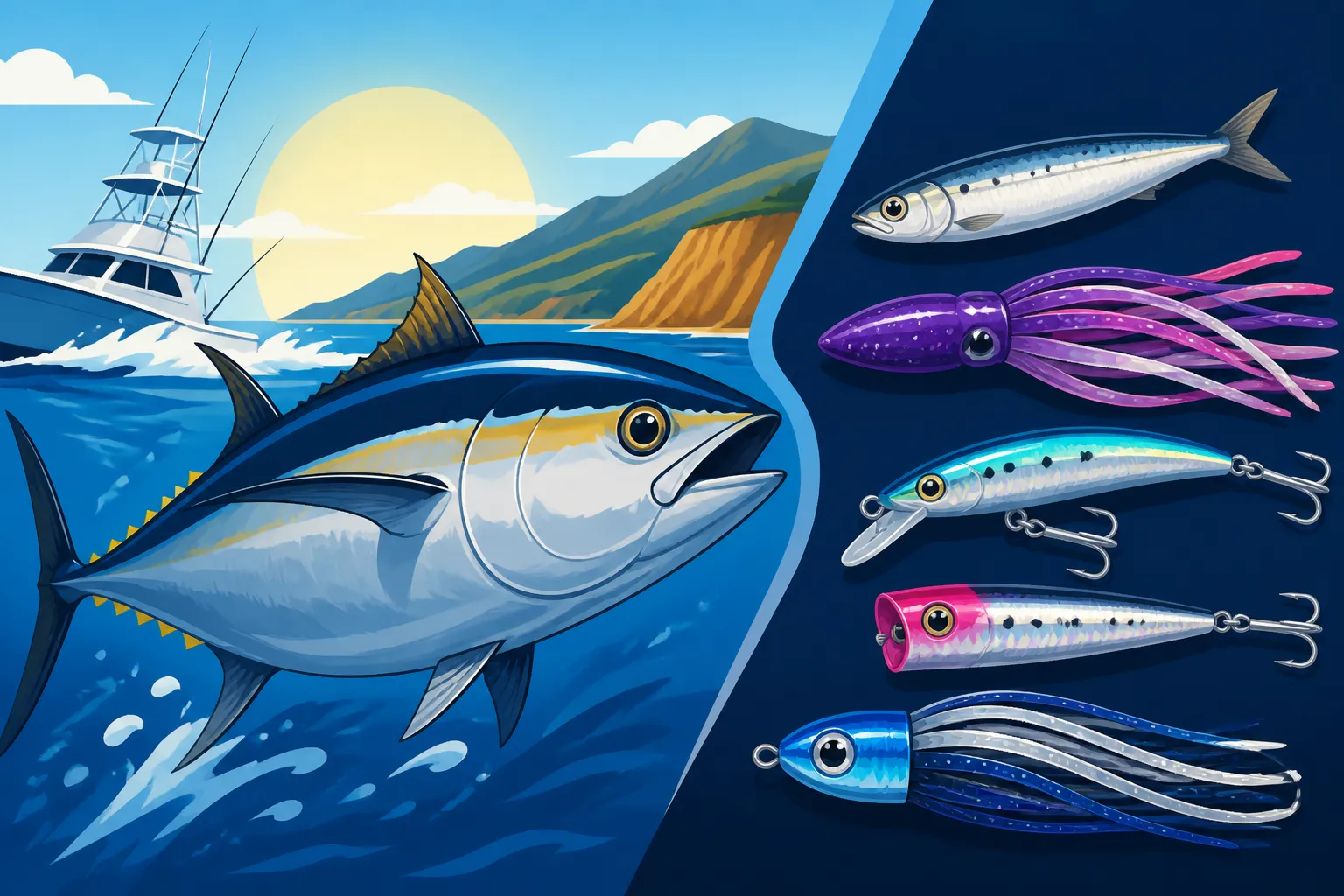
Sometimes, the tuna just don't want live bait, or you might find yourself in a situation where artificials are simply more efficient or can reach fish that live bait can't. Modern artificial lures are incredibly effective, and every serious Bluefin angler has a selection of these in their arsenal.
Surface Iron and Colt Snipers: The Casting Powerhouses
These are the lures you reach for when you see those incredible, heart-pounding surface boils or foamer schools. The adrenaline rush of a Bluefin smashing a surface lure is unparalleled.
- Surface Iron (Jig): Classic West Coast lures, surface irons like the Tady 45 or the Salas 7X are legendary. They're designed to be cast a mile and retrieved at a high speed, creating an erratic, wounded baitfish action. The key is to match the color and size to the predominant bait. Blue and white, sardine, and dorado patterns are perennial favorites. When tuna are busting on the surface, a well-placed, fast-retrieved surface iron can draw ferocious strikes. Make sure your reel is spooled with heavy braid and a strong fluorocarbon leader, because when a Bluefin hits, it hits hard.
- Colt Snipers/Flat-Fall Jigs (Casting Version): While flat-fall jigs are mostly for vertical jigging (which we’ll get to), lighter versions like the Shimano Colt Sniper or Daiwa's range of casting jigs are phenomenal. These are incredibly aerodynamic for long casts and sink with a seductive wobbling action. They're excellent when tuna are just below the surface and not quite hitting a traditional surface iron, or when they're breaking sporadically. Cast past the school and retrieve, allowing them to flutter on the fall.
Jigs: Vertical, Knife, and Flat-Fall Varieties
When the tuna are holding deeper, showing as meter marks, or simply refusing to come to the surface, vertical jigging is your secret weapon.
- Vertical Jigs (Knife Jigs): These long, slender, heavy jigs (like those from Shimano Butterfly or Nomad Design) are designed to be dropped straight down to the depth where fish are marked and then rapidly retrieved with a "yo-yo" or "speed jigging" motion. The erratic, darting action mimics a fleeing baitfish. It's a high-energy technique, but incredibly effective for deep-holding Bluefin. Colors like silver, blue/silver, and pink are popular. This is a common tactic when you've pinpointed tuna with your sonar but they aren't engaging with surface presentations.
- Flat-Fall Jigs: Brands like Shimano and Daiwa pioneered these. Unlike traditional vertical jigs, flat-falls are designed to flutter and "fall flat" on the retrieve, mimicking a wounded or dying baitfish. They are particularly deadly when fished with a slower, lift-and-drop retrieve. Drop it to the desired depth, engage the reel, lift your rod tip up, then drop it back down, allowing the jig to flutter. Most bites often come on the fall. This is a less physically demanding technique than speed jigging but just as effective for Bluefin that are feeding sub-surface. You can often find a great selection of these on Amazon.
Trolling Lures: Wahoo Bombs and Cedar Plugs
Trolling is a fantastic way to cover ground and find scattered fish, or to entice a bite when the tuna are not actively showing.
- Wahoo Bombs (or similar high-speed trolling lures): While often associated with Wahoo, these heavy, fast-trolling lures can be incredibly effective for Bluefin, especially when they're targeting larger, faster-moving prey. Brands like Nomad Design and Black Bart make excellent trolling lures that can be pulled at speeds of 8-15 knots. They create a lot of commotion and are great search baits. Colors with darker backs and shiny bellies are typically productive. Make sure your gear is up to snuff for the stresses of high-speed trolling.
- Cedar Plugs: A classic for a reason, cedar plugs are simple, effective, and have an irresistible swimming action when trolled. They're usually pulled at slower speeds than Wahoo bombs (around 6-9 knots) and are excellent for a wide range of tuna, including Bluefin. Their natural wood grain and simple design somehow just work. They're often fished in spreads with other lures, creating a school of "baitfish" behind the boat.
Poppers and Stickbaits: Exciting Topwater Action
For sheer excitement, nothing beats a topwater strike from a Bluefin. These lures are for those electrifying moments when tuna are boiling on the surface with incredible aggression.
- Poppers: These lures are designed to create a splashing, gurgling commotion on the surface when retrieved with a "pop-and-pause" action. The idea is to mimic a struggling baitfish, drawing the tuna's attention. Brands like Halco, Yo-Zuri, and Nomad Design offer excellent poppers. Work them with strong, sweeping rod movements to make that characteristic "pop." This is for aggressive, surface-oriented fish.
- Stickbaits: Often called "walk-the-dog" lures, stickbaits glide and sashay across the surface with a side-to-side action when retrieved correctly. They're typically more subtle than poppers but can be equally deadly, especially for finicky surface feeders. Like poppers, they require a specific retrieve, but once you master it, the results can be spectacular. They're fantastic for when you see tuna blowing up but not necessarily in a full-blown "foamer" state. You’ll want to review your How to Catch Bluefin Tuna off California guide for more advanced techniques.
Rigging and Presentation Tips for Maximum Effectiveness
Having the right bait or lure is only half the battle. How you rig and present it can dramatically influence your success.
Leader Lines and Hook Selection
This is where many anglers make mistakes, often going too heavy or too light. Bluefin have incredible eyesight, especially in clear California waters, so your leader choice is critical.
- Fluorocarbon Leaders: Always, always, always use fluorocarbon. It's nearly invisible underwater, much more abrasion-resistant than monofilament, and has less stretch. For Bluefin, you're usually looking at 60-150 lb test, depending on the size of the fish and the lure/bait. For fly-lined sardines, you might drop down to 40-50 lb test to get bites, but you risk getting cut off by bigger fish. A good rule of thumb is to start at 80 lb test and adjust as needed. You can often find quality fluorocarbon spools from brands like Seaguar or Berkley on Amazon.
- Hook Selection: Sharpness is non-negotiable. For live bait, use a strong, corrosion-resistant circle hook (e.g., Owner Mutu Light, Gamakatsu Octopus Circle) in sizes 2/0 to 6/0 for sardines/anchovies, and up to 8/0 for mackerel. Circle hooks are safer for the fish and reduce gut hooks, and they tend to set themselves in the corner of the fish's mouth. For lures, ensure your trebles or single hooks are heavy-duty and sharp, capable of withstanding the immense pressure of a fighting tuna. Single inline hooks are gaining popularity for lures as they can offer better hookups and are easier to remove.
Matching Tackle to Your Chosen Bait or Lure
Your rod and reel setup needs to be balanced with your chosen presentation and the size of the fish you're targeting.
- Light Tackle for Small Baits: If you're using small anchovies or light lures for smaller grade Bluefin (20-40 lbs), a spinning reel with 30-40 lb braid and a matching rod will give you the casting distance and sensitivity you need.
- Medium Tackle for Sardines/Jigs: For most live sardine fishing and lighter jigging, a conventional reel (like a Penn Fathom or a Daiwa Saltiga) spooled with 60-80 lb braid and a suitable 7-8 foot rod (rated for 40-80 lb line) is standard. This setup offers power for the fight and enough backbone for casting and working jigs.
- Heavy Tackle for Mackerel/Large Lures: When targeting those giants over 100 lbs with big mackerel or heavy jigs, you need serious gear. Think 100-130 lb braid, a powerful conventional reel (e.g., Shimano Talica, Accurate Valiant), and a stout 7-8 foot rod rated for 80-130 lb line. This is the kind of setup you'll want for long-range trips where you might encounter the biggest of the big, as discussed in our How to Prepare for a Long-Range Tuna Trip article.
- Casting Distance: For both live bait and lures, casting distance is often crucial. Tuna can be boat-shy, and the ability to put your offering far away from the boat without spooking them can dramatically increase your hookup ratio. Practice your casting, and ensure your lines are well-maintained for smooth deployment.
Seasonal and Situational Considerations
Bluefin fishing isn't a static game; it's constantly evolving with the seasons, water conditions, and the tuna's migratory patterns. Being adaptable is key. You might want to check out the California Fishing Seasons: Month-by-Month Guide for a broader overview.
Adjusting to Water Temperature and Forage
California's offshore waters can change rapidly. Water temperature fronts, currents, and upwellings all influence where tuna are, what they're eating, and how they're behaving.
- Warm Water: Typically, warmer water brings in more baitfish like sardines and mackerel, and often, more aggressive tuna. This is prime time for surface boils and aggressive lure bites. If the water is warm, focus on faster retrieves and brighter, more flashy lures. It’s also often when the Best Season for Bluefin Tuna in California is in full swing.
- Cooler Water: In cooler water, tuna might be deeper, less active, and keyed in on different forage, like squid. This is when dead bait jigging, chunking, or even slower presentations with flat-fall jigs really shine. Don't be afraid to slow down your retrieve and work the deeper water column.
- Forage Changes: Pay close attention to what's in the water. Are you seeing flying fish? Use a flying fish imitation lure. Is there krill? Small, subtle presentations. The more you can mimic what the tuna are currently eating, the better your chances. This is especially critical when hunting the Best Fighting Fish in California.
When to Switch Up Your Approach
Stubbornly sticking to one method when it's not working is a recipe for a fishless day. Bluefin can be incredibly frustrating precisely because they change their minds so often.
- No Bites? Change It Up: If you've been fly-lining a sardine for an hour with no success, try adding a small weight to get it deeper, or switch to a different bait altogether. If your surface iron isn't getting any love, try a flat-fall jig or a stickbait. Sometimes, even a slight change in color, size, or retrieve speed can make all the difference. Don't be afraid to be the first one on the boat to try something different.
- Observing Other Anglers: While you should experiment, also keep an eye on what other anglers on your boat (or nearby boats) are doing, especially if they're getting bit. Are they using a different color jig? A lighter leader? A slower retrieve? Take notes and try to adapt.
- Listen to the Crew: The deckhands and captains on fishing charters, like those found in Best Fishing Charters in San Diego, spend countless hours on the water. They've seen it all and often have excellent insights into what's been working lately. Don't be afraid to ask for advice on lure choice, rigging, or presentation. They're there to help you catch fish!
Knowing your baits and lures for Bluefin Tuna in California is about more than just having a tackle box full of options. It's about understanding the fish, reading the conditions, and being ready to adapt your strategy on the fly. The pursuit of these magnificent fish is a true challenge, but with the right approach and a bit of patience, the reward of landing a California Bluefin is absolutely priceless.
Disclaimer
The information provided in this guide is for general informational purposes only. Fishing regulations, seasons, and limits for Bluefin Tuna in California are subject to change. Always consult the latest California Department of Fish and Wildlife (CDFW) regulations before heading out. Fishing conditions and fish behavior can vary greatly, and past success does not guarantee future results. Stay safe and respect the marine environment.