How to Catch Rockfish in Deep Water
It’s a real head-scratcher sometimes, isn't it? You head out to your favorite spot, the sonar lights up with promising structure, but getting your bait down to those deep-dwelling rockfish, feeling that subtle bite through hundreds of feet of line, and then successfully reeling them up through all that water can feel like a Herculean task. It's frustrating when you know the fish are there, but the depth and current seem to conspire against you. This guide is here to untangle those frustrations, giving you the insider knowledge, essential gear tips, and proven techniques to confidently target and catch rockfish in the deep waters of California.
The Allure and Challenge of Deepwater Rockfish
California's coastline boasts an incredible variety of rockfish, from the vibrant vermilion to the hefty bocaccio, and many of them call the deep home. There's a certain thrill to venturing into those deeper zones, knowing you're pursuing fish that often grow larger and fight harder due to the colder, less-pressured environment. However, this pursuit also comes with unique challenges that require specific strategies.
What Makes Deepwater Rockfish Different?
Deepwater rockfish, by their very nature, are a different beast than their shallow-water cousins. These species have adapted to life in a world of low light, stable temperatures, and immense pressure. We're talking about depths that can range from 150 feet all the way down to 800 feet or more, depending on the species and location. For instance, you might find Vermilion Rockfish and Canary Rockfish thriving in these deeper zones, often associating with complex rocky reefs, pinnacles, and ledges. They tend to be less active, conserving energy in the cold, dark depths, which can translate to more subtle bites that are harder to detect from the surface.
One crucial aspect that differentiates deepwater rockfish fishing is the phenomenon of barotrauma. When these fish are brought up quickly from significant depths, the rapid change in pressure causes gases in their swim bladder to expand, leading to bloating and organ damage. This is why understanding California Fishing Regulations Explained and specifically regulations regarding descender devices is so vital. If you plan to release a deep-caught rockfish, you absolutely need a descender device to recompress its swim bladder and give it the best chance of survival.
Why Target Them in the Deep?
So, why go through all this trouble to chase fish in the deep? Simple: the rewards can be immense. First off, deepwater rockfish often grow to impressive sizes. The lack of fishing pressure in some of these deeper, harder-to-reach spots means fish have a better chance to mature into true trophies. Imagine hooking into a 10-pound Vermilion Rockfish or a massive Bocaccio – the fight is exhilarating, and the fillets are a delicious reward.
Beyond size, deepwater spots often hold a wider variety of species. While shallow reefs might be dominated by a few common types, the deep offers a smorgasbord of rockfish, many of which are absolutely stunning to look at. Plus, there's a certain satisfaction that comes from mastering a challenging environment. It’s not just about catching fish; it’s about refining your technique, understanding the ocean's intricate dynamics, and proving your skill against the elements. It’s an adventure that pushes you beyond the usual casting from the shore or a quick drift in shallow waters.
Gearing Up for the Deep: Rods, Reels, and Rigging
You wouldn't bring a butter knife to a sword fight, right? The same goes for deepwater rockfish. Your standard inshore setup just won't cut it when you're trying to punch through hundreds of feet of water and battle strong currents. The right gear makes all the difference, not only in getting your bait to the strike zone but also in feeling those faint bites and successfully landing your prize.
The Right Rod and Reel Combo
For deepwater rockfish, you need a rod that's built for power and sensitivity. Look for a heavy power, fast action rod typically in the 7 to 8-foot range. This length provides enough leverage to fight a strong fish but isn't so long it becomes unwieldy on a boat. The "fast action" means the tip is sensitive enough to telegraph those subtle deepwater bites, while the "heavy power" gives you the backbone needed to lift heavy weights and strong fish from the depths. Many anglers prefer conventional rods for their direct power transfer and robust construction, but stout spinning setups can also work, especially with modern braid technology.
When it comes to reels, capacity and drag are king. You'll want a conventional reel (like a Penn Fathom or a Daiwa Saltiga) or a large, heavy-duty spinning reel (such as a Shimano Saragosa or a Daiwa BG) capable of holding at least 300-400 yards of 50-80 lb braided line. A strong, smooth drag system is non-negotiable – it allows you to tire out a big fish without risking snapped lines or pulled hooks. Gear ratio is less critical than power and capacity for deep drops, as you're mostly cranking slowly, but a retrieve rate that helps you manage line quickly is a plus. If you're looking to explore options, checking platforms like Amazon can give you a broad overview of different models and price points suitable for this kind of demanding fishing.
Line Choice and Terminal Tackle Essentials
Your line is the crucial connection to the fish, and in deep water, it needs to be up to the task. Braided line is the undisputed champion here. Its minimal diameter means less water resistance, helping your weight sink faster and reducing bow in the line from current. More importantly, its near-zero stretch provides unparalleled sensitivity, allowing you to feel every bump, tap, and subtle bite even at extreme depths. I typically spool up with 50-80 lb braid as my main line.
Connecting your mainline to your rig is usually done with a heavy monofilament or fluorocarbon leader. This leader serves a few purposes: it provides some abrasion resistance against rocky structure, offers a bit of stretch for shock absorption, and some anglers believe fluorocarbon's invisibility helps with wary fish. A leader of 60-100 lb test, about 5-10 feet long, is a good starting point.
Now, for the terminal tackle – this is where you customize your setup for the deep.
- Weights: These are your most important tools for reaching the bottom. You'll need an assortment of heavy weights, ranging from 8 ounces up to 2 pounds or even more, depending on the depth and current. Torpedo sinkers or cannonball sinkers are common choices. Sometimes, using a sinker slide can be beneficial, allowing your mainline to slide through freely if your weight gets snagged.
- Hooks: Use strong, sharp octopus-style hooks or circle hooks in sizes appropriate for your bait and target species (e.g., 5/0 to 8/0). Circle hooks are excellent for rockfish as they tend to hook the fish in the corner of the mouth, making for easier release and reducing gut-hooking.
- Swivels and Snaps: Heavy-duty barrel swivels and snaps are essential for connecting leaders, weights, and reducing line twist.
Understanding California Rockfish Depth Restrictions is paramount. The maximum depth you can fish for rockfish can change seasonally and by management area, so always consult the latest regulations before heading out. Similarly, make sure you're aware of the California Rockfish Bag Limit Explained to stay within legal catch limits.
Proven Techniques for Deepwater Rockfish Success
Getting your gear together is just the first step. Knowing how to use it effectively in deep water is where the real magic happens. Deepwater rockfishing isn't about casting and retrieving; it's a game of precision, patience, and understanding what's happening hundreds of feet below the surface.
Vertical Jigging: Active and Effective
Vertical jigging is an incredibly active and rewarding technique for deepwater rockfish, especially when they're feeding aggressively or holding tight to structure. The idea is to drop a heavy, metallic jig straight down to the bottom and then work it with a series of lifts and drops, mimicking a wounded baitfish.
- The Technique: Once your jig hits the bottom, retrieve a few feet of line to get it off the immediate snags. Then, use your rod to make sharp, upward jerks (anywhere from 1 to 5 feet) followed by a controlled drop. The key is to let the jig flutter and fall naturally on the slack line, as most bites occur on the drop. Pay close attention to your line; any sudden stop or subtle tick could be a fish. After a few jigs, let it free-spool back to the bottom to confirm you’re still in the strike zone, especially if drifting.
- Types of Jigs: Heavy knife jigs (like those from Shimano or Daiwa) are popular for their fast drop rate and fluttering action. They come in various weights (from 100g to 400g+ or 4oz to over 14oz) and colors. Experiment with natural baitfish patterns, but don't shy away from bright, flashy colors like pink, chartreuse, or glow-in-the-dark, which can be highly effective in low-light deepwater conditions. Adding a small strip of squid to one of the assist hooks can also enhance the appeal. For more specific advice, check out California Jigging Tips and Techniques.
- When it Works Best: Jigging is fantastic when you've located a school of active fish on your fish finder or when there's minimal current, allowing your jig to maintain a vertical presentation. It's a more physically demanding method, but the excitement of a solid strike on a jig is unmatched.
Bait Fishing: The Classic Deepwater Approach
When fish are less active, or you want a more passive approach, bait fishing is often the most reliable method for deepwater rockfish. The goal is to present natural bait enticingly near the bottom, where rockfish are typically ambushing prey.
- Rigs: The most common deepwater bait rigs are variations of a dropper loop rig or a gangion rig.
- Dropper Loop Rig: This involves tying several loops directly into your leader, to which you attach snelled hooks. The weight is tied to the very bottom of the leader. This allows you to fish multiple baits at different depths just off the bottom.
- Gangion Rig: Similar to a dropper loop but often pre-tied, featuring multiple short leaders (snoods) coming off a main leader, each with a hook. This is often what you'll find on commercial party boats.
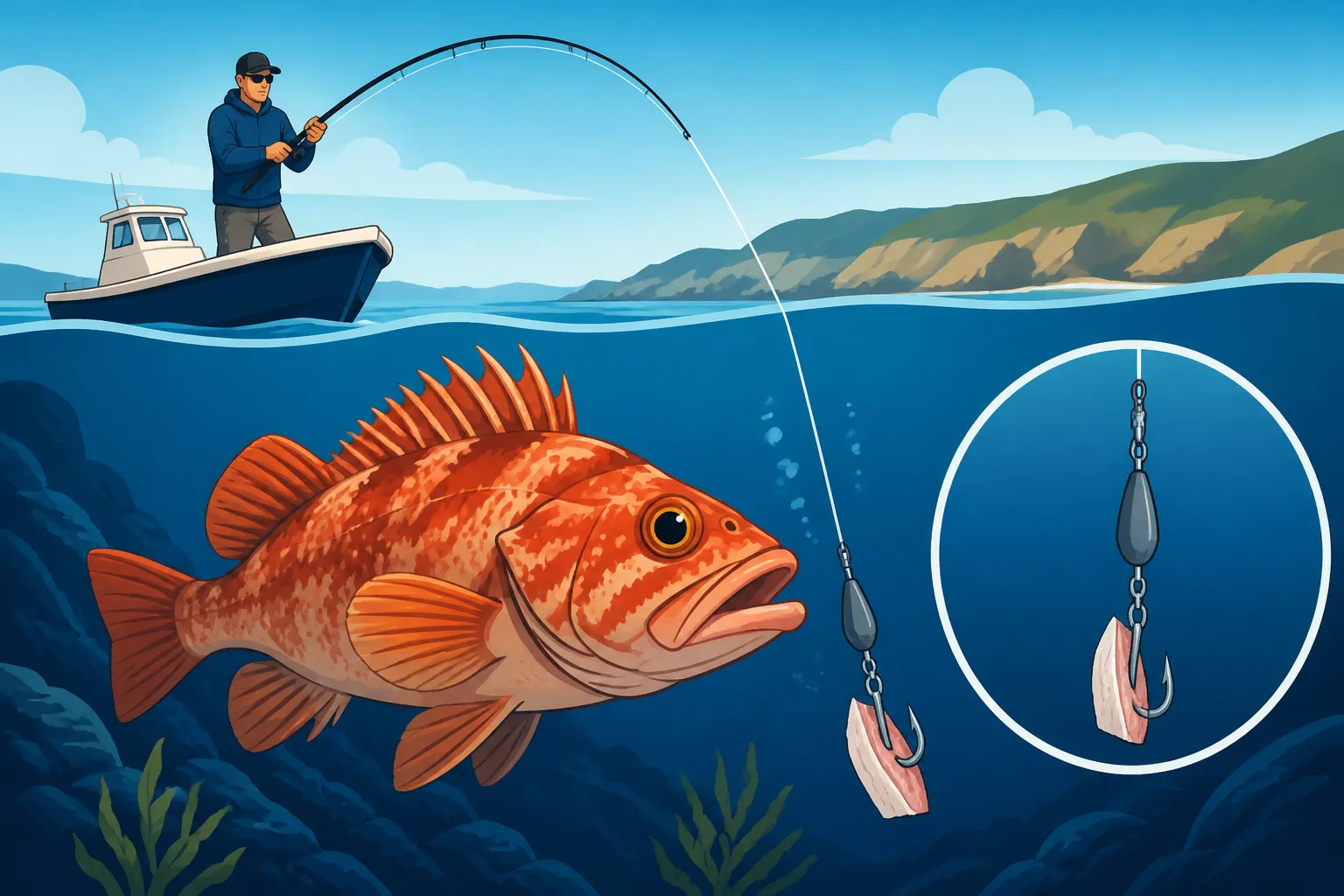
- Carolina Rig (or Bouncing Ball Rig): While more common for some shallow applications, a heavy Carolina rig can work. A barrel swivel connects your main line to a fluorocarbon leader (3-6 feet). A heavy sinker (often a sliding egg or torpedo sinker) is threaded onto the main line above the swivel, allowing the fish to pick up the bait without feeling the weight immediately. This can be great for presenting a single, larger bait.
You can find detailed instructions and diagrams for these setups in our guide on the Best Rigs for California Rockfish.
- Best Baits: For deepwater rockfish, squid is an absolute staple. It's tough, stays on the hook well, and is irresistible to many species. Cut bait like mackerel strips, anchovies, or sardine strips are also highly effective, releasing a strong scent trail in the water. If allowed and available, live bait like small anchovies or sardines can be dynamite, but keeping them alive at depth can be tricky.
- Feeling the Bottom: With any bait rig, it's crucial to know where your weight is. Let your rig hit the bottom, then reel up a few cranks to keep your bait just off the structure, avoiding snags. Every minute or so, let your weight fall back to the bottom to re-establish contact and ensure you're still in the strike zone, especially when drifting. This constant attention helps you detect the often subtle "thump" or "pull" of a rockfish bite in the deep.
Drifting and Anchoring Strategies
How you position your boat is just as important as your tackle and technique. Deepwater fishing almost always involves finding specific structure, and getting on top of it, and staying there, is key.
- Drifting: This is often the most common approach for deepwater rockfishing, especially in areas with widespread structure. The boat's movement allows you to cover more ground and search for active schools of fish. Use your fishfinder to mark promising ledges, pinnacles, or drop-offs.
- Controlling Your Drift: Wind and current can be your biggest enemies. A drift sock (sea anchor) deployed off the bow or stern can significantly slow your drift, allowing your baits more time in the strike zone and keeping your lines more vertical. Adjust the size and placement of your drift sock based on conditions. Keep a close eye on your GPS to monitor your drift speed and direction. If you're drifting too fast, your lines will angle out, making it harder to feel bites and increasing the chance of tangles.
- Interpreting Sonar: Learn to read your fishfinder. Look for hard bottom, sudden depth changes, and schools of baitfish or larger marks hovering near the bottom. These are prime areas to drop your lines. Once you've hooked a fish, mark the spot on your GPS so you can make another drift over the productive area.
- Anchoring: In certain situations, anchoring directly over a specific piece of productive structure can be incredibly effective, allowing you to thoroughly work a confined area. However, anchoring in deep water comes with its own set of challenges.
- Challenges of Deepwater Anchoring: It requires a lot of anchor line (typically 7:1 scope, meaning 7 feet of line for every 1 foot of depth), a substantial anchor, and often a powerful windlass. Heavy currents can also make it difficult to set and hold an anchor.
- When to Anchor: Consider anchoring if you find a very small, specific rockpile or pinnacle that's holding a lot of fish, and the current and wind are manageable. This allows multiple anglers to fish the same spot without drifting off. Always prioritize safety and ensure your anchor is well-set before deploying lines.
Ultimately, whether you're drifting or anchoring, effective use of your electronics (fishfinder and GPS) is non-negotiable. They are your eyes and ears in the deep, helping you locate the fish and stay on them. For a broader understanding of strategies, our guide on How to Catch Rockfish in California offers more foundational tips.
Navigating Regulations and Ethical Practices
Fishing in California, especially for sensitive species like deepwater rockfish, comes with strict regulations designed to protect these valuable resources. Being a responsible angler means not only knowing how to catch them but also understanding the rules and practicing ethical fishing.
Understanding California Rockfish Regulations
California's rockfish regulations are among the most complex, and they change frequently. Ignorance of the rules is no excuse, and penalties can be steep. Here are the key areas you absolutely must understand:
- Season Dates: Rockfish seasons vary dramatically by geographical management area (North, Central, and South Coast) and can even have sub-regions with different rules. For instance, the season for groundfish might open at different times in the Northern Management Area compared to the Central Management Area. These seasons are often closed for several months of the year to protect spawning populations. Always check the California Department of Fish and Wildlife (CDFW) website or the latest regulation booklet immediately before your trip.
- Bag and Size Limits: Each rockfish species often has its own bag limit (how many you can keep) and sometimes a size limit (minimum or maximum length). There's also a general aggregate bag limit for all rockfish species combined. Make sure you can identify common rockfish species, as covered in California Rockfish Species Identified, to ensure you're compliant.
- Depth Restrictions: This is particularly critical for deepwater fishing. The CDFW implements Rockfish Conservation Areas (RCAs), which dictate maximum fishing depths. These depth limits can change throughout the year and by management area (e.g., California Rockfish Rules in the Central Management Area might have different depth restrictions than the Southern or Northern areas). Fishing deeper than allowed in an RCA is a serious violation.
- Possession Limits: This refers to the total number of fish you can have in your possession, whether on your boat, in your vehicle, or at home. It's usually double the daily bag limit.
- Descender Devices: As mentioned earlier, if you're fishing for rockfish and plan to release any that show signs of barotrauma (bloated belly, bulging eyes, stomach protruding from mouth), you are legally required to have a functioning descender device on board and use it. These devices rapidly return the fish to depth, recompressing its swim bladder and significantly increasing its chances of survival.
- Marine Protected Areas (MPAs): Certain areas along the coast are designated as California Marine Protected Areas Explained, where fishing may be restricted or entirely prohibited. Always consult charts and regulations to ensure you're not fishing in a prohibited area.
The best source for the most up-to-date and comprehensive regulations is always the official CDFW sport fishing regulations booklet, available online or at license agents. Learning How to Read the California Fishing Regulations Booklet will save you a lot of headaches and potential fines.
Practicing Responsible Deepwater Fishing
Beyond just following the rules, responsible angling means adopting practices that minimize your impact and promote the health of the fishery.
- Barotrauma Awareness and Mitigation: If a fish comes up from deep water and you observe signs of barotrauma, and you intend to release it, immediately use your descender device. Don't delay. Gently clip the fish to the device and send it back down to the depth it was caught or until it swims away naturally.
- Proper Handling of Fish: Whether you're keeping a fish or releasing it, handle it carefully. Use wet hands to minimize damage to their protective slime coat. If keeping, dispatch the fish quickly and humanely.
- Minimizing Waste: Only keep what you can realistically eat or process. Avoid catching and releasing fish that are showing severe signs of barotrauma unless you can properly descend them. The goal is to make every kept fish count and every released fish survive.
- Conservation Mindset: Deepwater rockfish are slow-growing and long-lived, making them particularly vulnerable to overfishing. Their populations take a long time to recover. By adhering strictly to regulations, practicing responsible catch-and-release, and staying informed about the health of the fishery, you contribute to its sustainability for future generations.
| Species | Common Depth Range (feet) | Average Size (lbs) | Notes |
|---|---|---|---|
| Vermilion Rockfish | 100-600 | 3-8 | Prized eating fish, often found over rocky reefs. |
| Bocaccio | 150-1000 | 2-10 | Can form large schools, aggressive biters. |
| Canary Rockfish | 100-800 | 3-12 | Large, brightly colored, often near complex structure. |
| Yelloweye Rockfish | 150-1200 | 5-20+ | Very slow growing, often found in deep, rugged areas. Highly regulated/protected. |
| Lingcod | 50-800 | 5-30+ | Not a true rockfish, but often caught in the same deep habitats. |
| Chilipepper Rockfish | 200-1000 | 1-5 | Commonly caught in deeper water, good eating. |
Disclaimer
Fishing regulations, seasons, and limits in California are subject to change by the California Department of Fish and Wildlife (CDFW). Always consult the latest official CDFW regulations before engaging in any fishing activity. This guide is for informational purposes only and should not be considered a substitute for current legal regulations.