California Saltwater Fishing Regulations
There's nothing quite like the feeling of the salty air, the cry of gulls overhead, and the anticipation of a tug on your line as you fish California's stunning coastline or abundant offshore waters. But let's be honest, trying to decipher the seemingly endless list of California saltwater fishing regulations can feel like trying to untangle a hundred-pound snarl of fishing line in the dark. It’s overwhelming, it’s frustrating, and often, it makes you second-guess whether you’re even allowed to drop a line where you are. This comprehensive guide is here to cut through that confusion, breaking down the essential rules and regulations you absolutely need to know to enjoy a legal and responsible saltwater fishing adventure in the Golden State.
Why Saltwater Regulations Matter So Much in California
Fishing in California’s vast and diverse saltwater environments is an incredible privilege, but it comes with a serious responsibility. These regulations aren't just arbitrary rules designed to make your life harder; they are the bedrock of our conservation efforts, ensuring that these incredible fisheries remain healthy and productive for generations to come. Think about it: without careful management, the bounty we enjoy today could easily be depleted.
The Ever-Changing Landscape of Rules
One of the biggest frustrations anglers face in California is how frequently the regulations seem to shift. What was legal last season might be off-limits this season, or a specific area might have new restrictions. This constant evolution is a direct response to scientific data, fish stock assessments, and environmental changes. For example, if a specific rockfish population shows signs of decline, the California Department of Fish and Wildlife (CDFW) might implement new depth restrictions, reduce bag limits, or even close certain areas to fishing entirely. Keeping up with these changes is crucial, and it’s why savvy anglers always double-check the latest regulations before heading out. Relying on outdated information is a sure-fire way to end up with a violation, or worse, unintentionally harm a vulnerable species.
Protecting Our Marine Ecosystems
California's marine waters are home to an astonishing array of life, from the smallest anchovy to the mighty bluefin tuna. These ecosystems are incredibly delicate and interconnected. Saltwater fishing regulations play a vital role in protecting this biodiversity. They help prevent overfishing of specific species, which could have a cascade effect throughout the food chain. For instance, if too many anchovies are caught, it impacts the larger fish, marine mammals, and seabirds that rely on them for food. These rules also aim to minimize bycatch, protect critical habitats like kelp forests and rocky reefs, and ensure that our fishing practices are sustainable. It's about maintaining a delicate balance, allowing us to enjoy the resource while also safeguarding its future. Every regulation, from specific gear restrictions to seasonal closures, has a conservation purpose, even if it feels inconvenient at the moment.
Getting Your California Saltwater Fishing License
Before you even think about casting a line into the Pacific, you absolutely need to make sure your licensing is in order. This isn't just a suggestion; it's the law, and California takes it seriously. The good news is that getting your license is pretty straightforward, but there are some nuances for saltwater fishing specifically. If you're wondering How to Get a California Fishing License, this section will walk you through the specifics for ocean angling.
Who Needs a License and When
Generally speaking, anyone 16 years of age or older needs a valid California sport fishing license to fish in the ocean, bays, or estuaries. This applies whether you're casting from a private boat, a kayak, or even fishing from the shore or rocks. There are a few key exceptions, however. One notable one is that if you are fishing from a public pier in ocean waters, you generally do not need a fishing license. This is a fantastic opportunity for beginners or families to try out fishing without the upfront cost of a license. However, even on piers, all other regulations regarding species, size, bag limits, and gear still apply, so don't get complacent. Always check the specific rules for the pier you're visiting. If you're just visiting California, you'll also need to understand the California Fishing License Requirements for Visitors.
For everyone else, whether you're a seasoned local or just visiting, that license is non-negotiable. You can buy annual licenses, one-day, or two-day options, depending on your needs. For many, the convenience of an annual license is worth the investment, allowing spontaneous trips without worrying about last-minute purchases. You can grab your license online through the CDFW website, at authorized license agents like most sporting goods stores, or even some larger retailers. It's always a good idea to have your license physically with you, or at least a digital copy on your phone, because game wardens do check.
Essential Endorsements and Stamps
Just when you think you've got the license covered, California throws in a few extra requirements in the form of endorsements and stamps. These are additional fees that go towards specific conservation efforts or management programs. For saltwater anglers, the most common extra you'll encounter is the Ocean Enhancement Stamp. This stamp is required for anyone fishing in ocean waters south of Point Arguello (Santa Barbara County). This includes popular fishing destinations like the Santa Barbara Channel, Los Angeles, Orange County, and San Diego. The funds from this stamp specifically support programs that enhance marine resources, such as white seabass and abalone restoration efforts. If you're fishing north of Point Arguello, you typically won't need this stamp. This requirement for the California Ocean Enhancement Stamp is critical, so double-check your location!
While less common for purely saltwater pursuits, if you find yourself fishing for anadromous species like salmon or steelhead in their journey near ocean estuaries, you might also need specific report cards, which function like endorsements. These are crucial for data collection on these highly managed species. Always consult the current regulations booklet, which you can usually find online or pick up at a license agent, to confirm any additional requirements for your target species and location.
How to Secure Your License
The process of getting your California fishing license is pretty straightforward these days, thankfully. The most common and convenient way for many is to purchase it online directly from the CDFW website. This allows you to print a temporary license immediately and receive your official license in the mail. It's a lifesaver for those spur-of-the-moment fishing trips. When purchasing online, you'll need to create an account and provide some basic personal information.
Alternatively, you can visit a licensed vendor. These are typically bait and tackle shops, sporting goods stores like Big 5 Sporting Goods or Bass Pro Shops, and even some Walmarts. These agents can issue your license on the spot. They're also a fantastic resource for local knowledge, fishing reports, and often have the current regulations booklet available. The cost of a California fishing license can vary, so it’s good to check the current rates for your specific needs, whether it’s an annual resident license or a short-term visitor pass. You can learn more about the specific figures in our guide on California Fishing License Cost. Remember, once you have your license, you're responsible for understanding the rules that come with it.
General Saltwater Fishing Rules You Can't Ignore
Beyond just having a license, there's a whole framework of general rules that apply to nearly all saltwater fishing in California. These are the fundamental guidelines that ensure ethical fishing practices, protect marine life, and promote fair chase. Skipping over these basics can lead to immediate trouble, so pay close attention.
Hook, Line, and Sinker: Tackle Requirements
When it comes to your tackle, California has some specific rules, especially concerning hooks. A major one to be aware of, particularly in certain areas or when targeting specific species, is the requirement for barbless hooks. While not universally mandated for all saltwater fishing, barbless hooks are highly recommended for catch-and-release fishing as they cause less harm to the fish, increasing their survival rate. For instance, specific anadromous fisheries (like those for salmon or steelhead when they are in fresh or brackish water) often strictly require barbless hooks. Always check the specific regulations for your target species and fishing location.
Beyond barbs, there are rules about the number of hooks and lines you can use. Generally, in saltwater, you're limited to two rods and lines. Each line can typically have no more than two hooks. This means you can't go out with a multi-hook "gang rig" designed for commercial fishing. The intent is to keep sport fishing, well, sporty. Using illegal tackle can result in fines and confiscation of your gear. It’s important to stay informed about these specifics, as they can sometimes vary by region or species. You can find more detailed information in the comprehensive California Fishing Regulations Explained guide.
Fin Clipping and Species Identification
Accurate species identification is paramount in California saltwater fishing. This is because bag limits, size limits, and even seasonal closures are often species-specific. For example, knowing the difference between a kelp bass, a sand bass, and a spotted bay bass is critical, as they each have different regulations. Misidentifying a fish could lead to a violation, even if you caught a legal amount of a different species. It's on you, the angler, to know what you've caught. Carrying a good fish identification guide, or having a reliable app on your phone, is highly recommended.
Then there's the fin-clipping rule, primarily impacting certain salmon fisheries, though it’s crucial to understand for saltwater anglers who might encounter these fish. Many hatchery-reared salmon are marked with an adipose fin clip – a small fleshy fin on their back is removed before release. In some years and areas, only fin-clipped salmon are legal to retain. This is a measure to protect wild, naturally spawning salmon populations. If you catch a salmon and it has an intact adipose fin in an area where only fin-clipped fish are allowed, it must be immediately released unharmed. This requires careful observation and a quick decision, which is why it's vital to have this knowledge beforehand. Always carry a measuring device, like a tape measure or a fish ruler, to quickly check sizes too. Many fishing accessories available on platforms like Amazon will include these handy tools.
Protecting Special Status Species
California is home to several marine species that are considered endangered, threatened, or species of special concern. These species are heavily protected, and fishing for them is either strictly prohibited or comes with severe restrictions. Examples include certain abalone species (all recreational abalone fishing is currently closed in California), some rockfish populations, and various marine mammals. It is absolutely illegal to intentionally fish for, harass, or harm these protected species.
Even unintentional interactions must be handled with care. If you accidentally hook a protected species, you must release it immediately and with as little harm as possible. This often means cutting your line if retrieving the hook would cause further injury. Knowing which species are protected in your fishing area is just as important as knowing your target species. The CDFW website provides detailed information on protected species, and reviewing this list is part of being a responsible angler. Penalties for violating these protections can be substantial, including hefty fines and even jail time, underscoring the seriousness of these regulations.
Understanding Bag and Size Limits for Common Saltwater Species
One of the most complex, yet critical, aspects of California saltwater fishing regulations involves bag and size limits. These rules are put in place to ensure sustainable fishing practices, allowing enough fish to mature and reproduce, and preventing local populations from being depleted. These limits are rarely one-size-fits-all, often varying by species, time of year, and even geographical location.
Rockfish and Lingcod: A Complex Fishery
Ah, rockfish and lingcod – staples of the California bottom fishing scene. But let me tell you, navigating their regulations can be a true head-scratcher. The rules for rockfish are particularly intricate because there are so many different species, and their populations vary widely. Generally, rockfish are managed under a broad "Rockfish, Cabezon, and Greenling (RCG) complex" with a statewide bag limit, often a total of 10 RCG fish, with sub-limits on certain species like vermilion rockfish (usually a stricter 4-fish sub-limit within the 10). Within this complex, there are also minimum size limits for specific species. For instance, bocaccio, a popular rockfish, often has a minimum size.
Lingcod, while often caught in the same areas as rockfish, have their own distinct regulations, typically a daily bag limit of two fish and a minimum size limit, usually around 22 inches. What really throws a curveball into this fishery are the specific management areas and their associated depth restrictions and seasonal closures. For example, the season for rockfish and lingcod can open and close at different times in Northern California (e.g., San Francisco and north) compared to Southern California (e.g., Santa Barbara and south). Furthermore, depth restrictions can change; in some years, you might be limited to fishing in 60 feet of water or less, while in others, deeper fishing might be allowed during specific periods. It's a lot to keep track of, but resources like the CDFW's ocean sport fishing regulations booklet and online summaries are invaluable. Our guide on California Rockfish Regulations and Limits and California Lingcod Regulations and Limits delves even deeper into these specific rules.
Halibut and White Seabass: Prized Catches
California halibut and white seabass are two of the most sought-after fish on the coast, known for their excellent table fare and thrilling fights. Because of their popularity and historical fishing pressure, they are subject to strict regulations.
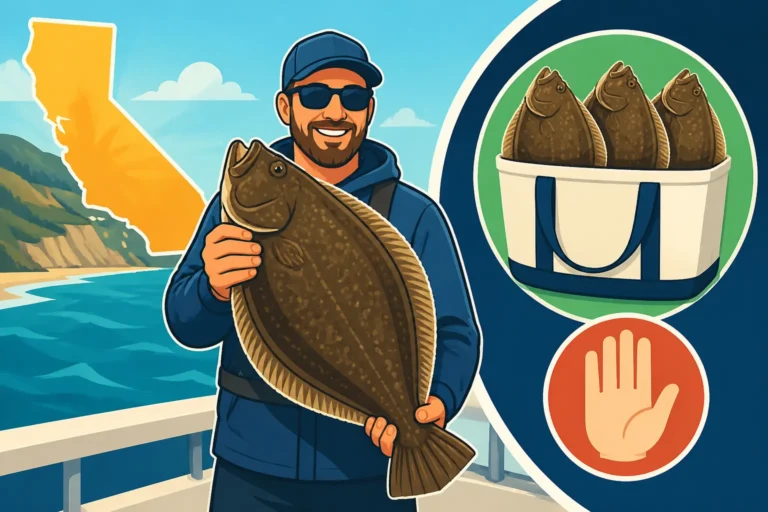
For California halibut, the general statewide bag limit is often three fish per person per day, with a minimum size limit of 22 inches total length. However, like many species, these limits can change. For example, during certain times in San Francisco Bay or other estuaries, there might be stricter limits. Halibut are typically measured from the tip of the jaw (mouth closed) to the tip of the longest lobe of the tail, so always have a reliable measuring tape on hand. Our specific article on California Halibut Size and Bag Limits provides even more detail.
White seabass are another highly prized species, known for their powerful runs and large size. Their bag limit is generally one fish per person per day, with a hefty minimum size limit, usually around 28 inches total length. Like halibut, this measurement is from the tip of the jaw to the tip of the longest lobe of the tail. Both of these species also have specific gear restrictions and often come with seasonal considerations, particularly for white seabass which can have seasonal closures in certain areas to protect spawning aggregations. Due to the high value and strict regulations, wardens often pay close attention to anglers targeting these species.
Tuna and Pelagic Species: Offshore Adventures
When you head offshore into the deep blue, you're often targeting migratory pelagic species like various tunas, dorado (mahi-mahi), yellowtail, and even marlin. These fish travel vast distances, and their regulations are often influenced by international agreements as well as state and federal management plans.
Tuna species, such as bluefin, yellowfin, and albacore, are subject to daily bag limits that can vary by species and year. For instance, bluefin tuna might have a limit of two fish, while yellowfin or albacore could have a limit of ten or more. These limits are usually aggregate, meaning a total number of all tuna species combined, with specific sub-limits for individual species. Size limits are less common for many tuna species, but for bluefin, there might be specific regulations concerning minimum or maximum lengths, or a slot limit, to protect different age classes.
Yellowtail (often called California yellowtail) are another highly popular offshore target, known for their incredible fight. They typically have a bag limit of 10 fish per person, with a minimum size limit, usually 24 inches total length. Dorado (Mahi-Mahi) usually have a 10-fish bag limit, with a 24-inch minimum, and often come with a strict rule that no more than 5 dorado may be 20 inches or less.
Keeping track of these offshore regulations can be a bit easier since they tend to be more stable than bottomfish rules, but always verify before a trip. Your sportfishing boat captain will also be an excellent source of information for current offshore limits.
Nearshore Species and Invertebrates
Don't forget the incredible diversity of nearshore species and invertebrates that call California's coastal waters home! This category includes everything from various perch and croaker species found in the surf to crabs, lobsters, and even clams.
For many surfperch species (e.g., barred surfperch, walleye surfperch), there’s often a generous aggregate bag limit, perhaps 20 fish per day, with a minimum size limit of around 10.5 inches. Other inshore species like corbina also have specific limits, often stricter than perch.
Invertebrates are a whole separate ballgame. Recreational crabbing for Dungeness crab and rock crabs requires specific gear (traps or hoop nets) and has strict size, sex, and seasonal limits. For example, Dungeness crab season typically runs from November to June, but this can shift based on meat quality and domoic acid levels. Lobster fishing is also highly regulated, requiring a specific recreational lobster report card, hoop nets, and adhering to strict minimum size limits and seasonal closures (usually October through March). Similarly, clamming regulations vary by species and location, with specific harvest methods, bag limits, and often seasonal closures.
It is absolutely crucial to consult the relevant sections of the CDFW regulations booklet for invertebrates. These rules are particularly detailed and often include specific illustrations to help you identify legal-sized and legal-sexed animals. Never guess when it comes to invertebrates; the fines can be steep, and you don't want to accidentally contribute to overharvesting these sensitive populations. Many anglers swear by specialized hoop nets found on Amazon for ethical lobster and crab harvesting.
| Species Category | Common Species | Typical Bag Limit | Typical Size Limit | Key Consideration |
|---|---|---|---|---|
| Rockfish Complex | Vermilion, Bocaccio, Lingcod | 10 RCG total (sub-limits apply) | Varies by species (e.g., Bocaccio 10") | Subject to depth limits and seasonal closures. |
| Lingcod | Lingcod | 2 | 22" minimum | Often caught with rockfish, but distinct limits. |
| California Halibut | Halibut | 3 | 22" minimum | Measure accurately, from jaw to tail. |
| White Seabass | White Seabass | 1 | 28" minimum | Highly prized, seasonal closures possible. |
| Yellowtail | Yellowtail | 10 | 24" minimum | Great fighter, often found offshore. |
| Bluefin Tuna | Bluefin Tuna | 2 (may vary) | Varies, often slot limit | Federal and international management. |
| Surfperch | Barred, Walleye | 20 (aggregate) | 10.5" minimum | Inshore species, popular for surf fishing. |
| Dungeness Crab | Dungeness Crab | 10 (either sex) | 5.75" minimum (carapace) | Seasonally restricted, requires specific gear. |
| Spiny Lobster | California Spiny Lobster | 7 | 3.25" minimum (carapace) | Requires report card, seasonal, hoop nets only. |
Note: This table provides typical regulations. Always consult the current California Department of Fish and Wildlife (CDFW) ocean sport fishing regulations booklet for the most up-to-date and legally binding information. Regulations can change frequently.
Navigating Seasonal Closures and Depth Restrictions
Just as important as knowing what you can catch and how many, is knowing when and where you can fish. California's dynamic marine environment necessitates a fluid approach to management, leading to seasonal closures and depth restrictions that anglers absolutely must respect. Failing to do so isn't just a simple mistake; it's a violation that can have significant consequences for both you and the fish populations.
Rockfish Conservation Areas and Depth Rules
The regulations surrounding Rockfish Conservation Areas (RCAs) and associated depth limits are arguably the most complex and frequently updated rules for California's saltwater anglers. RCAs are specific geographic zones where bottom fishing is restricted or prohibited to protect vulnerable groundfish species, particularly various rockfish, lingcod, and other deep-dwelling fish. These areas often coincide with critical habitat or zones where certain species are known to aggregate.
What makes it tricky is that these depth restrictions can vary by region (e.g., Northern, Central, and Southern California management areas) and by season. For instance, in some years, winter might see a complete closure of deeper water, limiting you to fishing in waters less than 60 feet, while summer might allow fishing out to 300 feet or more. These depth changes are usually announced by the CDFW well in advance, but it's crucial to check the most current regulations for the specific area and time you plan to fish. Going out beyond a specified depth limit, even unintentionally, can result in severe penalties. Using a reliable marine chart plotter with depth contours is essential for any boat angler. This detailed management is why we have a dedicated guide on California Rockfish Depth Restrictions.
Salmon and Halibut Season Specifics
While many species are open year-round, salmon and halibut have very specific and often fluctuating seasons.
Ocean salmon season in California is notoriously variable and often announced relatively late in the year, sometimes even changing mid-season. This is because the season dates, bag limits, and even allowable gear are highly dependent on forecasts of salmon returns, particularly Chinook (King) salmon, and are influenced by federal and international fishery management councils. For example, some years, only a very limited season might be allowed off the coast of Fort Bragg or San Francisco, while other years might see broader opportunities. These seasons can also be broken into different periods for different management areas. Anglers targeting salmon offshore must also be aware of minimum size limits and gear restrictions, such as the requirement for barbless hooks. Keeping an eye on the California Salmon Season Dates is critical if salmon is your target.
California halibut season is generally open year-round for recreational take, but there can be specific localized closures or restrictions, especially within bays and estuaries, to protect spawning aggregations or specific nursery areas. While not a "season" in the traditional sense like salmon, paying attention to local announcements is still important. Both species are also subject to specific bag and size limits, which we covered earlier, but it’s worth reiterating that these often go hand-in-hand with seasonal considerations.
Marine Protected Areas: Know Before You Go
California has established an extensive network of Marine Protected Areas (MPAs) along its coast. These are designated ocean areas designed to protect marine life and habitats, and they come with various levels of protection, from "no-take" zones where all fishing and harvesting are prohibited, to areas with more limited restrictions. The key is that all MPAs have some form of fishing restriction, and it is your responsibility to know where they are and what those restrictions entail.
There are different types of MPAs:
- State Marine Reserves (SMRs): These are the most restrictive, generally prohibiting all recreational and commercial fishing and take of marine resources. Think of them as underwater national parks.
- State Marine Parks (SMPs): These typically allow some recreational fishing, but often prohibit commercial fishing and have specific restrictions on certain gear or species.
- State Marine Conservation Areas (SMCAs): These are the most flexible, allowing some recreational and commercial fishing activities, but often with specific restrictions on gear, species, or seasons.
The boundaries of MPAs can be complex, often following lines of latitude and longitude or specific landmarks. Relying on GPS charts on your boat or a good map app on your phone that shows MPA boundaries is absolutely essential. Many anglers use resources like the CDFW's online MPA maps or apps to avoid accidental violations. For example, if you're fishing near popular areas like the Channel Islands or around Monterey Bay, you'll encounter numerous MPAs. Unintentionally fishing in a "no-take" zone carries serious penalties. Ignorance of the boundary is not a defense. Our guide on California Marine Protected Areas Explained is a must-read for anyone fishing our coastal waters.
Crucial Reporting Requirements: Report Cards and Logbooks
Beyond your general fishing license, California has implemented specific reporting requirements for certain species. These aren't just extra paperwork; they are absolutely vital data collection tools that allow the CDFW to monitor populations, assess fishing pressure, and make informed decisions about future regulations. Failing to comply with these reporting requirements is a violation, regardless of whether you actually caught any fish.
The Ocean Enhancement Stamp and its Purpose
Earlier, we mentioned the Ocean Enhancement Stamp as an essential endorsement for fishing in ocean waters south of Point Arguello. Let's delve a little deeper into its purpose and what it entails. This stamp is not a report card, but rather a dedicated funding mechanism. The revenue generated from the sale of this stamp directly supports programs managed by the Ocean Resources Enhancement and Hatchery Program (OREHP).
The primary focus of OREHP is to enhance populations of white seabass and abalone through aquaculture (hatchery rearing) and subsequent release into the wild. For example, white seabass raised at facilities like the Leon Raymond Greenberg Marine Fish Hatchery in Carlsbad are released into Southern California waters to supplement wild stocks. The stamp also funds research into the effectiveness of these enhancement programs and helps protect critical marine habitats. So, while it might seem like another fee, it’s a direct contribution to the health and abundance of the fisheries you enjoy. If you're fishing in the relevant Southern California waters, purchasing and having this stamp on your license is mandatory. It’s usually printed directly onto your fishing license or issued as a separate sticker.
What Happens If You Don't Report
The consequences of failing to comply with reporting requirements for report cards (such as those for Steelhead or Sturgeon, if you were to encounter them in saltwater estuaries, though this article focuses mainly on purely marine species) or if you simply ignore the rules regarding the Ocean Enhancement Stamp can be significant. First and foremost, you're looking at a citation and fine. These fines can range from a couple of hundred dollars to much steeper penalties, depending on the severity and nature of the violation. A first offense might be a warning and a fine, but repeat offenses can lead to much more serious consequences.
Beyond the monetary fine, you could also face confiscation of your gear. Imagine losing your favorite rod and reel, or your brand-new kayak, because you didn't properly report your catch or buy a required stamp. In some cases, particularly for serious or repeated violations, your fishing license could be suspended or revoked. This means you wouldn't be able to legally fish in California for a set period, or potentially ever again.
But it’s not just about the personal penalty. When anglers fail to report their catches (or lack thereof), it creates incomplete and inaccurate data for the CDFW. This directly hinders their ability to effectively manage fish populations. If they don't know how many fish are being caught, or how many people are fishing for a particular species, their stock assessments will be flawed. This can lead to either overly restrictive regulations (to compensate for lack of data) or, worse, unsustainable practices that could damage the fishery in the long run. So, every time you fill out a report card, you're contributing to the health of the resource.
Special Considerations for Pier and Shore Fishing
Not everyone has a boat or a kayak, and that's perfectly fine! California offers fantastic opportunities for land-based angling, whether you're casting from a public pier, a rocky jetty, or a sandy beach. While often more accessible, these forms of fishing still come with their own specific set of regulations and considerations that are important to understand.
The Pier Fishing License Exemption
This is arguably the most well-known and appreciated exception to California’s fishing license requirements: you do not need a fishing license to fish from a public pier in ocean waters. This is a huge benefit for families, tourists, and anyone wanting to try fishing without the initial investment of a license. Public piers are designated structures that extend over ocean water, typically managed by a city or county. However, this exemption is quite specific.
It only applies to public piers in ocean waters. If you're fishing from a private dock, a jetty (which is usually considered shore fishing), or a pier in a freshwater lake or river, the license exemption does not apply. Always confirm the specific status of the structure you're on. Even with the license exemption, all other sport fishing regulations still apply. This means you must adhere to bag limits, size limits, seasonal closures, gear restrictions, and any species-specific rules. For example, if the legal size limit for halibut is 22 inches, you can't keep a 15-inch halibut just because you're on a pier and don't have a license. This is a common misconception that often leads to citations. Our guide on Fishing from a Pier in California: Rules covers this in much more detail.
General Shore Fishing Rules
When you're fishing from the shore, be it a sandy beach, rocky outcrop, or cliffside, the rules revert to standard sport fishing regulations. This means:
- You absolutely need a valid California fishing license if you are 16 years of age or older.
- All statewide and regional bag limits, size limits, and seasonal closures apply to the species you are targeting.
- Gear restrictions, such as the number of rods and hooks, are in full effect.
Beyond the fishing-specific rules, shore anglers need to be mindful of broader coastal regulations. This includes respecting private property boundaries, adhering to park rules (some beaches or coastal parks might have specific restrictions on fishing hours or bait use), and being aware of Marine Protected Areas (MPAs). If you're surf fishing, for instance, and unknowingly step into a "no-take" SMR, you're in violation. Always check local signs and carry a map or GPS that shows MPA boundaries. Safety is also a huge concern for shore anglers; unpredictable waves, slippery rocks, and changing tides can be dangerous, so always prioritize your personal safety.
Specific Bait and Gear for Shore Anglers
While general tackle regulations apply, shore fishing often involves specific bait and gear choices that have their own considerations. Live bait, such as sand crabs, bloodworms, or anchovies, is extremely popular for species like surfperch, corbina, and halibut. If you're collecting your own bait, be aware that there are often specific limits on the amount and type of bait you can collect. For example, there are limits on how many ghost shrimp or sand crabs you can dig. It's also illegal to use certain invasive species as bait. Always check the regulations for bait collection.
As for gear, a typical surf fishing setup involves a long rod (9-12 feet) to cast beyond the breaking waves, a sturdy spinning reel, and suitable line. Lures like Kastmasters, Lucky Craft, or various soft plastics are effective for different species. Many anglers find high-quality surf fishing gear, including specialized rod holders and bait pumps for sand crabs, available on Amazon, which can significantly enhance the shore fishing experience. Whether you're using bait or lures, ensure your hooks comply with any barbless requirements for the area or species. Respecting the environment means cleaning up after yourself, properly disposing of monofilament line, and leaving no trace.
Penalties and Enforcement: Don't Risk It
Understanding the regulations is one thing, but knowing the potential consequences of not following them is another motivator entirely. The California Department of Fish and Wildlife (CDFW) employs dedicated game wardens who patrol our waters and shores, ensuring compliance. Their job is to protect our natural resources, and they take violations seriously. Ignorance of the law is never an excuse.
Common Violations and Their Fines
Many fishing violations are unfortunately common, often stemming from a lack of awareness or simply hoping to get away with it. Here are some of the most frequent infractions and their typical consequences:
- Fishing without a valid license: This is a basic one, but surprisingly common. The fine for this can be several hundred dollars, plus court fees. If you're a repeat offender, the penalties escalate. You can learn more about the specifics of California Fishing Without a License Penalty in our dedicated guide.
- Exceeding bag limits: Keeping more fish than legally allowed is a direct violation. Fines for this can vary widely depending on the species and the number of fish over the limit, potentially reaching hundreds or even thousands of dollars, especially for highly regulated species like white seabass or abalone (when it was open).
- Keeping undersized fish: This is another common mistake. Accidentally keeping a fish that doesn't meet the minimum size requirement can result in a fine. The smaller the fish and the more you keep, the higher the penalty.
- Fishing during a closed season or in a closed area (e.g., MPA): This is a serious offense, often carrying hefty fines and potentially confiscation of gear. Fishing in an SMR (State Marine Reserve) can lead to fines starting in the thousands of dollars.
- Using illegal gear or methods: Using too many hooks, the wrong type of net, or prohibited bait falls under this category. Fines apply, and the gear will almost certainly be confiscated.
- Failure to complete or return report cards: Even if you didn't catch anything, failure to return a required report card (like a lobster report card) by the deadline is a violation and can result in fines.
It's not just about the monetary cost; having a fishing violation on your record can sometimes impact other aspects of your life, though typically less severely than criminal convictions. The goal is to deter behavior that harms the fish populations.
How CDFW Enforces Regulations
CDFW game wardens are fully sworn peace officers with the authority to enforce not only fishing regulations but also other state laws. They are highly trained and often patrol by vehicle, boat, and even on foot in remote areas. They conduct routine checks at boat ramps, piers, harbors, and even while you're actively fishing on the water or from shore.
Wardens have the authority to:
- Stop and inspect: They can stop your vessel, vehicle, or personally inspect your catch, gear, and license at any time. You are required to comply with these inspections.
- Ask questions: They can ask about your fishing activity, where you've been, what you've caught, and how you caught it.
- Issue citations: If a violation is found, they can issue a citation, which is essentially a ticket requiring you to pay a fine or appear in court.
- Confiscate evidence: They can seize illegally caught fish, prohibited gear, or anything else used in a violation as evidence.
- Make arrests: For more serious offenses, they have the power to make arrests.
Remember, wardens are professionals dedicated to conservation. A polite and cooperative attitude goes a long way. If you are unsure about a regulation, it's always better to ask a warden or call the CDFW before you potentially violate a rule. They are often happy to educate responsible anglers.
The Importance of Personal Responsibility
Ultimately, the responsibility for knowing and following California's saltwater fishing regulations rests squarely on you, the angler. While charter boat captains and fishing guides will certainly inform you of the rules for your trip, when you're on your own, it's all on you. This isn't just about avoiding fines; it's about being a steward of the environment.
Every time you choose to adhere to a bag limit, release an undersized fish gently, or avoid fishing in a closed area, you're actively contributing to the health of our marine ecosystems. This personal responsibility ensures that the incredible fishing opportunities we have in California will continue for generations. Take the time to read the current regulations booklet, download the CDFW app, and consult reliable sources before each trip. It's a small investment of your time that pays huge dividends in sustainable fishing and peace of mind.
Disclaimer
Please note that fishing regulations are subject to change. While every effort has been made to provide accurate and up-to-date information in this guide, it is your responsibility to consult the official California Department of Fish and Wildlife (CDFW) ocean sport fishing regulations booklet or website for the most current and legally binding rules before engaging in any fishing activity. This article is for informational purposes only and should not be considered legal advice.