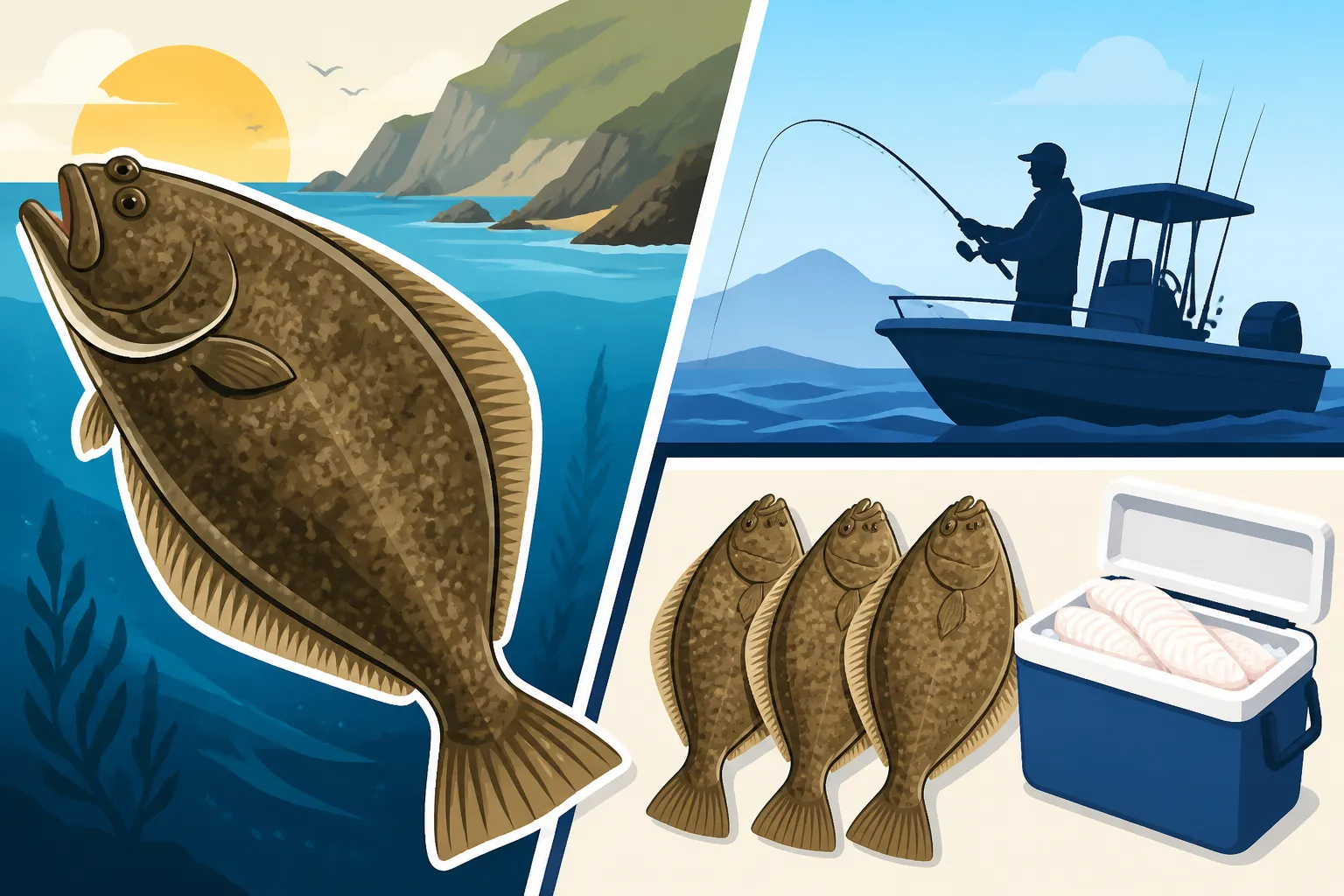
California Halibut Size and Bag Limits
There is nothing quite as heart-stopping for a California angler as watching a heavy, flat silhouette emerge from the murky green depth, only to realize you are not entirely sure if it hits the legal mark. Navigating California halibut size and bag limits can feel surprisingly overwhelming, especially when ocean management zones change and species look deceptively similar. This comprehensive guide breaks down every size requirement, regional bag limit, identification quirk, and rigging rule so you can fish with complete confidence and avoid costly citations on the water.
California Halibut vs. Pacific Halibut Regulations
Physical Differences and Identification Trapping Anglers
For anyone drop-shotting in the surf or drifting in a quiet bay, mistaking a Pacific halibut for a California halibut is easier than you might think, but the legal consequences of getting it wrong are severe. The two species belong to completely different flatfish families, and state wildlife officials hold anglers strictly accountable for knowing the difference. The primary physical marker lies in the mouth and jaw structure. A California halibut boasts a large mouth filled with sharp, prominent teeth designed for seizing agile baitfish like anchovies and smelt. In contrast, a Pacific halibut features a much smaller, duck-like mouth with smaller teeth adapted for crushing bottom-dwelling invertebrates and smaller forage.
Another telling characteristic is the lateral line running down the top side of the fish. A California halibut has an arched lateral line that curves distinctly upward right above the pectoral fin. On a Pacific halibut, that lateral line is remarkably straight from gill plate to tail, lacking a dramatic arch. Furthermore, California halibut are unique among flatfish because they can be “left-eyed” or “right-eyed,” meaning their eyes can lie on either the left or right side of their body. Pacific halibut are almost universally right-eyed. mistaking a juvenile Pacific halibut for a legal California halibut can result in an accidental citation, so taking a second look at the mouth arch and teeth before tossing a fish into your cooler is an essential habit.
Regulatory Distinction Between Species in California Waters
Because these two species are governed under separate frameworks, they carry completely different season dates, bag limits, and size requirements. The management of California halibut is overseen by state wildlife authorities, designed to sustain healthy coastal populations while accommodating year-round angling opportunities in many parts of the state. Understanding California Saltwater Fishing Regulations is critical because California halibut rules focus primarily on minimum size cutoffs and localized daily bag limits.
Pacific halibut, on the other hand, are managed internationally and nationally through coordinated marine fisheries commissions. Pacific halibut have strict annual quota caps, specific open seasons, and unique size parameters that fluctuate based on commercial and recreational catch quotas. If you happen to be drift fishing off the coast of Humboldt or Mendocino County where the ranges overlap, catching a Pacific halibut out of season or keeping one under the wrong regulatory criteria can draw heavy fines. Always verify which species is currently on your line before deciding to keep it.
Regional Range Boundaries and Overlapping Management
While California halibut can be caught anywhere from Baja California up into Washington state, they are far more abundant in the warm, shallow sandy stretches of Southern California and central hubs like San Francisco Bay. Pacific halibut prefer the colder, deeper waters of the Pacific Northwest, though their territory stretches south into Northern and Central California. The geographic sweet spot where both species frequently cross paths runs roughly from Point Conception up through Cape Mendocino.
In these overlapping zones, game wardens routinely inspect catches at launch ramps and public harbors. Anglers drifting over offshore banks or near deep structure might pull up both species on the very same drift. To keep yourself safe from legal trouble, memorize the mouth profile and lateral line arch. Keeping a waterproof marine life identification card in your tackle box or searching for quick digital references on Amazon before heading out into northern ocean waters can save you from an expensive oversight at the dock.
Understanding California Halibut Size Limits
Minimum Size Thresholds Across State Waters
The core standard across the state for California halibut is a strict minimum size limit of 22 inches total length. This regulation is designed to ensure that female halibut reach sexual maturity and have an opportunity to spawn at least once or twice before being removed from the ecosystem. A 22-inch California halibut is typically around four to five years old, representing a healthy, thriving fish capable of sustaining local populations.
Whether you are targeting flatfish from a kayak in San Diego Bay, drift-fishing near Santa Cruz, or tossing swimbaits into the surf off Santa Monica, that 22-inch mark remains your absolute benchmark. Keeping a fish even a fraction of an inch short of this limit is considered a serious wildlife violation. State wildlife officers do not offer warnings or benefit-of-the-doubt margins for undersized fish. For a detailed breakdown of overall flatfish governance, reviewing the broader California Halibut Regulations and Limits will keep you fully informed before your trip.
Proper Measurement Techniques to Prevent Citations
Measuring a flatfish sounds simple, but improper technique is one of the most common reasons well-intentioned anglers get ticketed. To measure a California halibut legally, lay the fish completely flat on a smooth surface or a rigid bump board. The nose or snout of the fish must be pressed firmly against a flat vertical headboard, with the mouth completely closed.
To take the measurement:
1. Lay the fish flat on its side on a clean, solid board or flat boat deck.
2. Press the tip of the snout firmly against the flat zero-mark stop at the end of the board.
3. Pinch the lobes of the tail fin together gently to reach the maximum total length.
4. Check the measurement line directly from above to eliminate visual angles that cause errors.
Never measure a fish while it is hanging from a lip gripper or resting curled up in the bottom of a flexible rubber landing net. Curving the fish over your knee or using a soft fabric tape measure dragged across the contoured body of the fish will give you an inaccurate, inflated reading. Rigid aluminum measuring scales or durable plastic bump boards, which are easily ordered on Amazon and mounted to your kayak or boat gunwale, provide an exact flat measurement line that matches the method game wardens use during field inspections.
Handling Sub-Legal Fish and Release Best Practices
When you bring a fish to the boat or beach that measures 21 and a half inches, the frustration can be intense. However, handling sub-legal halibut with gentle care is vital for the fishery’s future. California halibut possess soft, delicate skin and small scales that are easily dislodged by dry hands or rough canvas landing nets. Losing these protective outer coatings leaves the fish susceptible to fatal bacterial infections after release.
Always wet your hands thoroughly before touching a undersized halibut, and keep the fish in the water as much as possible while removing the hook. If the fish has swallowed the hook deeply into its throat or gut—a common occurrence when using live anchovies or sardines—do not forcefully pull on the leader. Cutting the line as close to the eye of the hook as possible gives the fish a dramatically higher chance of survival, as its digestive juices will break down soft wire hooks over time. Using barbless circle hooks or unbarbing your treble hooks can make releasing undersized fish much faster and safer.
Daily Bag and Possession Limits Explained
North vs. South Geographic Boundaries for Bag Limits
While the minimum size limit of 22 inches applies statewide, the daily bag limit for California halibut changes depending on where you are fishing. The state uses Point Sur in Monterey County as a major management dividing line. Knowing exactly which side of Point Sur you are drifting on is critical, as bag limits shift significantly north and south of this geographic landmark.
South of Point Sur—which encompasses popular fishing grounds around San Luis Obispo, Santa Barbara, Ventura, Los Angeles, Orange County, and San Diego—the daily bag limit is five California halibut per person. North of Point Sur—including Monterey Bay, San Francisco Bay, Bodega Bay, and up to the Oregon border—the daily bag limit drops down to three California halibut per person. Understanding this distinction is vital, especially if you are taking multi-day coastal boat trips across regional lines.
Daily Bag Limits and Total Boat Limits
Understanding your individual daily allowance is straightforward, but boat limits can create confusion on multi-angler charters and private vessels. A daily bag limit represents the maximum number of legal fish a single licensed angler may harvest in a single calendar day. For complete details on how daily catches are legally calculated, refer to the guide on California Halibut Bag Limit Explained.
Under California sport fishing regulations, boat limits are permitted on private boats and sportfishing vessels carrying multiple licensed anglers. A boat limit allows the boat as a whole to keep a cumulative total of fish equal to the sum of the individual daily bag limits for all licensed anglers onboard. However, once the collective boat limit is reached, every angler must cease fishing for that species. Furthermore, an individual angler can never take home more than their personal daily limit once they leave the boat.
Possession Limits for Multi-Day Trips and Processing
Possession limits dictate how many fish you may legally have in your possession at any given time, including on your boat, in your vehicle, or in your freezer at home. In California, the sport fishing possession limit for California halibut is equal to two daily bag limits. This means that if you are fishing south of Point Sur, your possession limit is 10 fish; north of Point Sur, your possession limit is six fish.
If you are participating in an extended multi-day fishing trip on a commercial passenger fishing vessel or private boat, specific multi-day permit rules allow you to possess up to two daily bag limits provided you meet strict record-keeping requirements. When filleting your catch at sea, state rules require that you leave a specific patch of skin attached to each fillet so fish wardens can easily verify the species. For detailed information on length cutoffs and retention rules, review the guide on California Halibut Size Limit Explained.
Seasonal Variations and Regional Depth Restrictions
Tides, Currents, and Seasonal Halibut Movement
California halibut are highly responsive to seasonal temperature shifts and tidal movements. During late winter and early spring, adult halibut move out of deep offshore waters into shallow bays, estuaries, and surf zones to feed and spawn. This spring movement creates some of the best angling opportunities of the year for surf casters and bay drifters alike. Understanding how environmental patterns influence fish movement can dramatically raise your success rate.
Tidal flow plays a huge role in halibut feeding behavior. During strong incoming tides, halibut drift up onto shallow mudflats and sandbars to hunt dislodged crabs, shrimp, and small baitfish. On outgoing tides, they settle into deep channels and drop-offs, burying themselves in the sand to ambush bait flushing out of the estuaries. Anglers looking to maximize their time on the water should study local tide charts and read up on Best Tides for California Halibut to schedule their trips during peak feeding windows.
Marine Protected Areas and Shallow Water Gear Rules
California’s coast is dotted with Marine Protected Areas (MPAs), State Marine Reserves, and Conservation Areas where fishing is either strictly regulated or completely prohibited. Halibut anglers drifting along coastal beaches or near rocky headlands must pay close attention to GPS plotters and MPA mapping applications. Accidental drifting into a closed area with flatfish in your live well or lines in the water can lead to immediate heavy fines and confiscation of gear.
In addition to MPA boundaries, groundfish depth restrictions sometimes overlap with halibut fishing areas depending on the season and management zone. While California halibut are primarily caught in shallow water over sandy bottoms, anglers targeting them in deeper ocean waters must stay aware of rockfish conservation boundaries. Reading through the details in How to Target Halibut on an Outgoing Tide will help you present your bait effectively within fully legal shallow-water zones.
Comparing Northern and Southern Catch Rules
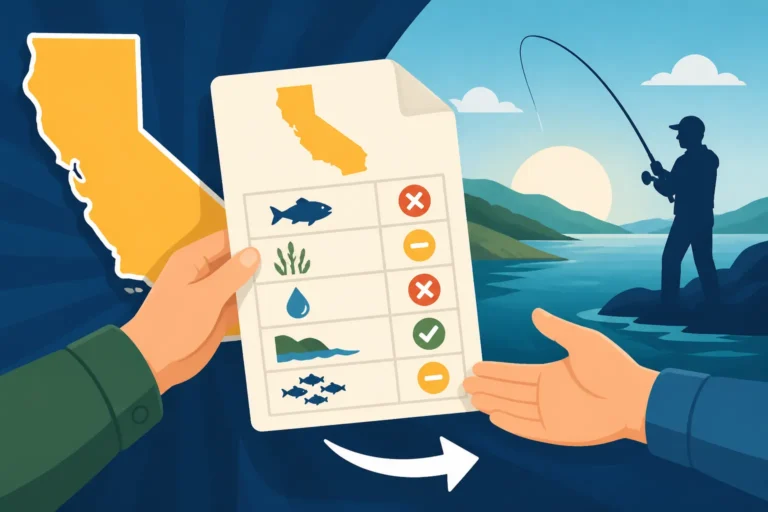
To help clarify the differences between Northern and Southern California regulatory environments, the following table highlights the essential rules every angler must follow based on their location.
| Regulatory Feature | South of Point Sur (Southern Region) | North of Point Sur (Northern Region) |
|---|---|---|
| Minimum Size Limit | 22 inches total length | 22 inches total length |
| Daily Bag Limit | 5 fish per person | 3 fish per person |
| Possession Limit | 10 fish (2 daily limits) | 6 fish (2 daily limits) |
| Primary Fishing Grounds | San Diego, Santa Monica, Ventura | San Francisco Bay, Monterey, Humboldt |
| Gaffing Allowance | Permitted for legal-size fish only | Permitted for legal-size fish only |
| Fillet Skin Patch Rule | Required on all filleted fish | Required on all filleted fish |
Keeping these distinctions clear prevents accidental infractions when traveling between coastal regions. Planning ahead based on your destination ensures a smooth, worry-free trip.
Essential Tackle, Gear, and Gear Compliance Rules
Hook Requirements and Legal Rigging Methods
When targeting California halibut, choosing the right hook setup is about both landing fish and staying legally compliant. In ocean waters, line limits and hook configurations are governed by strict gear rules. Most flatfish anglers prefer a classic bounce-ball rig or a sliding sinker rig (often called a Carolina rig) featuring a live bait hook paired with a fluorocarbon leader.
In certain waters or during specific seasonal closures, barbless hook regulations may apply, particularly if you are fishing in estuarine waters where protected salmon or trout species pass through. Using strong, sharp circle hooks is highly recommended when fishing with live anchovies, sardines, or Pacific mackerel. Circle hooks are designed to slide to the corner of the fish’s jaw, securing a clean lip hookup while preventing deep gut hooking on sub-legal fish that must be safely returned to the water.
Recommended Rods, Reels, and Rigging Tools
Halibut fishing requires gear that balances sensitivity with lifting power. A medium to medium-heavy conventional or spinning rod rated for 15- to 30-pound test line paired with a smooth, reliable reel is ideal for drifting over sandy bottoms. Mainlines made of braided line offer low stretch, allowing you to feel the subtle “tap-tap” of a halibut grabbing a bait in deep water.
For leader material, a durable fluorocarbon line, easily sourced on Amazon along with high-quality barrel swivels and weight slides, offers excellent abrasion resistance against the sharp teeth of a flatfish while staying virtually invisible underwater. Using a proper leader length—typically 3 to 5 feet—gives live bait room to swim naturally, which is crucial during slow, tough bites.
Landing Gear Rules: Nets, Gaffs, and Fish Care
Landing a large California halibut is often the most nerve-wracking part of the catch. State regulations strictly govern the use of landing nets and gaffs. A gaff may only be used to land a halibut if the fish is definitively of legal size (22 inches or longer). Using a gaff on an undersized halibut—even if you intended to measure it after landing—is an automatic illegal take violation because gaffing causes fatal wounds.
Because of this rule, every smart halibut angler carries a wide-mouthed landing net on board. Rubberized knotless mesh landing nets are by far the best option for flatfish. Soft rubber netting preserves the protective slime layer of undersized fish and prevents sharp teeth and hooks from tangling up in a mess. Rubber landing nets are inexpensive, readily available on Amazon, and essential for keeping your catch safe and legal.
LEGAL HARVEST CHECK
1. Confirm Species: Check mouth/teeth & lateral line arch.
2. Check Size: Ensure flat measurement is AT LEAST 22 inches.
3. Verify Region: Point Sur Boundary (5 South / 3 North).
- Safe Landing: Net sub-legal fish; gaff legal fish only.
Frequently Navigated Legal Scenarios for Anglers
Charter Boats, Party Boats, and Shared Catches
Booking a spot on a commercial passenger fishing vessel (often called a party boat or charter boat) is one of the most popular ways to target halibut in coastal hubs like San Francisco and San Diego. Before stepping aboard, verify whether you possess a valid state ocean fishing license. Anglers frequently wonder, Do You Need a License on a Party Boat in California? The answer is yes; every angler aged 16 and older must have a valid sport fishing license with proper ocean endorsements, even when fishing on a licensed commercial vessel.
On party boats, deckhands will often assist with netting fish, measuring length, and filleting catches at the end of the day. However, ultimate legal responsibility for retaining an undersized fish lies directly with the angler who caught it. Make sure you witness the measurement on the boat’s bump board before letting the crew toss a fish into your sack or filleting tray.
Surf Fishing and Pier Fishing Rules
Catching a halibut from shore presents its own unique regulatory scenarios. Surf anglers walking sandy beaches with light spinning gear must follow all standard size and bag limits, as well as hold a valid coastal fishing license. Reviewing California Ocean Fishing License Requirements ensures you carry the exact permissions needed before making your first cast into the ocean surf.
Public piers present a unique exception in California law. Anglers fishing from a public ocean pier do not need a California sport fishing license. However, all other fishing regulations—including minimum size thresholds, daily bag limits, species gear restrictions, and season dates—remain strictly enforced on public piers. Game wardens regularly patrol ocean piers, so carrying a portable measuring tape or bump board on pier trips is mandatory.
Reporting Violations and Warden Inspections
California Department of Fish and Wildlife (CDFW) officers work tirelessly to protect coastal fisheries from overharvest and illegal poaching. If you are approached by a warden at a public boat ramp, pier, or out on the water, you are legally required to allow them to inspect your licenses, catch, and fishing tackle. Keeping your fish intact or filleted according to state skin-patch rules makes these inspections quick and painless.
If you spot poaching activities—such as individuals keeping obviously undersized halibut, hiding fish in uninspected buckets, or using illegal dip nets—you can report the violation anonymously through the state’s wildlife protection hotline (CalTIP). Reporting illegal activity protects shared marine resources and ensures that healthy halibut populations remain accessible for future generations of anglers.
For anglers looking to build a successful halibut fishing schedule around regional seasonal shifts, studying Best Season for Halibut in California will help you pinpoint prime months along your local coastline. If you plan to focus your efforts within deep protected bays, reading up on How to Drift for Halibut in the Bay offers valuable tactical insight for rigging, drift speed, and locating productive sandy flats.
Disclaimer
This article is for general informational purposes only and does not constitute professional advice. Laws, prices and regulations vary by location and change over time. Consult a qualified professional for guidance on your specific situation.