California Steelhead Season Dates Explained
It’s no secret that fishing in California can feel like navigating a maze, and when it comes to steelhead, that maze seems to add a few extra twists and turns. The constantly shifting regulations, the delicate balance of conservation, and the sheer number of rivers and streams make understanding California steelhead season dates a real head-scratcher for even seasoned anglers. This guide is here to untangle that knot, walking you through the complexities so you can confidently plan your next steelhead adventure without accidentally breaking a rule.
The Elusive California Steelhead: Why Seasons Are So Intricate
If you've ever tried to pin down a definitive, statewide steelhead season in California, you've likely come up empty-handed and perhaps a little frustrated. That's because there isn't one. Unlike some other fisheries, steelhead seasons are a patchwork of highly localized rules, reflecting the unique challenges and conservation needs of these incredible fish across our diverse landscape. It's a lot to keep track of, but once you understand why it's so complex, it starts to make a bit more sense.
Understanding Steelhead Biology and Conservation Status
California's steelhead are anadromous rainbow trout – meaning they start their lives in freshwater streams, migrate to the ocean to grow, and then return to those same streams to spawn. This incredible life cycle is what makes them so special, and also so vulnerable. There are two main groups we generally refer to: Coastal Steelhead and Central Valley Steelhead. Both face significant threats from habitat loss, drought, dams, and historic overfishing, leading to their listing under the federal Endangered Species Act (ESA).
Think about it this way: a steelhead run on a pristine Northern California river like the Klamath might be relatively robust, while a run on a smaller, urbanized Southern California creek could be teetering on the brink of extinction. The seasons and regulations are tailored to these specific local conditions. You're not just fishing for a "steelhead" in California; you're often fishing for a specific, genetically distinct population that demands careful management to survive. This inherent vulnerability means that strict catch-and-release rules, specific gear limitations like barbless hooks, and very defined seasons are not just suggestions, but critical components of their survival.
The Role of CDFW and Federal Protections in Season Setting
The primary authority for setting fishing regulations in California is the California Department of Fish and Wildlife (CDFW). However, when it comes to steelhead, their hands are often tied, or at least heavily guided, by federal mandates. Because many steelhead populations are listed under the ESA, the National Oceanic and Atmospheric Administration (NOAA) Fisheries also plays a significant role, particularly regarding federal conservation plans. This dual layer of oversight means regulations are constantly reviewed, often changing based on scientific data, run sizes, and environmental factors like rainfall and river conditions.
This isn't just bureaucratic red tape; it's a genuine effort to protect these fish. Sometimes, a river that was open last year might be closed this year, or the season might be dramatically shortened if escapement numbers (the number of fish that make it back to spawn) are low. It means that checking the most current regulations from the CDFW is absolutely non-negotiable before every single trip. For a deeper dive into the broader regulatory landscape, check out our guide on California Fishing Regulations Explained.
Navigating California's Diverse Steelhead Seasons by Region
California is a massive state, and its geography and climate vary wildly from north to south. This is especially true for its rivers and, by extension, its steelhead runs. What applies to a river in Humboldt County might be completely different from a stream near Santa Barbara. Breaking down the state into key regions is the best way to understand the general patterns and specific nuances of steelhead season dates.
North Coast Powerhouses: Klamath, Trinity, Eel, and Russian Rivers
When most anglers think of California steelhead, their minds often drift to the legendary rivers of the North Coast. These river systems historically support some of the strongest runs, and consequently, offer more consistent—though still tightly regulated—fishing opportunities.
- Klamath River System: The Klamath, particularly its tributaries like the Trinity River, is a prime steelhead destination. Historically, fall and winter runs are targeted. For the main stem Klamath, below the confluence with the Trinity, the season often runs from August 1st through December 31st, with specific restrictions on bait and gear. Above the confluence, and on the Trinity itself, seasons can be more complex, often opening in September or October and running through February or March, sometimes with closures or gear restrictions in certain areas. It's crucial to consult the Klamath River Fishing Guide and the latest CDFW regulations booklet, which typically details specific sections with different rules. The emphasis here is almost always on catch-and-release for wild fish.
- Trinity River: As a major tributary to the Klamath, the Trinity has its own distinct steelhead populations, including both summer and winter runs. The prime winter steelhead season generally kicks off in September or October and extends through March or April in many sections. Similar to the Klamath, much of the Trinity is designated as "steelhead waters," meaning specific regulations apply. For example, some stretches may be artificial lures only with barbless hooks, while others might allow bait during certain windows. You'll want to review our comprehensive Trinity River Fishing Guide for the full scoop.
- Eel River System: The Eel River, once a steelhead powerhouse, has faced significant challenges. Seasons here are often shorter and more restrictive due to conservation efforts. The main stem typically opens for steelhead in early December and runs through February or March, but tributaries often have even tighter windows or are completely closed. The seasons are highly dependent on water levels and run forecasts, so always double-check the CDFW regulations.
- Russian River: Closer to the Bay Area, the Russian River offers a winter steelhead fishery. The season typically opens in December or January and can run through March, but again, this is highly dependent on rainfall and flow. Often, regulations specify fly-fishing-only or artificial lures only with barbless hooks in certain stretches to protect spawning fish. It's a great local option, but requires diligent checking of current conditions and rules. Our Russian River Fishing Guide provides further detail.
Central Coast's Sensitive Runs and Limited Opportunities
The Central Coast's steelhead runs are generally smaller and more vulnerable than their northern counterparts, often facing greater development pressure and intermittent water flows. As a result, fishing opportunities are much more limited, and conservation is the absolute priority.
- San Lorenzo River and Others: Rivers like the San Lorenzo near Santa Cruz or Lagunitas Creek in Marin County do support steelhead, but the seasons are typically very short and extremely restrictive. Often, these rivers are closed to all fishing except during specific, brief windows in winter (e.g., January to March), and almost always require 100% catch-and-release with strict gear limitations (e.g., artificial lures, barbless hooks). Some streams may even require a special permit or have specific days of the week they are open. These fisheries are delicate, and anglers must adhere to every rule to avoid further impacting these struggling populations. It’s a privilege to fish these waters, not a right.
Central Valley Rivers: Sacramento and Feather Steelhead Windows
The Central Valley river systems, particularly the Sacramento and Feather Rivers, support a unique population known as Central Valley Steelhead. While often overshadowed by salmon runs, these anadromous rainbows offer unique opportunities.
- Sacramento River: Below Keswick Dam, the Sacramento River has a winter steelhead run. The season here is generally open year-round for trout, but specific sections and seasons apply to steelhead when they are present. Often, the late fall and winter months (e.g., November through March) are when steelhead are most targeted, typically under general trout regulations which may still enforce barbless hooks and artificial lures in certain areas. It's not uncommon to hook a steelhead while targeting resident rainbow trout.
- Feather River: Similar to the Sacramento, the Feather River below Oroville Dam sees steelhead migrating upstream, often alongside salmon. The prime steelhead fishing is usually from late fall through winter (e.g., October through February). Regulations here often mirror general trout rules, but anglers must be mindful of salmon spawning closures or specific gear restrictions that might apply to protect both species. For more on this, check out our Feather River Fishing Guide. Always remember, the goal is not just to catch a fish, but to ensure its safe return, especially with these sensitive populations.
Southern California: A Glimmer of Hope in Highly Protected Waters
Steelhead in Southern California are perhaps the most imperiled, with many runs on the brink of extirpation. Rivers like Malibu Creek, Santa Clara River, or San Juan Creek might hold small, remnant populations, but fishing seasons are virtually non-existent for the general public.
- Strictly Protected: In most Southern California coastal streams, steelhead fishing is either permanently closed or so heavily restricted (e.g., research permits only) that it's not a recreational fishery. If there are any open windows, they are incredibly brief, localized, and come with stringent rules that make catch-and-release mandatory with specific gear. The focus in these areas is almost entirely on habitat restoration and recovery efforts, with any angling being a rare, scientifically managed event. It's important to appreciate these efforts from afar and support conservation initiatives that aim to bring these iconic fish back.
Essential Gear, Techniques, and Ethical Practices for Steelhead Season
Beyond knowing when and where to fish, knowing how to fish ethically and effectively for steelhead is paramount. These aren't your typical stocked trout; they are wild, powerful, and often require a nuanced approach, especially given their vulnerable status.
Must-Have Gear and Tackle for California Steelhead
When heading out for California steelhead, your gear can make a big difference in both your success and your ability to practice safe catch-and-release.
- Rods and Reels: A medium-action spinning rod (7-9 feet) paired with a 2500-4000 series reel is a versatile choice for many rivers, allowing for good casting distance and line control. For fly fishing, a 7-8 weight rod (9-10 feet) is standard, providing the backbone to handle these strong fish and cast heavy flies or sink tips. You can find excellent options for both types of setups on platforms like Amazon, often with reviews from fellow anglers.
- Line: For spinning, 8-12 lb monofilament or fluorocarbon main line, or braid with a fluorocarbon leader, is common. Fly anglers will use an appropriate weight-forward or Spey line, often with sinking tips to get flies down in fast currents.
- Terminal Tackle: This is where regulations are critical. Most steelhead waters mandate single, barbless hooks. Carry a good selection of jigs, spinners, spoons, or flies (like Caddis, Stoneflies, or egg patterns) that mimic natural forage. Always check if bait is allowed—in many designated steelhead waters, it is strictly prohibited. For a deeper dive into responsible angling, check out our guide on California Barbless Hook Requirements.
- Waders and Boots: Steelhead fishing often involves wading in cold, swift rivers. Quality breathable waders and sturdy wading boots with good felt or rubber soles (and often studs) are essential for comfort and safety.
- Landing Net: A large, rubber-mesh landing net is invaluable. Rubber mesh helps protect the fish's slime coat and fins, minimizing harm during the landing process.
Mastering Catch-and-Release: Preserving Future Generations
Given the conservation status of California steelhead, catch-and-release is not just encouraged, it's often legally mandated. Mastering proper techniques is crucial for the survival of the fish you catch.
- Minimize Fight Time: Use appropriate gear that can subdue the fish quickly, reducing stress and exhaustion.
- Keep Fish in Water: The most important rule. Keep the fish submerged as much as possible, especially its gills. Avoid dragging it onto the bank or holding it vertically by the jaw.
- Wet Hands: Always wet your hands before touching a fish to protect its delicate slime coat.
- Barbless Hooks: As mentioned, these are often required and make hook removal much easier and less damaging.
- Quick Release: Remove the hook quickly and gently. If a hook is deeply embedded, cut the line as close to the hook as possible. Don't try to rip it out.
- Revive Gently: Hold the fish upright in the current, allowing water to flow over its gills until it regains strength and can swim away on its own. Don't just toss it back.
For more comprehensive tips on this vital practice, refer to our detailed article on California Catch-and-Release Rules.
The Critical California Steelhead Report Card
Fishing for steelhead in California isn't just about having a valid California Fishing License Guide; it also requires a California Steelhead Report Card. This isn't just another piece of paper; it's a vital tool for conservation. The information you record on your report card helps the CDFW monitor catch rates, estimate population sizes, and inform future management decisions.
- Mandatory Purchase: You must purchase a Steelhead Report Card if you intend to fish for steelhead, regardless of whether you plan to keep any. Even if you're only targeting other species but might accidentally catch a steelhead, you should have one.
- Immediate Recording: As soon as you catch a steelhead (and before you continue fishing), you must immediately record the date, location, and whether you kept or released the fish.
- Return Requirement: The report card must be returned to the CDFW by January 31st of the following year, even if you didn't catch any fish. This data is critical, so please don't skip this step.
- Penalties: Failing to purchase, properly fill out, or return your Steelhead Report Card can result in fines. It's a non-negotiable part of responsible steelhead fishing in California. For everything you need to know, read our guide on California Steelhead Report Card.
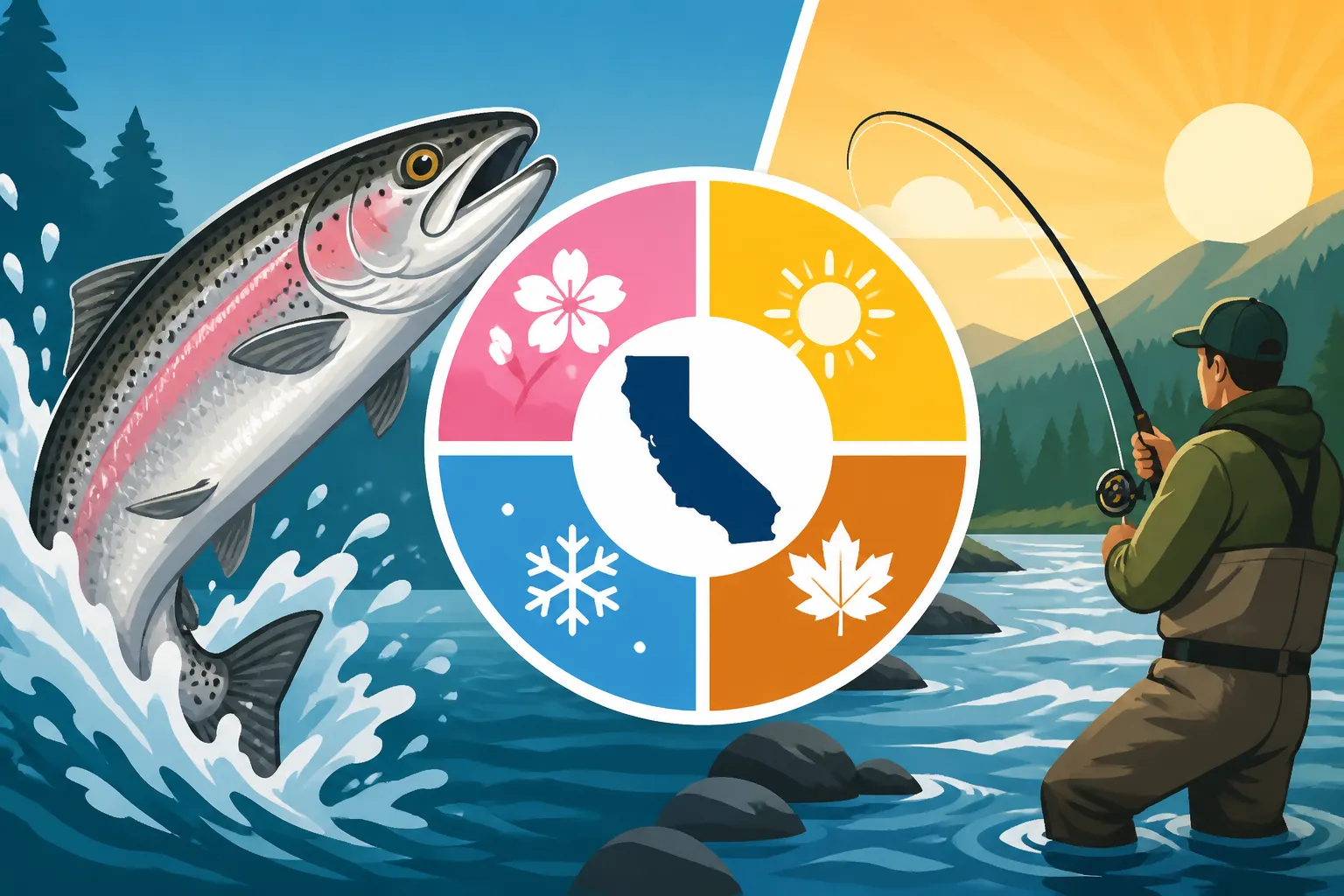
Here’s a simplified look at general steelhead season patterns for some key regions, but remember this is not a substitute for current regulations:
| Region | Primary Season Window | Common Restrictions (General) |
|---|---|---|
| North Coast Rivers | Fall/Winter (Oct-Mar) | Catch-and-release, artificial lures, barbless hooks, specific section rules |
| (e.g., Klamath, Trinity, Eel, Russian) | ||
| Central Valley Rivers | Late Fall/Winter (Nov-Feb) | Catch-and-release, artificial lures, barbless hooks, specific section rules |
| (e.g., Sacramento, Feather) | ||
| Central Coast Streams | Winter (Jan-Mar) | Extremely limited/closed, 100% C&R, artificial lures, barbless hooks |
| Southern California | Primarily Closed | No recreational fishery, conservation focus |
Staying Informed and Making the Most of Steelhead Season
The dynamic nature of California's steelhead seasons means that staying updated is an ongoing responsibility for any serious angler. Relying on last year's regulations or hearsay from a buddy is a recipe for disappointment, or worse, a citation.
How to Find the Most Current Steelhead Regulations
The single most important resource you have is the official word from the CDFW. Don't rely solely on online forums or social media groups, as information can quickly become outdated or misinterpreted.
- CDFW Sport Fishing Regulations Booklet: This is your bible. It's published annually and available online as a PDF (search for "California Freshwater Sport Fishing Regulations") or as a physical booklet at most tackle shops and sporting goods stores like those found through an Amazon search for "California fishing regulations booklet." Read it cover to cover, paying special attention to the "Special Regulations for Trout and Salmon" and "Steelhead Waters" sections, as well as specific river listings. Our guide on How to Read the California Fishing Regulations Booklet can help you navigate its complexities.
- CDFW Website and News Releases: Check the CDFW's official website regularly for emergency closures, season extensions, or updates. They often issue news releases for significant changes.
- Local Tackle Shops: These are goldmines of real-time, hyper-local information. Shop owners and staff are often anglers themselves and can tell you about recent river conditions, effective patterns, and any very recent changes that might not yet be fully reflected online.
- River Flow Data: Steelhead runs are heavily influenced by water levels. Websites like the California Data Exchange Center (CDEC) provide real-time river flow and reservoir data, which can inform whether a river is fishable and whether steelhead are likely to be moving.
Common Pitfalls and How to Avoid Them
Steelhead fishing requires diligence, and there are a few common mistakes that anglers often make.
- Not Checking Regulations for Specific River Sections: Regulations can change dramatically from one bridge to the next, or from a main stem to a tributary. Always verify the rules for the exact stretch of river you plan to fish.
- Misidentifying Fish: Sometimes, it can be hard to distinguish between a resident rainbow trout and a true anadromous steelhead, especially if they are smaller. When in doubt, assume it's a steelhead and treat it with catch-and-release principles. If the rules are catch-and-release for steelhead, then any fish that could be a steelhead must be released.
- Ignoring Gear Restrictions: Using bait in an artificial-lures-only section, or a barbed hook where barbless is required, isn't just a minor infraction; it can lead to hefty fines and, more importantly, harm fragile fish populations. Always double-check.
- Poor Fish Handling: Even if you intend to release a steelhead, improper handling can still kill it. Dragging it on rocks, prolonged air exposure for photos, or squeezing it too tightly are all detrimental. Follow the catch-and-release guidelines religiously.
- Underestimating Conditions: Winter steelhead fishing often means cold, wet weather and fast, high water. Ensure you have proper rain gear, layers, and stable footing (good wading boots, a wading staff) for safety.
- Ignoring the Steelhead Report Card: We can't stress this enough. It's mandatory, and the data is critical for the future of California steelhead. Don't forget to purchase it, fill it out, and return it.
Steelhead fishing in California is a challenging but immensely rewarding pursuit. By understanding the intricate regulations, respecting the fish, and staying informed, you can contribute to the conservation of these magnificent creatures while enjoying some of the most exciting freshwater fishing the state has to offer.
Disclaimer
The information provided in this guide is for general informational purposes only and is not legal advice. Fishing regulations in California are subject to change by the California Department of Fish and Wildlife (CDFW) and other governing bodies. It is the angler's sole responsibility to consult the most current official CDFW sport fishing regulations booklet and any emergency closures or updates before engaging in any fishing activity. Failure to do so may result in penalties.