Pacific Halibut in California: Where and How to Catch
Oh, the elusive Pacific Halibut! If you've spent any time on the water off California's northern coast, you know the thrill and frustration of chasing these impressive flatfish. They're a completely different beast than their smaller California cousins, and trying to land one without understanding their unique habits and preferred hangouts can feel like a fool's errand. This guide is dedicated to demystifying the pursuit of Pacific Halibut in California, giving you the insider knowledge on where to find them, when they're biting, and the best ways to bring these giants to your boat.
Understanding Pacific Halibut in California Waters
Catching Pacific Halibut in California is often a bucket-list item for anglers, and for good reason. These aren't your typical bay flatfish; they're substantial, powerful predators that inhabit deeper, colder waters. Getting to know their distinct characteristics and favored environments is the first step in successfully targeting them.
Distinguishing Pacific Halibut from California Halibut
This is where a lot of confusion often starts! Many anglers, especially those new to saltwater fishing in California, might lump all flatfish together, but Pacific Halibut and California Halibut are distinctly different species. Knowing how to tell them apart isn't just a matter of scientific curiosity; it's crucial for adhering to separate regulations and understanding their different behaviors.
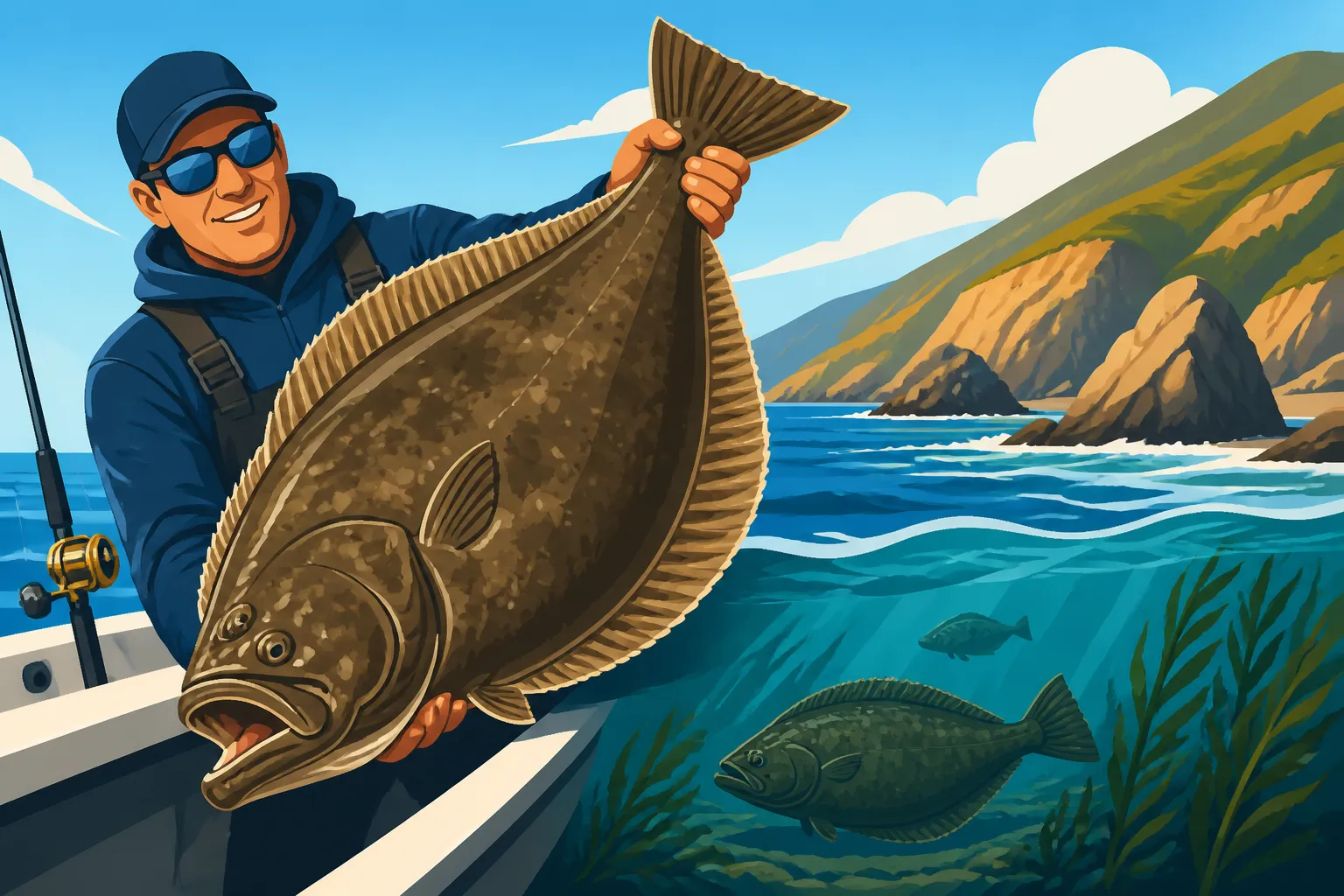
Pacific Halibut, Hippoglossus stenolepis, are truly massive fish. They can grow to incredible sizes, often exceeding 100 pounds, with some leviathans tipping the scales at over 500 pounds! Their bodies are generally diamond-shaped, thick, and robust. A key identifier is their coloration: the upper, eyed side is usually dark olive, brown, or black, providing excellent camouflage against the seafloor, while their underside is stark white. Critically, Pacific Halibut have a pronounced, symmetrical arch in their lateral line above the pectoral fin. Their mouth is large, extending back to the middle of the eye, and they have a distinct crescent-shaped tail. These are cold-water fish, preferring depths from 60 to well over 1,000 feet. You typically won't find them lounging in shallow bays or nearshore sandy bottoms where California Halibut thrive.
California Halibut, Paralichthys californicus, are much smaller by comparison, rarely exceeding 60 pounds, with most sport-caught fish being in the 5 to 20-pound range. They have a more elongated, oval-shaped body and a flatter profile. Their coloration is usually a sandy brown or olive, often mottled to blend in with inshore sand and mud flats. Unlike their Pacific cousins, the lateral line on a California Halibut is nearly straight. Their mouth is smaller, and their tail is more rounded. These are primarily warm-water, inshore species, commonly found in bays, estuaries, and along sandy beaches in depths generally less than 150 feet. If you're fishing a shallow pier or drifting a bay, you're almost certainly targeting California Halibut. The differences are stark once you know what to look for, and understanding them will prevent you from misidentifying your catch, which could lead to regulatory issues, especially regarding California Halibut Size and Bag Limits.
Prime Pacific Halibut Habitats in California
Forget the warm, calm waters of the bay; Pacific Halibut are deep-water connoisseurs. In California, their primary habitat tends to be the colder, nutrient-rich waters of the northern and central coasts, though they are occasionally caught further south. They absolutely love structure on the seafloor, but not necessarily rocky reefs like rockfish. Instead, they prefer large, relatively flat areas of gravel, sand, or mud bottoms, especially those adjacent to deeper drop-offs, underwater canyons, or shelf edges. These areas act as ambush points for the halibut as they lie camouflaged, waiting for unsuspecting prey to swim by.
You'll often find Pacific Halibut congregating around specific depths that provide both abundant food and comfortable temperatures. While they can be found shallower or much deeper, a common productive range in California is often between 200 and 800 feet. Think of offshore banks, seamounts, and the deeper edges of the continental shelf. Areas where currents sweep across these structures, bringing food to them, are particularly enticing. For instance, off the coast of Eureka, Fort Bragg, and parts of the Monterey Bay area, you'll find extensive deep-water grounds that fit this description. These larger marine structures provide the perfect environment for these apex predators to hunt and grow. It's a different world down there, and understanding that cold, deep, structured bottom is key to locating these magnificent fish.
Best Times and Seasons to Target Pacific Halibut
Timing is everything when it comes to chasing Pacific Halibut. Unlike some species you can reliably find year-round, these migratory giants have distinct seasons and preferred conditions that greatly influence your chances of success. Understanding these patterns can turn a frustrating search into a productive fishing trip.
Seasonal Movements and Spawning
Pacific Halibut undertake significant seasonal movements tied to feeding and spawning. In California, the primary season for Pacific Halibut generally kicks off in the late spring, often May or June, and can run through the early fall, perhaps September or October. This window aligns with warmer surface waters and increased baitfish activity in the offshore regions, drawing halibut up from their deeper wintering grounds to feed more aggressively. They migrate from even deeper waters to these shallower, but still deep, feeding grounds.
During the winter months, Pacific Halibut typically retreat to very deep waters, sometimes over 1,000 feet, where they are less accessible to recreational anglers and where spawning occurs. As spring progresses and ocean temperatures begin to stabilize and food sources become more abundant at moderate depths, the halibut start their move to shallower feeding grounds. This migratory pattern means that the specific timing can vary year-to-year based on oceanographic conditions like El Niño or La Niña, which influence water temperatures and current patterns. Keeping an eye on local California Fishing Seasons: Month-by-Month Guide and fishing reports from reputable charter operations is critical to pinpointing the best windows each year. The peak fishing often coincides with the late spring and summer months when baitfish are plentiful along the deeper shelf edges.
Ideal Conditions and Tides for Halibut Fishing
Beyond the season, specific daily conditions can make a huge difference. Pacific Halibut are sensitive to currents and often position themselves to ambush prey moving with the flow. This means that tide cycles, while less dramatic in deep offshore waters than in shallow bays, still play a significant role. A moderate current, often associated with a strong tide swing, can be beneficial because it disperses scent and moves baitfish, making it easier for the halibut to locate food.
However, too much current can be detrimental. Strong currents can make it incredibly difficult to get your gear to the bottom and keep it there, resulting in your bait or lure being swept away too quickly or lifted off the target depth. The ideal scenario is often a moderate current that allows for a good drift while still keeping your bait in the strike zone. Flat calm conditions with no current can sometimes be tougher for deep-water halibut, as there's less movement to attract their attention. Wind conditions also play a huge role, especially for private boaters. Light to moderate winds allow for comfortable and controlled drifts, keeping your line relatively vertical. Strong winds not only make for an uncomfortable boat ride but can also make it impossible to hold bottom effectively, particularly in deeper waters. So, a forecast with moderate seas and a good tide swing, perhaps an hour or two on either side of a tide change, often presents the best opportunities.
Essential Gear and Techniques for Pacific Halibut
Successfully landing a Pacific Halibut requires a serious investment in appropriate gear and a solid understanding of the techniques that coax these deep-water giants into biting. This isn't light tackle territory; you need robust equipment designed for battling powerful fish in challenging depths.
Rods, Reels, and Line Selection
When you're targeting Pacific Halibut, think "heavy duty." These fish are strong, and you're often fishing in hundreds of feet of water, so your gear needs to stand up to the challenge. For rods, you'll want something stout and powerful, typically a heavy-action conventional rod in the 7 to 8.5-foot range. Look for rods with a fast to moderate-fast taper that can handle lead weights of 16 to 32 ounces or more, depending on depth and current, and still have enough backbone to lift a big fish. Graphite composite rods offer a good balance of sensitivity and power.
For reels, a high-quality conventional reel with a strong drag system and a large line capacity is non-negotiable. Reels like the Shimano Talica, Penn International, or Daiwa Saltiga are popular choices among serious halibut anglers. You'll want something that can comfortably hold 500 yards or more of braided line. Speaking of line, braided line is almost universally preferred for deep-water halibut fishing. Its thin diameter cuts through the water with less resistance, allowing you to use less weight to reach the bottom, and its lack of stretch provides incredible sensitivity, letting you feel even the subtle "thump" of a halibut bite in deep water. A common setup involves 60 to 100-pound test braided main line. You'll then typically use a top shot or a leader of 60 to 100-pound monofilament or fluorocarbon, often 20 to 50 feet long, tied to your mainline with a strong knot like an FG or PR knot. This provides some shock absorption and abrasion resistance near the business end. You can find a fantastic selection of these heavy-duty rods, reels, and braided lines on online retailers like Amazon, making it easy to outfit yourself for the specific demands of deep-water fishing.
Effective Baits and Lures
Pacific Halibut are opportunistic predators with a hearty appetite, so presenting the right bait or lure effectively is paramount. The "go-to" bait for many experienced anglers is fresh, whole, or large cut bait. Live bait, if you can get it, is often king. Herring, mackerel, sardines, squid, and even smaller rockfish (where legal and appropriate as bait) are all excellent choices. When using cut bait, make sure it's fresh and has a good oily scent trail. A large chunk of salmon belly, or a whole small mackerel rigged to spin, can be incredibly enticing.
When it comes to artificial lures, large lead jigs, sometimes called "iron" or "go-go" jigs, are highly effective. These can range from 8 to 24 ounces or even heavier, depending on the depth and current. Popular jig styles include traditional chrome or glow-in-the-dark flat jigs, or those shaped like large baitfish. You'll often tip these jigs with a piece of squid or a large grub tail for added scent and visual appeal. Large swimbait lures, particularly those designed for deep drops and mimicking larger baitfish, can also draw strikes. The key with any bait or lure is presentation; it needs to be enticingly near the bottom where these ambush predators lie. Sometimes, a combination rig with a large bait on a dropper loop above a heavy jig or sinker can cover multiple bases.
Proven Fishing Techniques
Once you have your gear and bait sorted, it's time to talk tactics. The most common and often most effective method for Pacific Halibut in California is drifting. This involves allowing your boat to drift slowly over promising halibut grounds, with your bait or lure presented close to the bottom.
- Drifting with Bait: Rig your bait on a strong leader (80-100 lb fluorocarbon) with a large circle hook (8/0 to 12/0), often a double hook rig for larger baits. Attach a heavy sinker (16-32 oz or more) via a dropper loop or a slider rig, ensuring the bait is swimming or resting just a few feet off the bottom. As you drift, occasionally lift and drop your rod tip to impart some action to the bait, mimicking a struggling fish. Pay close attention to your depth sounder to stay over the preferred contours and structure. This technique is often used when pursuing California Offshore Fishing Techniques for a variety of species.
- Deep Jigging: This technique uses heavy jigs, often tipped with a piece of bait. Drop the jig to the bottom, reel up a few feet, and then aggressively jig it up and down. Vary the retrieve, sometimes a fast rip, sometimes a slow lift. Halibut often hit the jig on the drop, so stay focused and feel for any slack in your line or unusual weight. The flash and vibration of a large jig can call fish in from a distance.
- Power Drifting/Controlled Drifting: On a charter or party boat, the captain might employ specific drift patterns, sometimes using a sea anchor (drogue) to slow the boat's drift or even using the engines to control the speed and direction. This allows multiple anglers to present their baits effectively without tangling. When participating in California Sportfishing Trips Explained, listen carefully to the deckhands' instructions as they often have the best insights into current conditions and successful presentations.
Regardless of the technique, the absolute key is to maintain contact with the bottom. Halibut are ambush predators, and they rarely chase a bait far off the seafloor. Periodically check your depth and adjust your weight as needed to keep that bait or lure in the strike zone. If you feel a bite, resist the urge to set the hook immediately with a hard jerk. With circle hooks, a slow, steady lift and a turn of the reel handle is usually all it takes to engage the hook in the corner of the halibut's jaw.
Navigating Regulations and Conservation
Fishing for Pacific Halibut, like any responsible angling, means playing by the rules and thinking about the future of the fishery. California's regulations are designed to protect these majestic fish and ensure they're around for generations to come, and they can be complex and change year to year.
Key California Regulations for Pacific Halibut
This is where things can get tricky, and it's absolutely vital to be up-to-date before you ever leave the dock. Unlike California Halibut, which have relatively stable regulations, Pacific Halibut regulations are managed federally by the International Pacific Halibut Commission (IPHC) and then implemented by states like California. This means the rules can change annually, sometimes with little notice, based on stock assessments and harvest quotas.
Currently, California's recreational Pacific Halibut fishery is primarily concentrated in the northern management area, north of Point Arena, often from Fort Bragg north. Even then, the season dates are usually very specific and limited, often only opening for certain days or weekends within a larger window. You must check the latest California Department of Fish and Wildlife (CDFW) regulations before every trip. These regulations will specify the season dates, bag limits (which are typically very conservative, often one fish per person per day), and minimum size limits. Pacific Halibut generally have a substantial minimum size limit, often 40 inches or more, reflecting their slower growth rate and the desire to protect breeding stock.
Furthermore, you absolutely need a valid California Fishing License Guide with the appropriate saltwater enhancement stamps, if applicable, to fish for Pacific Halibut. Always carry your license on your person while fishing. Failing to adhere to these rules can result in hefty fines and potential loss of fishing privileges. Remember, ignorance of the law is not an excuse. Familiarize yourself with the full California Saltwater Fishing Regulations to avoid any issues.
Practicing Sustainable Halibut Fishing
Beyond just following the rules, true anglers understand the importance of conservation. Pacific Halibut are a slow-growing, long-lived species, making them particularly vulnerable to overfishing. Practicing sustainable fishing ensures that future generations can also experience the thrill of catching these magnificent fish.
This starts with responsible catch and release practices for any fish you don't intend to keep or that don't meet the legal size limits. If you must release a halibut, do so quickly and carefully. Avoid dragging the fish onto the deck if possible; if it's borderline legal or undersized, try to dehook it at the boat side. Use dehooking tools to minimize handling. If you do bring it aboard, handle it gently, supporting its body horizontally to avoid internal damage. Get it back into the water as quickly as possible. Many experienced anglers use single, barbless hooks to aid in easier release, though this isn't usually a requirement for Pacific Halibut.
Another critical aspect of conservation is being aware of and respecting California Marine Protected Areas Explained. These zones prohibit or restrict fishing activity to allow marine ecosystems to recover and thrive. Fishing in an MPA is a serious offense. Always know your location and verify that you are in an open fishing area. Finally, consider contributing to citizen science programs or reporting any unusual catches or observations to CDFW. The more data scientists have, the better they can manage the fishery. Every angler plays a role in protecting this incredible resource.
Pacific vs. California Halibut Comparison
To help clear up any lingering confusion between these two distinct flatfish, here's a quick comparison of their key characteristics. This table highlights the most important differences you'll encounter as an angler.
| Feature | Pacific Halibut (Hippoglossus stenolepis) | California Halibut (Paralichthys californicus) |
|---|---|---|
| Typical Size | Large to very large (30-500+ lbs) | Small to medium (5-60 lbs) |
| Body Shape | Thick, robust, diamond-shaped | Flatter, more elongated, oval-shaped |
| Lateral Line | Strong, symmetrical arch above pectoral fin | Nearly straight |
| Mouth Size | Large, extends past the middle of the eye | Smaller, typically ends before or at the front of the eye |
| Tail Shape | Distinct crescent-shaped (forked) | More rounded or slightly pointed |
| Coloration | Dark olive/brown/black (top), stark white (bottom) | Sandy brown/olive, often mottled (top), white (bottom) |
| Primary Habitat | Deep, cold offshore waters (200-800+ ft), gravel/mud | Shallow, warmer inshore waters (<150 ft), sand/mud bays |
| Geographic Range | Northern/Central California coast (and north) | Throughout California coast, common in southern CA bays |
| Management Body | IPHC (federal) and CDFW (state) | CDFW (state) |
| Season & Limits | Highly restricted, variable annually, high size limits | More consistent, lower size limits |
This table should serve as a handy reference on the water, especially when you're trying to quickly identify your catch and ensure you're in compliance with regulations.
Disclaimer
Fishing regulations, seasons, and limits for all species in California are subject to change by the California Department of Fish and Wildlife (CDFW) and other governing bodies. While every effort has been made to provide accurate and up-to-date information in this guide, it is the angler's sole responsibility to consult the official and most current CDFW regulations booklet or website before engaging in any fishing activity. This article is for informational purposes only and should not be considered a substitute for official legal guidance.