Best Baits and Lures for Yellowfin Tuna in California
There’s nothing quite like the thrill of a screaming reel as a powerful Yellowfin Tuna decides it’s time to head for Mexico. But for many anglers, especially those new to California's offshore scene, figuring out exactly what bait or lure to present to these fast, formidable fish can feel like a guessing game. This guide is here to cut through the confusion and arm you with the knowledge you need to choose the best baits and lures to entice Yellowfin Tuna, making your next trip out on the Pacific a lot more productive and a lot less frustrating.
Understanding Yellowfin Tuna Behavior and Diet
Before we even talk about specific baits and lures, it’s crucial to understand what makes Yellowfin Tuna tick. These aren't your lazy pond dwellers; they are apex predators of the open ocean, built for speed and relentless pursuit. Knowing their habits and preferences is like having a secret weapon in your tackle box.
Why Baits and Lures Matter for Yellowfin
Yellowfin Tuna, often called "ahi" by sushi enthusiasts, are opportunistic feeders. This means they’ll typically strike whatever looks like an easy meal in their environment. However, they can also be incredibly selective, especially when there's an abundance of natural forage. The challenge, and often the frustration, lies in presenting something that perfectly mimics what they're already keying in on, or something so enticingly different that they can't resist a predatory impulse. You might find yourself on a boat where everyone is throwing the same lure with no luck, only for one person to switch to a different color or size and suddenly start hooking up. It's a testament to how crucial bait and lure choice can be for Yellowfin Tuna in California waters. It's not just about having a bait; it's about having the right bait at the right time.
General Feeding Habits of Yellowfin
Yellowfin Tuna are primarily piscivores, meaning they mostly eat other fish. Their diet is incredibly varied, reflecting the diverse ecosystem of the open ocean. In California, this often includes sardines, anchovies, mackerel, squid, and even smaller bonita or skipjack. They tend to hunt in schools, using their incredible speed and keen eyesight to ambush prey. You'll often find them feeding near temperature breaks, current lines, or around floating kelp patties, which act as miniature ecosystems attracting smaller baitfish. Understanding these feeding patterns helps us narrow down our bait and lure choices. If you see them busting on tiny anchovies, throwing a huge mackerel might not be the best strategy, no matter how tempting it seems to offer a bigger meal. Conversely, if there are larger bait schools present, a bigger presentation might be exactly what’s needed.
Top Live Baits for California Yellowfin Tuna
When it comes to Yellowfin Tuna fishing in California, nothing quite beats the appeal of live bait. It's the gold standard for a reason: it's natural, it moves like a real meal, and Yellowfin often find it irresistible. However, getting and keeping good live bait is an art in itself.
Sardines and Anchovies: The Go-To Choice
If you're heading offshore for Yellowfin, your bait receiver will almost certainly be filled with lively sardines and anchovies. These small, oily fish are the bread and butter of the Yellowfin's diet in our local waters. They are relatively easy to procure and their frantic movements in the water column are a powerful attractant.
- Sardines: These are perhaps the most popular choice. Their size is ideal for Yellowfin of all sizes, and their oil content creates a strong scent trail in the water. When fished on light line with minimal weight, a frisky sardine swimming naturally away from the boat is often the first thing a Yellowfin will hit. You can often buy these directly from bait barges at major marinas like San Diego's Fisherman's Landing or H&M Landing, or from bait receivers in the Dana Point and Long Beach areas.
- Anchovies: Smaller than sardines, anchovies are excellent when Yellowfin are being picky or "finicky," as we often say. If the tuna are keyed in on a smaller forage, a live anchovy, delicately presented, can make all the difference. They are more fragile than sardines, so handling them gently and using appropriate tackle is key.
The art of fishing live bait for Yellowfin is all about natural presentation. You want that bait to look as alive and unhindered as possible. This often means using a small, sharp hook, avoiding heavy leader if possible, and letting the bait swim freely. Sometimes, simply pinning a sardine through the nose or the back and casting it out is all it takes. Other times, anglers will use a very small split shot or even a tiny rubber band around the tail to make the sardine swim downward, getting it into the strike zone quicker.
Mackerel and Small Bonito: For Bigger Tuna
While sardines and anchovies are fantastic, sometimes bigger bait is needed to tempt bigger Yellowfin or to stand out in a crowded bait ball. This is where mackerel and small bonito come into play.
- Mackerel: Specifically, Spanish mackerel or Pacific mackerel, are larger baitfish that offer a more substantial meal. Yellowfin, especially the larger cows, will readily smash a live mackerel. These are tougher baits and can withstand more aggressive casting and longer fights. Often, when the bite is tough or you’re targeting larger, more aggressive tuna, a lively mackerel is the ticket. They are also excellent for chumming to get the tuna boiling.
- Small Bonito: Baby bonito or skipjack, often caught right off the stern of the boat while chumming, can be incredible baits. There’s something about a fresh, live bonito swimming for its life that drives Yellowfin absolutely wild. These are typically bridle-rigged or slow-trolled, as their larger size makes them more challenging to cast effectively. When the tuna are feeding aggressively on larger prey, a small live bonito can result in an explosive strike you won't soon forget.
How to Rig Live Baits Effectively
Proper rigging is paramount to success with live bait. A poorly hooked bait will swim unnaturally, die quickly, or simply not entice a strike.
- Circle Hooks: For most live bait applications, circle hooks are the preferred choice, especially when fishing on sport boats or charters. They typically hook the fish in the corner of the mouth, leading to fewer gut-hooked fish and higher survival rates for catch-and-release, or easier hook removal if keeping the fish. When a fish bites, simply let the line tighten; don't set the hook. The fish will hook itself.
- J-Hooks: Some anglers still prefer J-hooks for a more direct hookset, especially for smaller baits like anchovies where a quick reaction time is necessary. However, they require a more active hookset and can lead to more deep-hooked fish.
- Hook Placement:
- Nose Hooking: Puts the hook through the very front of the bait's nose, allowing it to swim most naturally. Great for casting.
- Shoulder/Collar Hooking: Placing the hook just behind the head, through the "shoulder" of the bait. This provides a secure hold and allows the bait to swim well.
- Back Hooking: Puts the hook through the top of the bait's back, just in front of the dorsal fin. This can be effective for making the bait dive or swim deeper.
- Leader Material: Fluorocarbon leader is generally recommended due to its low visibility in water. Yellowfin have excellent eyesight, and a heavy, visible mono leader can deter bites. Match the leader strength to your main line and the expected size of the tuna; a good starting point might be 30-50lb test, depending on the situation. For more insights on this, you might find our guide on California Offshore Fishing Techniques helpful.
Essential Lures for Targeting Yellowfin Tuna
While live bait is king, lures are incredibly effective, especially when Yellowfin are in a feeding frenzy, actively busting on the surface, or when live bait is scarce. The versatility of lures allows you to cover more water, imitate various baitfish, and often provoke aggressive reaction strikes. Plus, you can easily stock up on a variety of lures on platforms like Amazon.
Poppers and Surface Iron: Topwater Excitement
There’s nothing quite like the explosive strike of a Yellowfin Tuna on a topwater lure. When tuna are crashing bait on the surface, poppers and surface iron are your go-to choices.
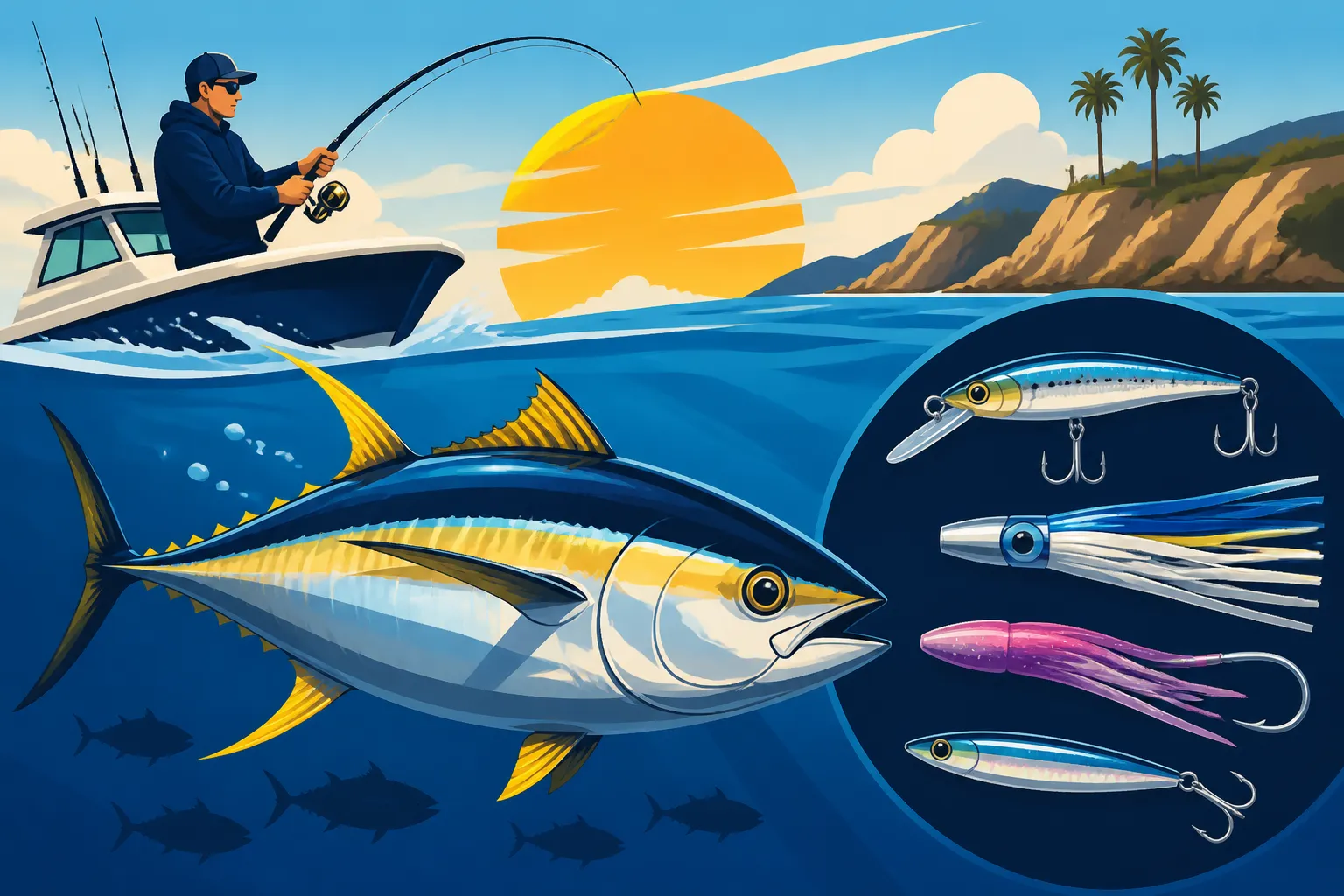
- Poppers: These lures are designed to mimic a struggling baitfish on the surface. They have a concave face that "cups" water, creating a loud "pop" and splash when retrieved with a sweeping motion. This commotion draws attention from a distance, often bringing tuna up from deeper water to investigate. Brands like Halco, Yo-Zuri, and Nomad Design make excellent poppers. A classic scenario is casting a popper into a school of actively feeding tuna and getting an immediate, violent strike.
- Surface Iron (Jigs): These are metal jigs designed to be cast long distances and retrieved quickly across the surface, mimicking a fleeing baitfish. They typically have a slender profile and an enticing wobble or darting action. Surface iron, also known as "candy bars" or "slugs," can be incredibly effective when Yellowfin are chasing smaller bait. The key is a fast, steady retrieve, making the lure skip and dart across the surface. Common colors include blue and white, sardine, or green and yellow. Some popular local brands and models include the Tady 45 and the Salas 7X.
The retrieve technique for surface lures is critical. For poppers, a "walk the dog" style retrieve (jerking the rod tip while reeling) or a series of hard sweeps followed by pauses can be deadly. For surface iron, a high-speed reel and a fast retrieve are often the ticket to get that enticing skipping action.
Jigs: Yo-Yo and Flat-Fall Varieties
When Yellowfin are holding deeper, or you’re fishing a structure like a high spot or a kelp paddy, jigs become indispensable. They allow you to target fish in the mid-water column or near the bottom.
- Yo-Yo Jigs: These heavy, compact jigs are designed for quickly dropping to depth and then retrieved with a fast, erratic "yo-yo" motion. The idea is to mimic a fleeing or injured baitfish darting upwards. Yo-Yo jigs are particularly effective when Yellowfin are spotted on the sonar below the surface, but not actively feeding on top. The weight helps them get down fast through any current or surface activity, right into the strike zone. Colors like blue/chrome, scrambled egg (yellow/orange), and mint green are perennial favorites.
- Flat-Fall Jigs: A newer innovation, flat-fall jigs, sometimes called "butterfly jigs," are designed to flutter and fall horizontally like a wounded baitfish, even on slack line. This seductive action on the drop is often what triggers a strike. Once it hits the desired depth, you can retrieve it with a slow, sweeping motion or fast jigging. They are excellent for targeting suspended Yellowfin that might be less aggressive or when fishing deeper spots. Shimano's Butterfly Jigs are a well-known example. For more detailed jigging techniques, consider checking out our guide on California Offshore Fishing Techniques.
Trolling Lures: Covering Water and Attracting Schools
Trolling is an incredibly effective strategy for finding and attracting Yellowfin Tuna, especially when you're covering vast expanses of open ocean. The idea is to drag multiple lures behind the boat at varying depths and speeds, creating a spread that mimics a school of baitfish.
- Feather Jigs and Cedar Plugs: These traditional trolling lures are simple yet highly effective. Feather jigs, often made with nylon or natural feathers, imitate small baitfish. Cedar plugs, made from weighted cedar wood, have a distinct swimming action that many tuna can't resist. Both are often fished plain or with a small bit of bait. They're great for when you're searching for schools and covering lots of ground.
- Hard Baits (Stickbaits and Diving Plugs): Modern hard baits, like Rapala X-Rap Magnums or Nomad Design Maverick, can dive to specific depths and have incredibly lifelike swimming actions. They come in a wide range of colors and sizes, allowing you to match the prevalent baitfish. These are particularly good for targeting tuna that might be holding a bit deeper in the water column or when trying to replicate a larger profile bait.
- Squid Spreader Bars and Daisy Chains: These advanced trolling setups consist of multiple plastic squid or other lures rigged in a chain or on a bar, mimicking a school of baitfish. The "teaser" lures don't have hooks, but there's a single hooked lure trailing at the end. These create a massive commotion in the water, often bringing tuna right up to the stern of the boat. Companies like ChatterLures and Sterling Tackle offer excellent options, which you can also find on Amazon.
When trolling, pay close attention to your boat speed, lure depth, and the spread of your lines. Experimentation is key to finding what the Yellowfin are responding to on any given day. To learn more about broader fishing tactics, our California Fishing Seasons: Month-by-Month Guide offers additional insights.
Matching Baits and Lures to Conditions
Successfully catching Yellowfin Tuna isn't just about having the right gear; it’s about knowing when and how to use it. The ocean is dynamic, and what worked yesterday might not work today. Being adaptable is key.
Reading the Water and Fish Activity
One of the biggest lessons you'll learn as an offshore angler is how to "read the water." This means observing subtle clues that tell you where fish might be and what they might be feeding on.
- Surface Activity: Look for birds diving, porpoises or dolphins feeding, or, ideally, tuna crashing the surface. If you see tuna actively busting on bait, immediately reach for your poppers or surface iron. This is the ultimate topwater scenario. If the boils are small and quick, indicating tiny baitfish, match that with smaller lures or delicately presented anchovies.
- Sonar Readings: Your boat's sonar is invaluable for finding schools of Yellowfin, especially when they're not showing on the surface. If you see fish marking deep, below a bait ball, that's a prime situation for yo-yo jigs or flat-fall jigs. You might also find our piece on Best Times to Fish in California useful for understanding seasonal patterns.
- Kelp Patties: Floating kelp patties are magnets for baitfish and, consequently, tuna. Approach them cautiously. Often, you'll start by casting live bait around the edges, then perhaps switch to jigs or even slow-trolling around them if there's no immediate bite. Tuna holding under kelp can be very susceptible to a well-presented live sardine.
- Current Lines and Temperature Breaks: These are often areas where bait concentrates, and therefore, where tuna hunt. Trolling through these zones with a spread of lures is a great search pattern. Keep an eye on your temperature gauge and GPS to identify these productive areas.
Gear Selection for Different Presentations
Having the right rod and reel setup for each bait and lure type is crucial. You wouldn't use a delicate trout rod for heavy jigging, and the same applies to tuna fishing.
- Live Bait Setup: For lighter live bait like sardines and anchovies, a sensitive but powerful rod (7-8 feet, medium-heavy action) paired with a high-quality conventional reel spooled with 25-40lb fluorocarbon or monofilament is ideal. Think smooth drags and good casting ability. This setup also works well for Yellowtail, as covered in our Best Season for Yellowtail in California guide.
- Popping/Surface Iron Setup: You need a rod capable of making long casts and handling the stress of aggressive hooksets and powerful tuna. A 7-8 foot heavy spinning rod with a fast action, paired with a large, robust spinning reel (like a Shimano Stella or Penn Slammer) spooled with 60-80lb braided line and a heavy fluorocarbon leader (60-100lb) is standard.
- Jigging Setup: For yo-yo and flat-fall jigs, a shorter, stiffer conventional jigging rod (5.5-6.5 feet, heavy action) is common. Pair this with a high-speed conventional reel (like a Penn Fathom or Daiwa Saltiga) spooled with 60-80lb braid. The shorter rod provides more leverage for working the jig and fighting powerful fish.
- Trolling Setup: Robust conventional rods (6-7 feet, heavy action) with large, high-capacity reels are needed for trolling. These reels (like a Shimano Talica or Avet LX) are often spooled with 80-130lb braided line and a heavy leader to handle the drag of the lures and the force of a large tuna strike. Remember to check California Tuna Regulations and Limits before heading out.
Here's a quick reference table to help you decide:
| Bait/Lure Type | Best Conditions | Ideal Gear | Notes |
|---|---|---|---|
| Live Sardines/Anchovies | Tuna feeding on small bait, kelp patties, picky bite | Light conventional rod/reel, 25-40lb fluoro | Delicate presentation, light line, circle hooks are common. |
| Live Mackerel/Bonito | Larger tuna, aggressive bite, chumming | Heavier conventional rod/reel, 50-80lb fluoro | Larger presentation, tough bait, bridle rigging for big ones. |
| Poppers | Tuna actively busting on surface, calm conditions | Heavy spinning rod/reel, 60-80lb braid, 80lb leader | Explosive topwater action, aggressive retrieve. |
| Surface Iron | Tuna chasing bait on surface, fast retrieve | Heavy spinning rod/reel, 60-80lb braid, 80lb leader | High-speed retrieve, mimic fleeing bait, Tady/Salas models are popular. |
| Yo-Yo Jigs | Tuna marking deep, aggressive subsurface bite | Conventional jigging rod/reel, 60-80lb braid | Fast, erratic retrieve, get to depth quickly. |
| Flat-Fall Jigs | Suspended tuna, deeper water, less aggressive bite | Conventional jigging rod/reel, 60-80lb braid | Seductive flutter on the drop, slower retrieve, Shimano Butterfly is common. |
| Trolling Lures (Feathers, Plugs) | Searching for schools, covering large areas, any depth | Heavy conventional trolling setup, 80-130lb braid | Vary speeds/depths, spreader bars/daisy chains are very effective. |
No matter your chosen method, always keep your hooks razor-sharp. A dull hook can be the difference between a triumphant catch and a heartbreaking miss, especially with the tough mouths of Yellowfin Tuna. Many excellent hook sharpeners can be found on Amazon. Good luck out there, and may your drag sing! You might also be interested in what to use for other tuna species by checking out Best Baits and Lures for Albacore Tuna in California.
Disclaimer
Fishing regulations and conditions in California can change frequently. Always consult the latest California Department of Fish and Wildlife (CDFW) regulations before any fishing trip. This guide is for informational purposes only and does not supersede official regulations.